
FR SHOWRI DAILY REFLECTIONS
Scripture for today...
September 22
Daily Reflection
Luke 8:19-21
Hear the Word of God and Do It
Who do you love and cherish the most? God did not intend for us to be alone, but to be with others. He gives us many opportunities for developing relationships with family, friends, neighbors, and co-workers. Why does Jesus seem to ignore his own relatives when they pressed to see him? His love and respect for his mother and his relatives is unquestionable.
Jesus never lost an opportunity to teach his disciples a spiritual lesson and truth about the kingdom of God. On this occasion when many gathered to hear Jesus he pointed to another higher reality of relationships, namely our relationship with God and with those who belong to God.
What is the essence of being a Christian? It is certainly more than doctrine, precepts, and commandments. It is first and foremost a relationship – a relationship of trust, affection, commitment, loyalty, faithfulness, kindness, thoughtfulness, compassion, mercy, helpfulness, encouragement, support, strength, protection, and so many other qualities that bind people together in mutual love and unity.
God seeks a personal intimate relationship with each one of us
God offers us the greatest of relationships – union of heart, mind, and spirit with himself, the very author and source of love (1 John 4:8,16). God’s love never fails, never forgets, never compromises, never lies, never lets us down nor disappoints us. His love is consistent, unwavering, unconditional, unrelenting and unstoppable.
There is no end to his love. Nothing in this world can make him leave us, ignore us, or withhold from us his merciful love and care (Romans 8:31-39). He will love us no matter what. It is his nature to love. That is why he created us – to be united with him and to share in his love (1 John 3:1).
God is a trinity of divine persons – one in being with the eternal Father, Son, and Holy Spirit – and a community of undivided love. God made us in his image and likeness (Genesis 1:26,27) to be a people who are free to choose what is good, loving, and just and to reject whatever is false and contrary to his love and righteousness (moral goodness).
That is why Jesus challenged his followers, and even his own earthly relatives, to recognize that God is the true source of all relationships. God wants all of our relationships to be rooted in his love and goodness.
The heavenly Father’s offer of friendship and adoption
Jesus Christ is God’s love incarnate – God’s love made visible in human flesh (1 John 4:9-10). That is why Jesus describes himself as the good shepherd who lays down his life for his sheep and the shepherd who seeks out the sheep who have strayed and lost their way.
God is like the father who yearns for his prodigal son to return home and then throws a great party for his son when he has a change of heart and comes back (Luke 15:11-32).
Jesus offered up his life on the cross for our sake, so that we could be forgiven and restored to unity and friendship with God. It is through Jesus that we become the adopted children of God – his own sons and daughters.
That is why Jesus told his disciples that they would have many new friends and family relationships in his kingdom. Whoever does the will of God is a friend of God and a member of his family – his sons and daughters who have been ransomed by the precious blood of Jesus Christ.
Through Jesus Christ we become brothers and sisters – members of God’s family
Lucian of Antioch (240-312 AD), an early Christian martyr once said that “a Christian’s only relatives are the saints”- namely those who have been redeemed by the blood of Christ and adopted as sons and daughters of God.
Those who have been baptized into Jesus Christ and who live as his disciples enter into a new family, a family of “saints” here on earth and in heaven. Jesus changes the order of relationships and shows that true kinship is not just a matter of flesh and blood.
Our adoption as sons and daughters of God transforms all of our relationships and requires a new order of loyalty to God first and to his kingdom of righteousness and peace.
Do you want to grow in love and friendship? Allow the Holy Spirit to transform your heart, mind, and will to enable you to love freely and generously as God has loved you.
Prayer
“Heavenly Father, you are the source of all true friendship and love. In all my relationships, may your love be my constant guide for choosing what is good and for rejecting what is contrary to your will.” Amen
The Life Story of Saint
Saint Lorenzo Ruiz and Companions (1600 – September 29 or 30, 1637)
Saint Lorenzo Ruiz was born in Manila of a Chinese father and a Filipino mother, both Christians. Thus he learned Chinese and Tagalog from them, and Spanish from the Dominicans whom he served as altar boy and sacristan.
He became a professional calligrapher, transcribing documents in beautiful penmanship. He was a full member of the Confraternity of the Holy Rosary under Dominican auspices. He married and had two sons and a daughter.
Lorenzo’s life took an abrupt turn when he was accused of murder. Nothing further is known except the statement of two Dominicans that “he was sought by the authorities on account of a homicide to which he was present or which was attributed to him.”
At that time, three Dominican priests, Antonio Gonzalez, Guillermo Courtet, and Miguel de Aozaraza, were about to sail to Japan in spite of a violent persecution there. With them was a Japanese priest, Vicente Shiwozuka de la Cruz, and a layman named Lazaro, a leper.
Lorenzo, having taken asylum with them, was allowed to accompany them. But only when they were at sea did he learn that they were going to Japan.
They landed at Okinawa. Lorenzo could have gone on to Formosa, but, he reported, “I decided to stay with the Fathers, because the Spaniards would hang me there.” In Japan they were soon found out, arrested, and taken to Nagasaki.
The site of wholesale bloodshed when the atomic bomb was dropped had known tragedy before. The 50,000 Catholics who once lived there were dispersed or killed by persecution.
They were subjected to an unspeakable kind of torture: After huge quantities of water were forced down their throats, they were made to lie down. Long boards were placed on their stomachs and guards then stepped on the ends of the boards, forcing the water to spurt violently from mouth, nose and ears.
The superior, Fr. Gonzalez, died after some days. Both Fr. Shiwozuka and Lazaro broke under torture, which included the insertion of bamboo needles under their fingernails. But both were brought back to courage by their companions.
In Saint Lorenzo Ruiz’s moment of crisis, he asked the interpreter, “I would like to know if, by apostatizing, they will spare my life.” The interpreter was noncommittal, but in the ensuing hours Lorenzo felt his faith grow strong.
He became bold, even audacious, with his interrogators.
The five were put to death by being hanged upside down in pits. Boards fitted with semi-circular holes were fitted around their waists and stones put on top to increase the pressure.
They were tightly bound, to slow circulation and prevent a speedy death. They were allowed to hang for three days. By that time Lorenzo and Lazaro were dead. Still alive, the three priests were then beheaded.
In 1987, Pope John Paul II canonized these six and 10 others: Asians and Europeans, men and women, who spread the faith in the Philippines, Formosa, and Japan. Lorenzo Ruiz is the first canonized Filipino martyr. The liturgical feast of Saint Lorenzo Ruiz and Companions is celebrated on September 28.
Reflection
We ordinary Christians of today—how would we stand up in the circumstances these martyrs faced? We sympathize with the two who temporarily denied the faith. We understand Lorenzo’s terrible moment of temptation.
But we see also the courage—inexplainable in human terms—which surged from their store of faith. Martyrdom, like ordinary life, is a miracle of grace.
Blessings from
Fr Showri R Narra
JESUS I TRUST IN YOU!
Scripture for today...
September 11
Daily Reflection
Luke 6:39-42
Do You Not See the Log in Your Own Eye?
Are you clear-sighted, especially in your perception of sin and the need for each of one of us to see ourselves correctly as God sees us – with our faults,weaknesses, and strengths?
Jesus’ two parables about poor vision allude to the proverb: Without vision the people perish! (Proverbs 29:18) What can we learn from the illustration of a blind guide and a bad eye (the log in the eye)?
A bad eye left untreated and a blind guide can cause a lot of trouble that will only end in misery and disaster for us! We can only help and teach others what we have learned and received from wise teachers and guides.
And how can we help others overcome their faults if we are blinded by our own faults and misperceptions? We are all in need of a physician who can help us overcome the blind spots and failing of own sins, weaknesses, and ignorance.
Overcoming blind spots in our own lives
The Gospel of Luke was written by a disciple who was trained as a physician. Luke, with keen insight, portrays Jesus as the good physician and shepherd of souls who seeks out those who desire healing, pardon, and restoration of body, mind, and spirit.
Jesus came to free us from the worst oppression possible – slavery to sin, fear, and condemnation. Like a gentle and skillful doctor, the Lord Jesus exposes the cancer of sin, evil, and oppression in our lives so we can be set free and restored to wholeness.
A key step to healing and restoration requires that we first submit to the physician who can heal us. The Lord Jesus is our great Physician because he heals the whole person – soul and body, mind and heart – and restores us to abundant life both now and for the age to come in his everlasting kingdom.
Thinking the best of others
The Lord Jesus wants to heal and restore us to wholeness, not only for our own sake alone. He also wants us to be his instruments of healing, pardon, and restoration for others as well.
What can hinder us from helping others draw near to Jesus the divine Physician? The Rabbis taught: “He who judges his neighbor favorably will be judged favorably by God.” How easy it is to misjudge others and how difficult it is to be impartial in giving good judgment.
Our judgment of others is usually “off the mark” because we can’t see inside the other person, or we don’t have access to all the facts, or we are swayed by instinct and unreasoning reactions to people. It is easier to find fault in others than in oneself.
A critical and judgmental spirit crushes rather than heals, oppresses rather than restores, repels rather than attracts. “Thinking the best of other people” is necessary if we wish to grow in love. And kindliness in judgment is nothing less that a sacred duty.
What you give to others will return to you
Jesus states a heavenly principle we can stake our lives on: what you give to others (and how you treat others) will return to you (Mark 4:24).
The Lord knows our faults and he sees all, even the imperfections and sins of the heart which we cannot recognize in ourselves. Like a gentle father and a skillful doctor he patiently draws us to his seat of mercy and removes the cancer of sin which inhabits our hearts.
Do you trust in God’s mercy and grace? Ask the Lord to flood your heart with his loving-kindness and mercy that you may only have room for charity, forbearance, and kindness towards your neighbor.
Prayer
“O Father, give us the humility which realizes its ignorance, admits its mistakes, recognizes its need, welcomes advice, accepts rebuke. Help us always to praise rather than to criticize, to sympathize rather than to discourage, to build rather than to destroy, and to think of people at their best rather than at their worst. This we ask for thy name’s sake. (Prayer of William Barclay, 20th century)” Amen
Life Story of a Saint
Saint Cyprian
d. 258
Saint Cyprian is important in the development of Christian thought and practice in the third century, especially in northern Africa.
Highly educated and a famous orator, he became a Christian as an adult. He distributed his goods to the poor, and amazed his fellow citizens by making a vow of chastity before his baptism. Within two years he had been ordained a priest and was chosen, against his will, as Bishop of Carthage.
Saint Cyprian complained that the peace the Church had enjoyed had weakened the spirit of many Christians and had opened the door to converts who did not have the true spirit of faith.
When the Decian persecution began, many Christians easily abandoned the Church. It was their reinstatement that caused the great controversies of the third century, and helped the Church progress in its understanding of the Sacrament of Penance.
Novatus, a priest who had opposed Cyprian’s election, set himself up in Saint Cyprian’s absence (he had fled to a hiding place from which to direct the Church—bringing criticism on himself) and received back all apostates without imposing any canonical penance. Ultimately he was condemned.
Cyprian held a middle course, holding that those who had actually sacrificed to idols could receive Communion only at death, whereas those who had only bought certificates saying they had sacrificed could be admitted after a more or less lengthy period of penance.
Even this was relaxed during a new persecution.
During a plague in Carthage, Cyprian urged Christians to help everyone, including their enemies and persecutors.
A friend of Pope Cornelius, Cyprian opposed the following pope, Stephen. He and the other African bishops would not recognize the validity of baptism conferred by heretics and schismatics.
This was not the universal view of the Church, but Cyprian was not intimidated even by Stephen’s threat of excommunication.
He was exiled by the emperor and then recalled for trial.
He refused to leave the city, insisting that his people should have the witness of his martyrdom.
Saint Cyprian was a mixture of kindness and courage, vigor and steadiness. He was cheerful and serious, so that people did not know whether to love or respect him more.
He waxed warm during the baptismal controversy; his feelings must have concerned him, for it was at this time that he wrote his treatise on patience. Saint Augustine remarks that Cyprian atoned for his anger by his glorious martyrdom. His liturgical feast is celebrated on September 16.
Reflection
The controversies about Baptism and Penance in the third century remind us that the early Church had no ready-made solutions from the Holy Spirit.
The leaders and members of the Church of that day had to move painfully through the best series of judgments they could make in an attempt to follow the entire teaching of Christ and not be diverted by exaggerations to right or left.
Saint Cyprian is the Patron Saint of:
North Africa
Blessings from
Fr Showri R Narra
JESUS I TRUST IN YOU!
Scripture for today...
September 11
Daily Reflection
Luke 6:39-42
Do You Not See the Log in Your Own Eye?
Are you clear-sighted, especially in your perception of sin and the need for each of one of us to see ourselves correctly as God sees us – with our faults,weaknesses, and strengths?
Jesus’ two parables about poor vision allude to the proverb: Without vision the people perish! (Proverbs 29:18) What can we learn from the illustration of a blind guide and a bad eye (the log in the eye)?
A bad eye left untreated and a blind guide can cause a lot of trouble that will only end in misery and disaster for us! We can only help and teach others what we have learned and received from wise teachers and guides.
And how can we help others overcome their faults if we are blinded by our own faults and misperceptions? We are all in need of a physician who can help us overcome the blind spots and failing of own sins, weaknesses, and ignorance.
Overcoming blind spots in our own lives
The Gospel of Luke was written by a disciple who was trained as a physician. Luke, with keen insight, portrays Jesus as the good physician and shepherd of souls who seeks out those who desire healing, pardon, and restoration of body, mind, and spirit.
Jesus came to free us from the worst oppression possible – slavery to sin, fear, and condemnation. Like a gentle and skillful doctor, the Lord Jesus exposes the cancer of sin, evil, and oppression in our lives so we can be set free and restored to wholeness.
A key step to healing and restoration requires that we first submit to the physician who can heal us. The Lord Jesus is our great Physician because he heals the whole person – soul and body, mind and heart – and restores us to abundant life both now and for the age to come in his everlasting kingdom.
Thinking the best of others
The Lord Jesus wants to heal and restore us to wholeness, not only for our own sake alone. He also wants us to be his instruments of healing, pardon, and restoration for others as well.
What can hinder us from helping others draw near to Jesus the divine Physician? The Rabbis taught: “He who judges his neighbor favorably will be judged favorably by God.” How easy it is to misjudge others and how difficult it is to be impartial in giving good judgment.
Our judgment of others is usually “off the mark” because we can’t see inside the other person, or we don’t have access to all the facts, or we are swayed by instinct and unreasoning reactions to people. It is easier to find fault in others than in oneself.
A critical and judgmental spirit crushes rather than heals, oppresses rather than restores, repels rather than attracts. “Thinking the best of other people” is necessary if we wish to grow in love. And kindliness in judgment is nothing less that a sacred duty.
What you give to others will return to you
Jesus states a heavenly principle we can stake our lives on: what you give to others (and how you treat others) will return to you (Mark 4:24).
The Lord knows our faults and he sees all, even the imperfections and sins of the heart which we cannot recognize in ourselves. Like a gentle father and a skillful doctor he patiently draws us to his seat of mercy and removes the cancer of sin which inhabits our hearts.
Do you trust in God’s mercy and grace? Ask the Lord to flood your heart with his loving-kindness and mercy that you may only have room for charity, forbearance, and kindness towards your neighbor.
Prayer
“O Father, give us the humility which realizes its ignorance, admits its mistakes, recognizes its need, welcomes advice, accepts rebuke. Help us always to praise rather than to criticize, to sympathize rather than to discourage, to build rather than to destroy, and to think of people at their best rather than at their worst. This we ask for thy name’s sake. (Prayer of William Barclay, 20th century)” Amen
Life Story of a Saint
Saint Cyprian
d. 258
Saint Cyprian is important in the development of Christian thought and practice in the third century, especially in northern Africa.
Highly educated and a famous orator, he became a Christian as an adult. He distributed his goods to the poor, and amazed his fellow citizens by making a vow of chastity before his baptism. Within two years he had been ordained a priest and was chosen, against his will, as Bishop of Carthage.
Saint Cyprian complained that the peace the Church had enjoyed had weakened the spirit of many Christians and had opened the door to converts who did not have the true spirit of faith.
When the Decian persecution began, many Christians easily abandoned the Church. It was their reinstatement that caused the great controversies of the third century, and helped the Church progress in its understanding of the Sacrament of Penance.
Novatus, a priest who had opposed Cyprian’s election, set himself up in Saint Cyprian’s absence (he had fled to a hiding place from which to direct the Church—bringing criticism on himself) and received back all apostates without imposing any canonical penance. Ultimately he was condemned.
Cyprian held a middle course, holding that those who had actually sacrificed to idols could receive Communion only at death, whereas those who had only bought certificates saying they had sacrificed could be admitted after a more or less lengthy period of penance.
Even this was relaxed during a new persecution.
During a plague in Carthage, Cyprian urged Christians to help everyone, including their enemies and persecutors.
A friend of Pope Cornelius, Cyprian opposed the following pope, Stephen. He and the other African bishops would not recognize the validity of baptism conferred by heretics and schismatics.
This was not the universal view of the Church, but Cyprian was not intimidated even by Stephen’s threat of excommunication.
He was exiled by the emperor and then recalled for trial.
He refused to leave the city, insisting that his people should have the witness of his martyrdom.
Saint Cyprian was a mixture of kindness and courage, vigor and steadiness. He was cheerful and serious, so that people did not know whether to love or respect him more.
He waxed warm during the baptismal controversy; his feelings must have concerned him, for it was at this time that he wrote his treatise on patience. Saint Augustine remarks that Cyprian atoned for his anger by his glorious martyrdom. His liturgical feast is celebrated on September 16.
Reflection
The controversies about Baptism and Penance in the third century remind us that the early Church had no ready-made solutions from the Holy Spirit.
The leaders and members of the Church of that day had to move painfully through the best series of judgments they could make in an attempt to follow the entire teaching of Christ and not be diverted by exaggerations to right or left.
Saint Cyprian is the Patron Saint of:
North Africa
Blessings from
Fr Showri R Narra
JESUS I TRUST IN YOU!
Scripture for today...
August 29
Daily Reflection
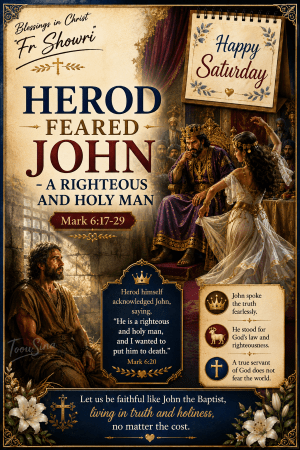
Mark 6:17-29
Herod Feared John – a Righteous and Holy Man
Are you prepared to be a witness, and if necessary, a martyr for Jesus Christ? John the Baptist bridged the Old and New Testaments. He is the last of the Old Testament prophets who pointed the way to the Messiah. He is the first of the New Testament witnesses and martyrs. Jesus equated the coming of his kingdom with violence.
From the days of John the Baptist until now the kingdom of heaven has suffered violence, and men of violence take it by force(Matthew 11:12). John suffered violence for announcing that the kingdom of God was near. He was thrown into prison and then beheaded.
Whose pleasure do you seek?
King Herod, the most powerful and wealthy man in Judea, had everything he wanted, except a clear conscience and peace with God. Herod had respected and feared John the Baptist as a great prophet and servant of God.
John, however did not fear to rebuke Herod for his adulterous relationship with his brother’s wife. John ended up in prison because of Herodias’ jealousy. Herod, out of impulse and a desire to please his family and friends, had John beheaded.
Why did Herod put John to death when he knew him to be a righteous and holy man? Herod’s power and influence were badly flawed. He was more bent on pleasing others and making friends than on doing what was right and just in the sight of God. He could take a strong stand on the wrong things when he knew the right. Such a stand, however, was a sign of weakness and cowardice.
God is our help and our strength Where do you get the strength of will and heart to choose what is right and to reject what is wrong and sinful? The Lord Jesus gives strength and courage to those who humbly acknowledge their dependence on him. The Lord knows our weaknesses better than we do.
He pardons and heals those who ask for his mercy and forgiveness. In whatever situation we find ourselves the Lord is there to guide and direct us. Do you seek the Lord’s strength and wisdom? Ask with expectant faith and trust in the Lord’s help and grace.
The love of Christ is stronger than death
Since the martyrdom of John the Baptist to the present time, the kingdom of God has suffered violence and persecution at the hands of violent people.
The blood of Christian martyrs throughout the ages bear witness to this fact. Their testimony to the truth of the Gospel and their willingness to suffer and die for their faith prove victory rather than defeat for the kingdom of God.
What fuels their faith and courage in the face of suffering, persecution, and death? They know and believe with the “eyes of faith” that nothing in this present world can separate us from the love of God in Christ Jesus (Romans 8:35-39).
Power to witness the love and mercy of Jesus Christ
What gives us the power, boldness, and courage to witness to Jesus Christ and to the truth of the Gospel?
The Holy Spirit fills us with courage, love, and boldness to make Jesus Christ known and loved. We do not need to fear those who oppose the Gospel, because the love of Jesus Christ is stronger than fear and death itself.
His love conquers all, even our fears and timidity in the face of opposition and persecution. We can trust in his grace and help at all times. Are you ready to make the Lord Jesus known and loved, and if necessary to suffer for his sake and the sake of the Gospel? Ask the Lord Jesus to fill you with the power and grace of the Holy Spirit.
Prayer
“Lord Jesus Christ, give me faith, boldness, and courage to stand firm in the truth of the Gospel and to not waver in my testimony of your love and mercy. Give me hope and joy in the promise of everlasting life with you in your kingdom.” Amen
Life Story of a Saint
The Story of the Martyrdom of Saint John the Baptist
1st. century
The drunken oath of a king with a shallow sense of honor, a seductive dance and the hateful heart of a queen combined to bring about the martyrdom of John the Baptist.
The greatest of prophets suffered the fate of so many Old Testament prophets before him: rejection and martyrdom. The “voice crying in the desert” did not hesitate to accuse the guilty, did not hesitate to speak the truth. But why? What possesses a man that he would give up his very life?
This great religious reformer was sent by God to prepare the people for the Messiah. His vocation was one of selfless giving.
The only power that he claimed was the Spirit of Yahweh. “I am baptizing you with water, for repentance, but the one who is coming after me is mightier than I. I am not worthy to carry his sandals. He will baptize you with the Holy Spirit and fire” (Matthew 3:11).
Scripture tells us that many people followed Saint John the Baptist looking to him for hope, perhaps in anticipation of some great messianic power. John never allowed himself the false honor of receiving these people for his own glory. He knew his calling was one of preparation.
When the time came, he led his disciples to Jesus: “The next day John was there again with two of his disciples, and as he watched Jesus walk by, he said, ‘Behold, the Lamb of God.’ The two disciples heard what he said and followed Jesus” (John 1:35-37).
It is John the Baptist who has pointed the way to Christ. John’s life and death were a giving over of self for God and other people. His simple style of life was one of complete detachment from earthly possessions.
His heart was centered on God and the call that he heard from the Spirit of God speaking to his heart. Confident of God’s grace, he had the courage to speak words of condemnation, repentance, and salvation.
Reflection
Each of us has a calling to which we must listen. No one will ever repeat the mission of Saint John the Baptist, and yet all of us are called to that very mission. It is the role of the Christian to witness to Jesus. Whatever our position in this world, we are called to be disciples of Christ.
By our words and deeds, others should realize that we live in the joy of knowing that Jesus is Lord. We do not have to depend upon our own limited resources, but can draw strength from the vastness of Christ’s saving grace.
Blessings from
Fr Showri R Narra
JESUS I TRUST IN YOU!
Scripture for today...
August 27
Daily Reflection
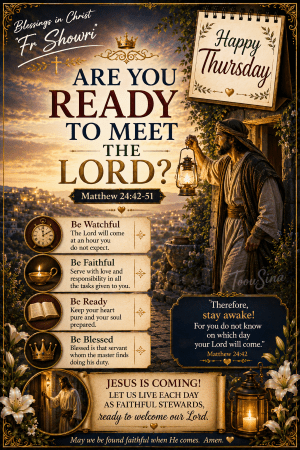
Matthew 24:42-51
Are You Ready to Meet the Lord?
Has your community or town ever participated in a grand homecoming party for a celebrated hero or champion who courageously and selflessly risked all to serve their people and nation – who risked great odds to protect people from harm and who achieved great victory over an enemy bent on destroying their land and freedom?
The Lord Jesus promises us a great victory celebration when he returns again to put down his enemies and to establish his everlasting kingdom of peace, joy, and righteousness.
That day when the Lord Jesus returns will be joy and peace for those who are prepared to meet him – but grief and sorrow for those who did not accept him as Lord and ruler of all.
Jesus will return to establish his everlasting kingdom
Jesus’ first coming was a rescue mission – he was sent by the eternal Father in heaven to save us from the tyranny of sin, Satan, and death.
Jesus’ sacrificial death on the cross and his triumphant victory over the grave won pardon for us and reconciliation with our heavenly Father, and the promise of everlasting life and joy in his kingdom.
The Lord Jesus told his disciples on a number of occasions that he would return again at the end of this present age – not simply to rescue us again from our enemies – but as a victor King and Lord who will vindicate all who have believed in him – by releasing us from the curse of death and condemnation and restoring for us the plan he had from the beginning of creation – a new heavens and earth for a people perfectly united with God in peace, joy, and harmony forever.
This is the background to Jesus story (parable) about the householder and the thief in the night (Matthew 24:42-51). When the Lord Jesus returns, he doesn’t want to find us flirting with the enemy or worse joining forces with enemies who are opposed to God and his kingdom.
Don’t let Satan rob you of your heavenly treasure
What does Jesus’ parable of the thief in the night teach us about God’s kingdom? If you knew that a thief was prowling about and trying to strike your home and threaten your life, wouldn’t you seek to protect yourself from harm’s way?
Jesus’ parable of the thief in the night brings home the necessity for watchfulness and being on guard to avert the danger of plunder and destruction, especially under the cover of darkness and secrecy!
While no thief would announce his intention in advance, nor the time when he would strike, lack of vigilance would nonetheless invite disaster for those who are unprepared to keep their treasure and their lives secure at all times! The intruder strikes when he is least expected!
Our adversary the devil seeks to rob us of the treasure which the Lord freely offers us. What is the treasure which the Lord Jesus wants us to guard lest we lose it?
It is the treasure of a personal relationship with the Lord Jesus himself – who is our greatest gift and portion in this life. The Scriptures remind us that there is no greater treasure on earth or in heaven than the Lord himself (Psalm 16:5,11, Job 22:25-26, and Philippians 3:8):
“Whom have I in heaven but you?
And there is nothing upon earth that I desire besides you. My flesh and my heart may fail, but God is the strength of my heart and my portion for ever” (Psalm 73:25-26).
The Lord Jesus chooses to come and dwell in our hearts through the gift and working of his Holy Spirit. He knocks at the door of our heart and invites us to let him enter (Revelation 3:21). Are you ready to meet the Lord – each and every day?
Be ready to give your account to the Lord Jesus
Jesus ends his teaching on watchfulness and vigilance with another parable about a master and his servants (Matthew 24:.45-49).
The storyline is similar. There is an element of surprise – the master suddenly returns home unexpectedly, probably from a long journey.
He rewards the dutiful servant for his faithfulness to his master. He has performed his service with diligence and has done all that the master required of him. The master punishes the other servant who behaved wickedly.
This servant was not only irresponsible – he was frequently absent from work and spent his master’s money by throwing endless parties with his friends. The wicked servant also abused his fellow workers with physical force and violence – probably to make them do the work he was supposed to do for his master.
The master not only throws him out of his house, he fires him from his job! He also throws him into the worst possible place – a prison of no return where there is nothing but torment and misery.
Should we be surprised to see the master acting with such swift judgment? After all he is only giving back what they have given to him.
The master rewards the faithful servant with honor, promotion, and friendship, and he punishes the unfaithful servant – who stole from his master and used his position to abuse others – by removing him from his position of trust with the master and by throwing him into prison for robbing the master and mistreating his fellow servants.
The Lord has entrusted each of us with his gifts and grace – the grace to love God with faithfulness, trust, and obedience – and the grace to love our neighbor as our self. Do you love faithfulness?
Always be prepared for your homecoming
The Lord Jesus calls us to be vigilant in watching for his return and to be ready to meet him when he calls us to himself. The Lord gives us his Holy Spirit so that we may have the wisdom, help, and strength we need to turn away from sin to embrace God’s way of love, justice, and holiness.
The Lord’s warning of judgment causes dismay for those who are unprepared, but it brings joyful hope to those who eagerly wait for his return in glory. God’s judgment is good news for those who are ready to meet him. Their reward is God himself, the source of all truth, beauty, goodness, love and everlasting life.
Prayer
“Lord Jesus, you have captured my heart and it is yours. Take my life and all that I possess that I may have you alone as my treasure and joy. Make me strong in faith, steadfast in hope, and generous in love that I may seek to please you in all things and bring you glory.” Amen
Life Story of a Saint
Saint Monica
330 – 387
The circumstances of Saint Monica’s life could have made her a nagging wife, a bitter daughter-in-law, and a despairing parent, yet she did not give way to any of these temptations.
Although she was a Christian, her parents gave her in marriage to a pagan, Patricius, who lived in her hometown of Tagaste in North Africa.
Patricius had some redeeming features, but he had a violent temper and was licentious.
Monica also had to bear with a cantankerous mother-in-law who lived in her home. Patricius criticized his wife because of her charity and piety, but always respected her.
Monica’s prayers and example finally won her husband and mother-in-law to Christianity. Her husband died in 371, one year after his baptism. Monica had at least three children who survived infancy. The oldest, Augustine, is the most famous.
At the time of his father’s death, Augustine was 17 and a rhetoric student in Carthage. Saint Monica was distressed to learn that her son had accepted the Manichean heresy—”all flesh is evil”—and was living an immoral life. For a while, she refused to let him eat or sleep in her house.
Then one night she had a vision that assured her Augustine would return to the faith. From that time on, she stayed close to her son, praying and fasting for him. In fact she often stayed much closer than Augustine wanted.
When he was 29, Augustine decided to go to Rome to teach rhetoric. Saint Monica was determined to go along. One night he told his mother that he was going to the dock to say goodbye to a friend.
Instead he set sail for Rome. Monica was heartbroken when she learned of Augustine’s trick, but she still followed him. She arrived in Rome only to find that he had left for Milan. Although travel was difficult, Monica pursued him to Milan.
In Milan, Augustine came under the influence of the bishop, Saint Ambrose, who also became Monica’s spiritual director. She accepted his advice in everything and had the humility to give up some practices that had become second nature to her. Saint Monica became a leader of the devout women in Milan as she had been in Tagaste.
She continued her prayers for Augustine during his years of instruction. At Easter 387, Saint Ambrose baptized Augustine and several of his friends. Soon after, his party left for Africa.
Although no one else was aware of it, Saint Monica knew her life was near the end. She told Augustine, “Son, nothing in this world now affords me delight. I do not know what there is now left for me to do or why I am still here, all my hopes in this world being now fulfilled.”
She became ill shortly after and suffered severely for nine days before her death.
Almost all we know about Saint Monica is in the writings of Saint Augustine, especially his Confessions.
Reflection
Today, with Google searches, online shopping, text messages, tweets, and instant credit, we have little patience for things that take time. Likewise, we want instant answers to our prayers. Monica is a model of patience.
Her long years of prayer, coupled with a strong, well-disciplined character, finally led to the conversion of her hot-tempered husband, her cantankerous mother-in-law and her brilliant but wayward son, Augustine.
Saint Monica is the Patron Saint of:
Alcoholics
Conversion
Mothers
Wives
Blessings from
Fr Showri R Narra
JESUS I TRUST IN YOU!
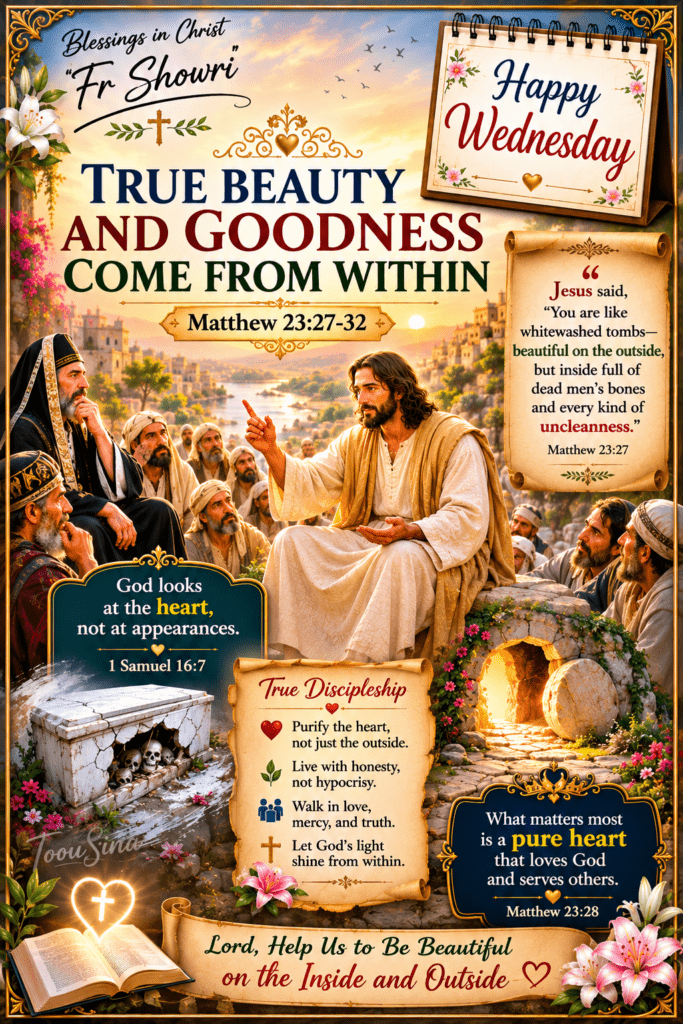
Scripture for today...
August 26
Daily Reflection
Matthew 23:27-32
True Beauty and Goodness Come from Within
How can you tell if someone is real or fake, genuine or counterfeit? Outward appearances can be deceptive. Isaiah prophesied that the Messiah would not judge by what his eyes see, or decide by what his ears hear; but with righteousness he shall judge the poor, and decide with equity for the meek of the earth(Isaiah 11:3-4).
The heart reveals the true intentions and attitudes that form the way we think of others and treat them. Jesus used strong language to warn the religious leaders and teachers about the vanity of outward appearance and pretense – wearing a mask that hides the true intentions and thoughts of the heart.
In Palestine tombs were often placed by the sides of roads. They were painted white which made them glisten in the midday sun, especially around the time of the great feasts, so that people would not accidentally touch them and incur ritual impurity.
True beauty and goodness come from within
Jesus equates true beauty and goodness with a clean heart and mind that is set on God and his way of love and goodness and sin with a corrupt mind and heart that is set on doing what is wrong and evil.
Jesus issued a stern warning to the scribes and Pharisees not to condemn them but to call them to examine their hearts in the light of God’s truth and holiness. Jesus called them hypocrites because their hearts were set on pleasing themselves rather than God.
A hypocrite is an actor or imposter who says one thing but does the opposite or who puts on an outward appearance of doing good while inwardly clinging to wrong attitudes, selfish desires and ambitions, or bad intentions.
Many scribes and Pharisees had made it a regular practice to publicly put on a good show of outward zeal and piety with the intention of winning greater honors, privileges, and favors among the people.
Sin is ugly because it corrupts heart and mind
Jesus warns that what truly corrupts a person is not external ritual impurity but the impurity of wrong and sinful attitudes that come from within a person’s mind and heart – such as pride, greed, sloth, envy, hatred, gluttony, and lust – these are what produce sinful habits (vices) and ways of speaking, acting, judging, and treating others. That is why every good deed is beautiful in God’s sight and every wrong or sinful deed is ugly in his sight.
The scribes and Pharisees were intensely religious in their outward observances, but their outward show didn’t match the inner reality of the state of their minds and hearts. They not only neglected the poor and the weak, but they were intolerant towards anyone who challenged their idea of religion.
That is why so many of the prophets in past ages – who warned about tolerating evil desires and unjust behavior towards one’s neighbor – were persecuted and even killed by their own rulers and people.
Jesus chastised the religious leaders for being double-minded and for demanding from others standards which they refused to satisfy. They professed admiration for the prophets who spoke God’s word by building tombs in their honorBut their outward show of respect did not match their inward refusal to heed the prophets’ warning to turn away from sinful attitudes and from neglecting to lead their people – through teaching and their own example – in God’s way of love and holiness of life.
They shut themselves to heaven and they hindered others from growing in the knowledge of God’s truth and goodness. They rejected Jesus as their Messiah because their hearts were blinded and hardened to the voice of God.
The Holy Spirit renews the heart and mind
True beauty, goodness, and piety come from within – from a heart that is set on pleasing God and a mind that is set on hearing and obeying God’s word.
Jesus came to set us free from slavery to sin and harmful habits and addictions that lead us into wrong and sinful ways of thinking, acting, and relating to others. Only the humble of heart can receive from God true wisdom and understanding, pardon and healing.
The Holy Spirit is ever ready to renew our minds and hearts and to lead us in God’s way of love and holiness. Ask the Holy Spirit to purify your heart and mind and to fill you with the power of God’s love and goodness.
Prayer
“Lord Jesus, incline my heart to your wisdom and teach me your ways. Fill me with your Holy Spirit that I may love your ways and obey your word.” Amen
Life Story of a Saint
Saint Joseph Calasanz
September 11, 1556
August 25, 1648
From Aragon where he was born in 1556, to Rome where he died 92 years later, fortune alternately smiled and frowned on the work of Joseph Calasanz.
A priest with university training in canon law and theology, respected for his wisdom and administrative expertise, he put aside his career because he was deeply concerned with the need for education of poor children.
When he was unable to get other institutes to undertake this apostolate at Rome, Joseph and several companions personally provided a free school for deprived children. So overwhelming was the response that there was a constant need for larger facilities to house their effort.
Soon, Pope Clement VIII gave support to the school, and this aid continued under Pope Paul V. Other schools were opened; other men were attracted to the work, and in 1621 the community—for so the teachers lived—was recognized as a religious community, the Clerks Regular of Religious Schools—Piarists or Scolopi. Not long after, Joseph was appointed superior for life.
A combination of various prejudices and political ambition and maneuvering caused the institute much turmoil. Some did not favor educating the poor, for education would leave the poor dissatisfied with their lowly tasks for society!
Others were shocked that some of the Piarists were sent for instruction to Galileo—a friend of Joseph Calasanz—as superior, thus dividing the members into opposite camps.
Repeatedly investigated by papal commissions, Joseph Calasanz was demoted; when the struggle within the institute persisted, the Piarists were suppressed. Only after Joseph’s death were they formally recognized as a religious community. His liturgical feast is celebrated on August 25
Reflection
No one knew better than Joseph Calasanz the need for the work he was doing; no one knew better than he how baseless were the charges brought against him.
Yet if he were to work within the Church, he realized that he must submit to its authority, that he must accept a setback if he was unable to convince authorized investigators.
While the prejudice, the scheming and the ignorance of men often keep the truth from emerging for a long period of time, Joseph Calasanz was convinced, even under suppression, that his institute would again be recognized and authorized. With this trust he joined exceptional patience and a genuine spirit of forgiveness.
Blessings from
Fr Showri R Narra
JESUS I TRUST IN YOU!
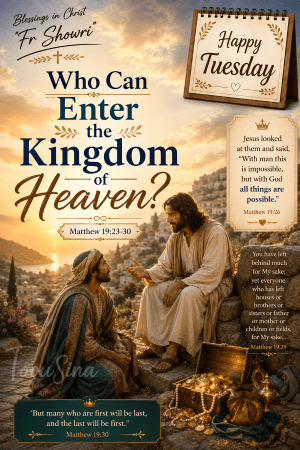
Scripture for today...
August 18
Daily Reflection
Matthew 19:23-30
Who Can Enter the Kingdom of Heaven?
Was Jesus really against wealth (Matthew 19:23)? And why did he issue such a strong warning to the rich (as well as to the rest of us who desire to be rich)?
We know that Jesus was not opposed to wealth per se, nor was he opposed to the wealthy. He had many friends who were well-to-do, including some notorious tax collectors! One even became an apostle!
Jesus’ warning reiterated the wisdom of the Old Testament: “Better is a poor man who walks in his integrity than a rich man who is perverse in his ways” (Proverbs 28:6; see also Psalm 37:16). “Do not wear yourself out to get rich; be wise enough to desist” (Proverbs 23:4).
We are all poor beggars in need of God
Jesus seems to say that it is nearly impossible for the rich to live as citizens of God’s kingdom. The camel was regarded as the largest animal known by the Jews where Jesus lived and taught.
The “eye of the needle” could be interpreted quite literally or it could figuratively describe the narrow and low gate of the city walls which was used by travelers when the larger public gate was locked at night. Normal sized people had to “lower” themselves to enter that gate. A camel would literally have to kneel and crawl through it.
Until we humbly kneel before the Lord and acknowledge our total need and dependence on him, we will not find true peace, security, and happiness that can sustain us now and forever. Only God alone can satisfy our deepest need and longing.
Augustine of Hippo reminds us that we are all poor beggars of God.
“Even though you possess plenty, you are still poor. You abound in temporal possessions, but you need things eternal.
You listen to the needs of a human beggar, yet you yourself are a beggar of God. What you do with those who beg from you is what God will do with his beggar. You are filled and you are empty. Fill your empty neighbor from your fullness, so that your emptiness may be filled with God’s fullness.” (Sermon 56,9)
Possessions can create false security and independence
Why is Jesus so cautious about wealth? Wealth can make us falsely independent. The church at Laodicea was warned about their attitude towards wealth and a false sense of security: “For you say, I am rich, I have prospered, and I need nothing” (Revelations 3:17).
Wealth can also lead us into hurtful desires and selfishness (see 1 Timothy 6:9-10). Look at the lesson Jesus gave about the rich man and his sons who refused to aid the poor man Lazarus (see Luke 16:19ff).
They neglected to serve God. Only those who put their trust in God and who depend on him, and who share what they have with those in need, will find true peace, security, and happiness which lead to everlasting life and joy in God’s kingdom.
Where is your treasure?
The Scriptures give us a paradox – we lose what we keep and we gain what we give away. Generosity will be amply repaid, both in this life and in the age to come (Proverbs 3:9-10, Luke 6:38). Jesus offers us an incomparable treasure which no money can buy and no thief can steal.
The thing we most set our heart on is our highest treasure. Material wealth will shackle us, like a bound slave, to this earth unless we guard our heart and set our treasure in God and his kingdom of everlasting life and joy. Where is your treasure?
Prayer
“Lord Jesus, you have captured our hearts and opened to us the treasures of heaven. May you always be my treasure and delight and may nothing else keep me from giving you my all.” Amen
Life Story of a Saint
Saint Louis of Toulouse
February 9, 1274
August 19, 1297
When he died at the age of 23, Louis was already a Franciscan, a bishop, and a saint!
Louis’s parents were Charles II of Naples and Sicily, and Mary, daughter of the King of Hungary.
Louis was related to Saint Louis IX on his father’s side and to Elizabeth of Hungary on his mother’s side.
Louis of Toulouse of Toulouse showed early signs of attachment to prayer and to the corporal works of mercy. As a child he used to take food from the castle to feed the poor.
When he was 14, Louis and two of his brothers were taken as hostages to the king of Aragon’s court as part of a political deal involving Louis’s father. At the court, Louis was tutored by Franciscan friars under whom he made great progress both in his studies and in the spiritual life. Like Saint Francis he developed a special love for those afflicted with leprosy.
While he was still a hostage, Louis decided to renounce his royal title and become a priest. When he was 20, he was allowed to leave the king of Aragon’s court.
He renounced his title in favor of his brother Robert and was ordained the next year. Very shortly after, he was appointed bishop of Toulouse, but the pope agreed to Louis’s request to become a Franciscan first.
The Franciscan spirit pervaded Louis. “Jesus Christ is all my riches; he alone is sufficient for me,” Louis kept repeating. Even as a bishop he wore the Franciscan habit and sometimes begged. He assigned a friar to offer him correction—in public if necessary—and the friar did his job.
Louis of Toulouse’s service to the Diocese of Toulouse was richly blessed. In no time he was considered a saint. Louis set aside 75 percent of his income as bishop to feed the poor and maintain churches.
Each day he fed 25 poor people at his table. Louis of Toulouse was canonized in 1317 by Pope John XXII, one of his former teachers. His liturgical feast is celebrated on August 19.
Reflection
When Cardinal Hugolino, the future Pope Gregory IX, suggested to Francis that some of the friars would make fine bishops, Francis protested that they might lose some of their humility and simplicity if appointed to those positions. Those two virtues are needed everywhere in the Church, and Louis shows us how they can be lived out by bishops.
Blessings from
Fr Showri R Narra
JESUS I TRUST IN YOU!
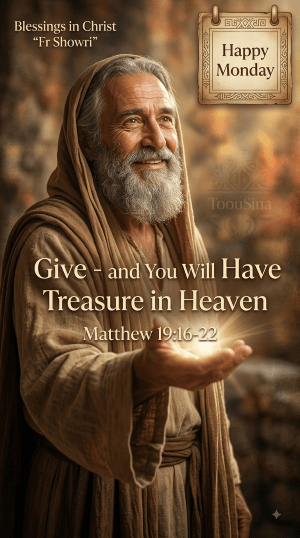
Scripture for today...
August 17
Daily Reflection
Matthew 19:16-22
Give – and You Will Have Treasure in Heaven
Where can you find true peace, security, and happiness?
A young man who had the best the world could offer – wealth, position, and security – came to Jesus because he lacked one thing.
He wanted the kind of lasting peace and happiness which money and possessions could not buy him. The answer he got, however, was not what he was looking for. He protested that he kept all the commandments – but Jesus spoke to the trouble in his heart. One thing kept him from giving himself wholeheartedly to God.
While he lacked nothing in material goods, he was nonetheless possessive of what he had. He placed his hope and security in what he possessed. So when Jesus challenged him to make God his one true possession and treasure, he became dismayed.
What do you treasure the most?
Why did he go away from Jesus with sadness rather than with joy? His treasure and his hope for happiness were misplaced.
Treasure has a special connection to the heart, the place of desire and longing, the place of will and focus. The thing we most set our heart on is our highest treasure. The Lord himself is the greatest treasure we can possibly have.
Giving up everything else to have the Lord as our treasure is not sorrowful, but the greatest joy. See Jesus’ parable about the treasure hidden in a field (Matthew 13:44). Selling all that we have could mean many different things – our friends, our job, our style of life, what we do with our free time.
Possessiveness and fear robs us of joy and abundant life
Jesus challenged the young man because his heart was possessive. He was afraid to give to others for fear that he would lose what he had gained. Those who are generous towards God and others find that they cannot outmatch God in generosity.
God blesses us with innumerable spiritual goods – such as long-lasting peace, unspeakable joy, enduring love, abiding relationships and friendship that do not fade or fail – that far outweigh the fleeting joys of material possessions which fail to satisfy us beyond the present moment.
God alone can satisfy the deepest longing and desires of our heart. Are you willing to part with anything that might keep you from seeking true and everlasting joy with Jesus?
Prayer
“Lord Jesus, you alone can satisfy the deepest longing in my heart. No other treasure can compare with you. Keep me free from all discontentment, possessiveness, greed and selfishness, that I may have joy in knowing that you alone are my true Treasure and my Portion.” Amen
Life Story of a Saint
Saint Joan of the Cross
June 18, 1666
August 17, 1736
An encounter with a shabby old woman many dismissed as insane prompted Joan of the Cross to dedicate her life to the poor. For Joan, who had a reputation as a businesswoman intent on monetary success, this was a significant conversion.
Born in 1666, in Anjou, France, Joan of the Cross worked in the family business—a small shop near a religious shrine—from an early age. After her parents’ death she took over the shop. She quickly became known for her greediness and insensitivity to the beggars who often came seeking help.
That was until she was touched by the strange woman who claimed she was on intimate terms with the deity. Joan of the Cross, who had always been devout, even scrupulous, became a new person. She began caring for needy children.
Then the poor, elderly, and sick came to her. Over time, she closed the family business so she could devote herself fully to good works and penance.
She went on to found what came to be known as the Congregation of Saint Anne of Providence.
It was then she took the religious name of Joan of the Cross. By the time of her death in 1736 she had founded 12 religious houses, hospices, and schools. Pope John Paul II canonized her in 1982.
Reflection
The downtown areas of most major cities hold a population of “street people.” Well-dressed folks usually avoid making eye contact, probably for fear of being asked for a handout.
That was Joan of the Cross’ attitude until the day one of them touched her heart. Most people thought the old woman was crazy, but she put Joan on the road to sainthood. Who knows what the next beggar we meet might do for us?
Blessings from
Fr Showri R Narra
Reflect today on the difference between obeying God’s Commandments and surrendering to Him in radical, wholehearted love. If you keep the Law, what do you still lack? What might Jesus be asking you to let go of so that you can follow Him more perfectly? Ask Him to reveal where your attachments lie. Then pray for the courage not to walk away in sadness, but to follow Him in joy and trust, wherever He leads.
Feliz Lunes
17 de agosto
Reflexión Diaria
Mateo 19:16-22
Da, y tendrás un tesoro en el Cielo
¿Dónde puedes encontrar la verdadera paz, seguridad y felicidad?
Un joven que tenía lo mejor que el mundo podía ofrecer —riqueza, posición y seguridad— se acercó a Jesús porque le faltaba una cosa.
Deseaba esa paz y felicidad duraderas que el dinero y las posesiones no podían comprar. Sin embargo, la respuesta que recibió no era la que esperaba. Él afirmó que había guardado todos los mandamientos, pero Jesús señaló el problema que había en su corazón. Una cosa le impedía entregarse completamente a Dios.
Aunque no le faltaba nada en cuanto a bienes materiales, estaba demasiado apegado a lo que poseía. Había puesto su esperanza y seguridad en sus posesiones. Por eso, cuando Jesús lo desafió a hacer de Dios su única y verdadera posesión y su auténtico tesoro, quedó profundamente entristecido.
¿Qué es lo que más atesoras?
¿Por qué se alejó de Jesús con tristeza en lugar de hacerlo con alegría? Porque había puesto equivocadamente su tesoro y su esperanza de felicidad.
El tesoro tiene una relación especial con el corazón, el lugar de nuestros deseos y anhelos, de nuestra voluntad y de aquello en lo que centramos nuestra vida. Aquello en lo que más ponemos nuestro corazón se convierte en nuestro mayor tesoro. El Señor mismo es el tesoro más grande que podemos poseer.
Renunciar a todo lo demás para tener al Señor como nuestro tesoro no es motivo de tristeza, sino la mayor alegría. Recordemos la parábola de Jesús sobre el tesoro escondido en un campo (Mateo 13:44). Vender todo lo que tenemos puede significar muchas cosas diferentes: nuestros amigos, nuestro trabajo, nuestro estilo de vida o aquello a lo que dedicamos nuestro tiempo libre.
El apego y el miedo nos roban la alegría y la vida abundante
Jesús desafió al joven porque su corazón estaba apegado a sus posesiones. Tenía miedo de dar a los demás por temor a perder lo que había adquirido. Quienes son generosos con Dios y con los demás descubren que nunca podrán superar a Dios en generosidad.
Dios nos bendice con innumerables bienes espirituales —como una paz duradera, una alegría indescriptible, un amor que permanece, relaciones y amistades profundas que no se desvanecen ni fracasan—, dones que superan ampliamente las alegrías pasajeras de las posesiones materiales, las cuales no pueden satisfacernos más allá del momento presente.
Solo Dios puede satisfacer los anhelos y deseos más profundos de nuestro corazón. ¿Estás dispuesto a desprenderte de cualquier cosa que pueda impedirte buscar la verdadera y eterna alegría con Jesús?
Oración
“Señor Jesús, solo Tú puedes satisfacer el anhelo más profundo de mi corazón. Ningún otro tesoro puede compararse contigo. Líbrame de toda insatisfacción, apego, avaricia y egoísmo, para que pueda encontrar mi alegría sabiendo que solo Tú eres mi verdadero Tesoro y mi Herencia.” Amén.
Historia de la Vida de una Santa
Santa Juana de la Cruz
18 de junio de 1666
17 de agosto de 1736
Un encuentro con una anciana pobre y desaliñada, a quien muchos consideraban demente, impulsó a Juana de la Cruz a dedicar su vida a los pobres. Para Juana, que tenía fama de ser una mujer de negocios empeñada en alcanzar el éxito económico, esto significó una profunda conversión.
Nacida en 1666 en Anjou, Francia, Juana de la Cruz trabajó desde muy joven en el negocio familiar, una pequeña tienda cercana a un santuario religioso. Después de la muerte de sus padres, se hizo cargo de la tienda. Rápidamente se hizo conocida por su avaricia e insensibilidad hacia los mendigos que acudían con frecuencia en busca de ayuda.
Todo cambió cuando aquella extraña mujer, que afirmaba tener una relación íntima con Dios, tocó profundamente su corazón. Juana de la Cruz, que siempre había sido devota, incluso escrupulosa, se convirtió en una persona nueva. Comenzó a cuidar de niños necesitados.
Después acudieron a ella los pobres, los ancianos y los enfermos. Con el tiempo, cerró el negocio familiar para poder dedicarse por completo a las obras de caridad y a la penitencia.
Más adelante fundó lo que llegó a conocerse como la Congregación de Santa Ana de la Providencia.
Fue entonces cuando tomó el nombre religioso de Juana de la Cruz. Para el momento de su muerte, en 1736, había fundado doce casas religiosas, hospicios y escuelas. El Papa Juan Pablo II la canonizó en 1982.
Reflexión
Las zonas céntricas de la mayoría de las grandes ciudades albergan a muchas personas que viven en la calle. Las personas bien vestidas suelen evitar hacer contacto visual con ellas, probablemente por temor a que les pidan una limosna.
Esa era también la actitud de Juana de la Cruz hasta el día en que una de esas personas tocó su corazón. La mayoría pensaba que aquella anciana estaba loca, pero ella puso a Juana en el camino hacia la santidad. ¿Quién sabe lo que el próximo mendigo que encontremos podría hacer por nosotros?
Bendiciones de
Fr Showri R Narra
JESUS I TRUST IN YOU!

Scripture for today...
August 13
Daily Reflection
Matthew 18:21-19:1
Lord, How Often Shall I Forgive My Brother?
Does mercy overlook justice? Justice demands that everyone be given their due. So when is it right to show mercy and pardon to those who have acted unjustly or wrongly?
The prophet Amos speaks of God forgiving transgression three times, but warns that God may not revoke punishment for the fourth (see Amos 1:3-13; 2:1-6).
When Peter posed the question of forgiveness, he characteristically offered an answer he thought Jesus would be pleased with. Why not forgive seven times! How unthinkable for Jesus to counter with the proposition that one must forgive seventy times that.
No limit to granting forgiveness and pardon
Jesus makes it clear that there is no limit to giving and receiving forgiveness. He drove the lesson home with a parable about two very different kinds of debts.
The first man owed an enormous sum of money – millions in our currency. In Jesus’ time this amount was greater than the total revenue of a province – more than it would cost to ransom a king!
The man who was forgiven such an incredible debt could not, however, bring himself to forgive his neighbor a very small debt which was about one-hundred-thousandth of his own debt. The contrast could not have been greater!
Jesus paid our ransom to set us free from the debt of sin
No offense our neighbor can do to us can compare with our own personal debt to God for offending him! We have been forgiven an enormous debt we could not repay on our own. That is why the Father in heaven sent his only begotten Son, the Lord Jesus Christ, who freely and willing gave up his life for our sake to ransom us from slavery to sin, Satan, and death.
Paul the Apostle states, “you were bought with a price” (1 Corinthians 7:23 ) and that price was Jesus’ death on the cross. Through the shedding of his blood on the cross, Jesus not only brought forgiveness and pardon for our offenses, but release from our captivity to Satan and bondage to sin.
Set free from futile thinking and sinful living
The Lord Jesus sets us free from a futile mind and way of living in sin and spiritual darkness. “You were ransomed from the futile ways inherited from your fathers …with the precious blood of Christ” (1 Peter 1:18). Christ “gave himself to redeem us from all iniquity” (Titus 2:14).
Iniquity describes the futile ways of wrong thinking, sinful attitudes and wrong behavior, and disregarding or treating God’s commandments lightly. We have been forgiven an enormous debt which we could never possibly repay. We owe God a debt of gratitude for the mercy and grace he has given us in his Son, Jesus Christ.
Forgiving others is a sacred duty
If God has shown mercy to us in granting us pardon for our sins, then we, in turn, must show mercy and forgiveness towards every person who has offended us. The willingness to forgive those who offend us is a sacred duty.
If we expect God to pardon us and show us his mercy when we sin and disobey his commandments, then we must be willing to let go of any resentment, grievance, or ill-will we feel towards our neighbor. Jesus teaches us to pray daily for the grace and strength to forgive others in the same measure in which God has forgiven us (Matthew 6:12,14-15).
If we do not show mercy and forgiveness to our fellow human beings, how can we expect God to forgive us in turn? The Apostle James says that “judgment is without mercy to one who has shown no mercy” (James 2:13).
Mercy seasons justice and perfects it
Mercy is the flip-side of God’s justice. Without mercy justice is cold, calculating, and even cruel. Mercy seasons justice as salt seasons meat and gives it flavor.
Mercy follows justice and perfects it. Justice demands that the wrong be addressed. To show mercy without addressing the wrong and to pardon the unrepentant is not true mercy but license.
C.S. Lewis, a 20th century Christian author wrote: “Mercy will flower only when it grows in the crannies of the rock of Justice: transplanted to the marshlands of mere Humanitarianism, it becomes a man-eating weed, all the more dangerous because it is still called by the same name as the mountain variety.” If we want mercy shown to us we must be ready to forgive others from the heart as God has forgiven us.
Do you hold any grudge or resentment towards anyone? Ask the Lord to purify your heart that you may show mercy and loving-kindness to all – and especially to those who cause you grief and ill-will.
Prayer
“Lord Jesus, you have been kind and forgiving towards me. May I be merciful as you are merciful. Free me from all bitterness and resentment that I may truly forgive from the heart those who have caused me injury or grief.” Amen
Life Story of a Saint
Saint Jane Frances de Chantal
January 28, 1572
December 13, 1641
Jane Frances was wife, mother, nun, and founder of a religious community.
Her mother died when she was 18 months old, and her father, head of parliament at Dijon, France, became the main influence on her education.
Jane developed into a woman of beauty and refinement, lively and cheerful in temperament. At 21, she married Baron de Chantal, by whom she had six children, three of whom died in infancy.
At her castle, she restored the custom of daily Mass, and was seriously engaged in various charitable works. Jane Frances de Chantal’s husband was killed after seven years of marriage, and she sank into deep dejection for four months at her family home.
Her father-in-law threatened to disinherit her children if she did not return to his home. He was then 75, vain, fierce, and extravagant. Jane Frances de Chantal managed to remain cheerful in spite of him and his insolent housekeeper.
When she was 32, Jane Frances de Chantal met Saint Francis de Sales who became her spiritual director, softening some of the severities imposed by her former director. She wanted to become a nun but he persuaded her to defer this decision.
She took a vow to remain unmarried and to obey her director.
After three years, Francis told Jane of his plan to found an institute of women that would be a haven for those whose health, age, or other considerations barred them from entering the already established communities.
There would be no cloister, and they would be free to undertake spiritual and corporal works of mercy. They were primarily intended to exemplify the virtues of Mary at the Visitation—hence their name the Visitation nuns—humility and meekness.
The usual opposition to women in active ministry arose and Francis de Sales was obliged to make it a cloistered community following the Rule of Saint Augustine. Francis wrote his famous Treatise on the Love of God for them. The congregation consisting of three women began when Jane Frances was 45.
She underwent great sufferings: Francis de Sales died; her son was killed; a plague ravaged France; her daughter-in-law and son-in-law died. She encouraged the local authorities to make great efforts for the victims of the plague, and she put all her convent’s resources at the disposal of the sick.
During a part of her religious life, Jane Frances de Chantal had to undergo great trials of the spirit—interior anguish, darkness, and spiritual dryness. She died while on a visitation of convents of the community.
Reflection
It may strike some as unusual that a saint should be subject to spiritual dryness, darkness, interior anguish. We tend to think that such things are the usual condition of “ordinary” sinful people.
Some of our lack of spiritual liveliness may indeed be our fault. But the life of faith is still one that is lived in trust, and sometimes the darkness is so great that trust is pressed to its limit.
Saint Jane Frances de Chantal is a Patron Saint of: Mothers / Widows / Wives
Blessings from
Fr Showri R Narra
JESUS I TRUST IN YOU!
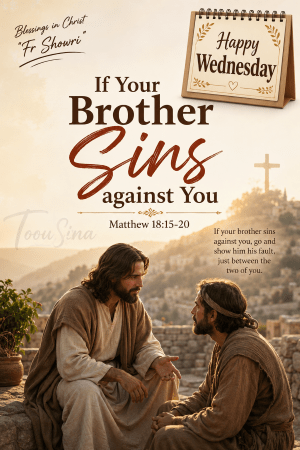
Scripture for today...
August 12
Daily Reflection
Matthew 18:15-20
If Your Brother Sins against You
What’s the best way to repair a damaged relationship? Jesus offers his disciples spiritual freedom and power for restoring broken or injured relationships. Don’t brood over an offense – speak directly and privately What can we learn from Jesus’ instructions about how to mend a damaged relationship (Matthew 18:15-20)?
If you feel you have been wronged by someone, Jesus says the first step is to speak directly but privately to the individual who has done the harm. One of the worst things we can do is brood over our grievance. This can poison our mind and heart and make it more difficult to go directly to the person who caused the damage. Seek the help of wise Christians If we truly want to settle a difference with someone, we need to do it face to face. If this fails in its purpose, then the second step is to bring another person or persons, someone who is wise and gracious rather than someone who is hot-tempered or judgmental.
The goal is not so much to put the offender on trial, but to persuade the offender to see the wrong and to be reconciled. And if this fails, then we must still not give up, but seek the help of the Christian community.
Note the emphasis here is on restoring a broken relationship by seeking the help of other Christians who hopefully will pray and seek a solution for reconciliation based on Christian love and wisdom, rather than relying on coercive force or threat of legal action, such as a lawsuit. Pray for the offender – for healing and reconciliation Lastly, if even the Christian community fails to bring about reconciliation, what must we do?
Jesus seems to say that we have the right to abandon stubborn and obdurate offenders and treat them like social outcasts. The tax-collectors and Gentiles were regarded as “unclean” by the religious-minded Jews and they resorted to shunning them.
However we know from the Gospel accounts that Jesus often had fellowship with tax-collectors (as well as other public sinners), ate with them, and even praised them at times! Jesus refuses no one who is open to receive pardon, healing, and restoration. Set no obstacle in seeking to heal your brother’s wound When you are offended, are you willing to put aside your own grievance and injury in order to help your brother’s wound?
The Lord Jesus wants to set us free from resentment, ill-will, and an unwillingness to forgive. The love of Christ both purifies and sets us free to do good to all – even those who cause us grief.
The call to accountability for what we have done and have failed to do is inevitable and we can’t escape it, both in this life and at the day of judgment when the Lord Jesus will return. But while we have the opportunity today, we must not give up on praying for those who cause us offense.
With God’s help we must seek to make every effort to win them with the grace and power of God’s healing love and wisdom. Do you tolerate broken relationships or do you seek to repair them as God gives you the opportunity to mend and restore what is broken?
Prayer
“Lord Jesus, make me an instrument of your healing love and peace. Give me wisdom and courage to bring your healing love and saving truth to those in need of healing and restoration.” Amen
Life Story of a Saint
Saint Clare of Assisi
July 16, 1194 – August 11, 1253
One of the more sugary movies made about Francis of Assisi pictures Clare as a golden-haired beauty floating through sun-drenched fields, a sort of one-woman counterpart to the new Franciscan Order.
The beginning of her religious life was indeed movie material. Having refused to marry at 15, Clare of Assisi was moved by the dynamic preaching of Francis. He became her lifelong friend and spiritual guide.
At 18, Clare of Assisi escaped from her father’s home one night, was met on the road by friars carrying torches, and in the poor little chapel called the Portiuncula received a rough woolen habit, exchanged her jeweled belt for a common rope with knots in it, and sacrificed her long tresses to Francis’ scissors.
He placed her in a Benedictine convent, which her father and uncles immediately stormed in rage. Clare clung to the altar of the church, threw aside her veil to show her cropped hair, and remained adamant.
Sixteen days later her sister Agnes joined her. Others came. They lived a simple life of great poverty, austerity, and complete seclusion from the world, according to a Rule which Francis gave them as a Second Order. At age 21, Francis obliged Clare under obedience to accept the office of abbess, one she exercised until her death.
The Poor Ladies went barefoot, slept on the ground, ate no meat, and observed almost complete silence. Later Clare, like Francis, persuaded her sisters to moderate this rigor: “Our bodies are not made of brass.” The greatest emphasis, of course, was on gospel poverty.
They possessed no property, even in common, subsisting on daily contributions. When even the pope tried to persuade Clare to mitigate this practice, she showed her characteristic firmness: “I need to be absolved from my sins, but I do not wish to be absolved from the obligation of following Jesus Christ.”
Contemporary accounts glow with admiration of Saint Clare of Assisi’s life in the convent of San Damiano in Assisi. She served the sick and washed the feet of the begging nuns.
She came from prayer, it was said, with her face so shining it dazzled those about her. She suffered serious illness for the last 27 years of her life. Her influence was such that popes, cardinals, and bishops often came to consult her—Clare herself never left the walls of San Damiano.
Francis always remained her great friend and inspiration. Saint Clare of Assisi was always obedient to his will and to the great ideal of gospel life which he was making real.
A well-known story concerns her prayer and trust.
Saint Clare of Assisi had the Blessed Sacrament placed on the walls of the convent when it faced attack by invading Saracens. “Does it please you, O God, to deliver into the hands of these beasts the defenseless children I have nourished with your love?
I beseech you, dear Lord, protect these whom I am now unable to protect.” To her sisters she said, “Don’t be afraid. Trust in Jesus.” The Saracens fled.
Reflection
The 41 years of Clare’s religious life are scenarios of sanctity: an indomitable resolve to lead the simple, literal gospel life as Francis taught her; courageous resistance to the ever-present pressure to dilute the ideal; a passion for poverty and humility; an ardent life of prayer; and a generous concern for her sisters.
Saint Clare is the Patron Saint of:
Protection from eye disorders Television
Blessings from
Fr Showri R Narra
JESUS I TRUST IN YOU!
Scripture for today...
August 10
Daily Reflection
John 12:24-26
If It Dies, It Bears Much Fruit
What can a grain of wheat tell us about life and the kingdom of God? Jesus drew his parables from the common everyday circumstances of life.
His audience, mostly rural folk in Palestine, could easily understand the principle of new life produced by dead seeds sown into the earth. What is the spiritual analogy which Jesus alludes to?
Is this, perhaps, a veiled reference to his own impending death on the cross and his resurrection on the third day? Or does he have another kind of “death and rebirth” in mind for his disciples? Jesus, no doubt, had both meanings in mind for his disciples.
The image of the grain of wheat dying in the earth in order to grow and bear a harvest can be seen as a metaphor of Jesus’ own death and burial in the tomb and his resurrection. Jesus knew that the only way to victory over the power of sin and death was through the cross.
Jesus reversed the curse of our first parents’ [Adam and Eve] disobedience through his obedience to the Father’s will – his willingness to go to the cross to pay the just penalty for our sins and to defeat death once and for all. His obedience and death on the cross obtain for us freedom and new life in the Holy Spirit.
His cross frees us from the tyranny of sin and death and shows us the way of perfect love. There is a great paradox here. Death leads to life. When we “die” to our selves, we “rise” to new life in Jesus Christ.
What does it mean to “die” to oneself? It certainly means that what is contrary to God’s will must be “crucified” or “put to death”. God gives us grace to say “yes” to his will and to reject whatever is contrary to his loving plan for our lives.
Jesus also promises that we will bear much “fruit” for him, if we choose to deny ourselves for his sake. Jesus used forceful language to describe the kind of self-denial he had in mind for his disciples.
What did he mean when he said that one must hate himself? The expression to hate something often meant to prefer less. Jesus says that nothing should get in the way of our preferring him and the will of our Father in heaven.
Our hope is in Paul’s reminder that “What is sown in the earth is subject to decay, what rises is incorruptible” (1 Corinthians 15:42). Do you hope in the Lord and follow joyfully the path he has chosen for you?
Prayer
“Lord Jesus, let me be wheat sown in the earth, to be harvested for you. I want to follow wherever you lead me. Give me fresh hope and joy in serving you all the days of my life.” Amen
Life Story of a Saint
Saint Lawrence
c. 225 – August 10, 258
The esteem in which the Church holds Lawrence is seen in the fact that today’s celebration ranks as a feast. We know very little about his life. He is one of those whose martyrdom made a deep and lasting impression on the early Church. Celebration of his feast day spread rapidly.
He was a Roman deacon under Pope Saint Sixtus II. Four days after this pope was put to death, Lawrence and four clerics suffered martyrdom, probably during the persecution of the Emperor Valerian.
Legendary details of Saint Lawrence’s death were known to Damasus, Prudentius, Ambrose, and Augustine. The church built over his tomb became one of the seven principal churches in Rome and a favorite place for Roman pilgrimages.
A well-known legend has persisted from earliest times. As deacon in Rome, Saint Lawrence was charged with the responsibility for the material goods of the Church, and the distribution of alms to the poor.
When Lawrence knew he would be arrested like the pope, he sought out the poor, widows, and orphans of Rome and gave them all the money he had on hand, selling even the sacred vessels of the altar to increase the sum. When the prefect of Rome heard of this, he imagined that the Christians must have considerable treasure.
He sent for Saint Lawrence and said, “You Christians say we are cruel to you, but that is not what I have in mind. I am told that your priests offer in gold, that the sacred blood is received in silver cups, that you have golden candlesticks at your evening services.
Now, your doctrine says you must render to Caesar what is his. Bring these treasures—the emperor needs them to maintain his forces. God does not cause money to be counted: He brought none of it into the world with him—only words.
Give me the money, therefore, and be rich in words.”
Saint Lawrence replied that the Church was indeed rich. “I will show you a valuable part. But give me time to set everything in order and make an inventory.”
After three days he gathered a great number of blind, lame, maimed, leprous, orphaned, and widowed persons and put them in rows. When the prefect arrived, Lawrence simply said, “These are the treasure of the Church.”
The prefect was so angry he told Lawrence that he would indeed have his wish to die—but it would be by inches. He had a great gridiron prepared with coals beneath it, and had Lawrence’s body placed on it.
After the martyr had suffered the pain for a long time, the legend concludes, he made his famous cheerful remark, “It is well done. Turn me over!”
Reflection
Once again we have a saint about whom almost nothing is known, yet one who has received extraordinary honor in the Church since the fourth century.
Almost nothing—yet the greatest fact of his life is certain: He died for Christ. We who are hungry for details about the lives of the saints are again reminded that their holiness was after all, a total response to Christ, expressed perfectly by a death like this.
Saint Lawrence is a Patron Saint of:
Cooks
Deacons
Poor
Blessings from
Fr Showri R Narra
JESUS I TRUST IN YOU!
Scripture for today...
August 07
Daily Reflection
Matthew 16:24-28
Whoever Loses His Life for My Sake Will Find It
What is the most important investment you can make with your life? Jesus poses some probing questions to challenge our assumptions about what is most profitable and worthwhile. In every decision of life we are making ourselves a certain kind of person.
The kind of person we are, our character, determines to a large extent the kind of future we will face and live. It is possible that some can gain all the things they set their heart on, only to wake up suddenly and discover that they missed the most important things of all.
Of what value are material things if they don’t help you gain what truly lasts in eternity. Neither money nor possessions can buy heaven, mend a broken heart, or cheer a lonely person.
The great exchange – my life for His Life
Jesus asks the question: What will a person give in exchange for his or her life? Everything we have is an out-right gift from God. We owe him everything, including our very lives.
It’s possible to give God our money, but not ourselves, or to give him lip-service, but not our hearts. A true disciple gladly gives up all that he or she has in exchange for an unending life of joy and happiness with God. God gives without measure. The joy he offers no sadness or loss can diminish.
True freedom and gain
The cross of Christ leads to victory and freedom from sin, despair, and death. What is the cross which Jesus Christ commands me to take up each day? When my will crosses with his will, then his will must be done. Are you ready to lose all for Jesus Christ in order to gain all with Jesus Christ?
Prayer
“Take, Lord, and receive all my liberty, my memory, my understanding, and all my will, all that I have and possess. You have given them to me; to you, O Lord, I restore them; all things are yours, dispose of them according to your will. Give me your love and your grace, for this is enough for me.” (Prayer of Ignatius of Loyola, 1491-1556).” Amen
Life Story of a Saint
Saint Cajetan
October 1, 1480
August 7, 1547
Like most of us, Saint Cajetan seemed headed for an “ordinary” life—first as a lawyer, then as a priest engaged in the work of the Roman Curia.
Saint Cajetan’s life took a characteristic turn when he joined the Oratory of Divine Love in Rome, a group devoted to piety and charity, shortly after his ordination at 36. When he was 42 he founded a hospital for incurables at Venice.
At Vicenza, he joined a “disreputable” religious community that consisted only of men of the lowest stations of life—and was roundly censured by his friends, who thought his action was a reflection on his family. He sought out the sick and poor of the town and served them.
The greatest need of the time was the reformation of a Church that was “sick in head and members.” Cajetan and three friends decided that the best road to reformation lay in reviving the spirit and zeal of the clergy.
Together they founded a congregation known as the Theatines—from Teate [Chieti] where their first superior-bishop had his see. One of the friends later became Pope Paul IV.
They managed to escape to Venice after their house in Rome was wrecked when Emperor Charles V’s troops sacked Rome in 1527.
The Theatines were outstanding among the Catholic reform movements that took shape before the Protestant Reformation. Cajetan founded a monte de pieta—“mountain or fund of piety”—in Naples, one of many charitable, nonprofit credit organizations that lent money on the security of pawned objects.
The purpose was to help the poor and protect them against usurers. Saint Cajetan’s little organization ultimately became the Bank of Naples, with great changes in policy.
Reflection
If Vatican II had been summarily stopped after its first session in 1962, many Catholics would have felt that a great blow had been dealt to the growth of the Church. Saint Cajetan had the same feeling about the Council of Trent, held from 1545 to 1563.
But as he said, God is the same in Naples as in Venice, with or without Trent or Vatican II. We open ourselves to God’s power in whatever circumstances we find ourselves, and God’s will is done. God’s standards of success differ from ours.
Blessings from
Fr Showri R Narra
JESUS I TRUST IN YOU!
Scripture for today...
August 06
Daily Reflection
Matthew 17:1-9
Listen to My Beloved Son
Are you prepared to see the glory of the Lord and to share in his glory as well? The Lord Jesus is eager to share his glory with us! We get a glimpse of this when some of the disciples see Jesus transfigured in glory on a high mountain. [In many churches of the east and west this event is celebrated as a major feast on August 6.]
Jesus often went to a lonely place to pray – to seek solitude and sanctuary away from the crowds. But on this occasion, Jesus’ face became radiant like the sun and his clothing became dazzling white (Matthew 17: 2 and Luke 9:29).
This vision of radiant light and glory is prefigured in the prophecy of Daniel. In chapter 7 of the Book of Daniel in the Old Testament we see a vision of the “Son of Man who came with the clouds of heaven” and was presented before the royal court of heaven and the “Ancient of Days” who is clothed in a radiant garment “white as snow” (Daniel 7:9,13).
The prophet Daniel foretold that God would send his Anointed One, the Son of Man who would come on the clouds of heaven to bring God’s reign of glory and righteousness on the earth (see Daniel 7:13-15).
Daniel’s vision describes a royal investiture of a human king before God’s throne. The Son of Man is a Messianic title for God’s anointed King, the Lord Jesus Christ. The New Testament word for “Messiah” is “Christ” which literally means the “Anointed One” or the “Anointed King”.
God sent us his Son not to establish an earthly kingdom but to bring us into his heavenly kingdom – a kingdom ruled by truth, justice, peace, and holiness. The kingdom of God is the central theme of Jesus’ mission. It’s the core of his Gospel message.
The Lord Jesus came to fulfill all that Moses and the prophets spoke
Jesus on three occasions told his disciples that he would undergo suffering and death on a cross to fulfill the mission the Father gave him. As the time draws near for Jesus’ ultimate sacrifice on the cross, he takes three of his beloved disciples to the top of a high mountain.
Just as Moses and Elijah were led to the mountain of God to discern their ultimate call and mission, so Jesus now appears with Moses and Elijah on the highest mountain overlooking the summit of the promised land. Matthew’s Gospel tells us that Jesus was transfigured before them, and his face shone like the sun, and his garments became white as light (Matthew 17:2).
Jesus reveals his glory to the apostles and to us
Why did Jesus appear in dazzling light with Moses and Elijah? The book of Exodus tells us that when Moses had met with God on Mount Sinai the skin of his face shone because he had been talking with God(Exodus 34:29). Paul the Apostle wrote that the Israelites could not look at Moses’ face because of its brightness (2 Corinthians 3:7).
After Elijah, the greatest of the prophets, had destroyed all the priests and idols of Baal in the land, he took refuge on the mountain of God at Sinai. There God showed Elijah his glory in great thunder, whirlwind, and fire, and then spoke with him in a still quiet voice.
God questioned Elijah, “What are you doing here?” And then directed him to go and fulfill the mission given him by God. Jesus, likewise, appears in glory with Moses and Elijah, as if to confirm with them that he, too, is ready to fulfill the mission which the Father has sent him to accomplish.
Jesus went to the mountain knowing full well what awaited him in Jerusalem – betrayal, rejection, and crucifixion. Jesus very likely discussed this momentous decision to go to the cross with Moses and Elijah. God the Father also spoke with Jesus and gave his approval: This is my beloved Son; listen to him.The Father glorified his son because he was faithful and willing to obey him in everything.
The cloud which overshadowed Jesus and his apostles fulfilled the dream of the Jews that when the Messiah came the cloud of God’s presence would fill the temple again (see Exodus 16:10, 19:9, 33:9; 1 Kings 8:10; 2 Maccabees 2:8).
Christ’s way to glory
The Lord Jesus not only wants us to see his glory – he wants to share this glory with us. And Jesus shows us the way to the Father’s glory – follow me – obey my words. Take the path I have chosen for you and you will receive the blessing of my Father’s kingdom – your name, too, will be written in heaven.
Jesus fulfilled his mission on Calvary where he died for our sins so that Paradise and everlasting life would be restored to us. He embraced the cross to win a crown of glory – a crown that awaits each one of us, if we, too, will follow in his footsteps.
Origen (185-254 AD), a noted early church bible scholar and teacher, explains the significance of Jesus’ transfiguration for our own lives:
“Do you wish to see the transfiguration of Jesus? Behold with me the Jesus of the Gospels.
Let him be simply apprehended. There he is beheld both “according to the flesh” and at the same time in his true divinity. He is beheld in the form of God according to our capacity for knowledge. This is how he was beheld by those who went up upon the lofty mountain to be apart with him.
Meanwhile those who do not go up the mountain can still behold his works and hear his words, which are uplifting. It is before those who go up that Jesus is transfigured, and not to those below. When he is transfigured, his face shines as the sun, that he may be manifested to the children of light, who have put off the works of darkness and put on the armor of light.
They are no longer the children of darkness or night but have become the children of day. They walk honestly as in the day. Being manifested, he will shine to them not simply as the sun but as he is demonstrated to be, the sun of righteousness.” (Commentary on Matthew)
Luke’s Gospel tells us that while Jesus was transfigured, Peter, James, and John were asleep (Luke 9:32)! Upon awakening they discovered Jesus in glory along with Moses and Elijah. How much do we miss of God’s glory and action because we are asleep spiritually?
There are many things which can keep our minds asleep to the things of God: Mental lethargy and the “unexamined life” can keep us from thinking things through and facing our doubts and questions.
The life of ease can also hinder us from considering the challenging or disturbing demands of Christ. Prejudice can make us blind to something new the Lord may have for us. Even sorrow can be a block until we can see past it to the glory of God.
We are partakers of his glory
Are you spiritually awake? Peter, James, and John were privileged witnesses of the glory of Christ. We, too, as disciples of Jesus Christ are called to be witnesses of his glory.
We all, with unveiled face, beholding the glory of the Lord, are being changed into his likeness from one degree of glory to another; for this comes from the Lord who is the Spirit (2 Corinthians 3:18). The Lord wants to reveal his glory to us, his beloved disciples. Do you seek his presence with faith and reverence?
Prayer
“Lord Jesus, keep me always alert to you, to your word, your action, and your constant presence in my life. Let me see your glory.” Amen
Life Story of a Saint
The Story of the Transfiguration of the Lord
1st. century
All three Synoptic Gospels tell the story of the Transfiguration (Matthew 17:1-8; Mark 9:2-9; Luke 9:28-36).
With remarkable agreement, all three place the event shortly after Peter’s confession of faith that Jesus is the Messiah and Jesus’ first prediction of his passion and death. Peter’s eagerness to erect tents or booths on the spot suggests it occurred during the week-long Jewish Feast of Booths in the fall.
According to Scripture scholars, in spite of the texts’ agreement it is difficult to reconstruct the disciples’ experience, because the Gospels draw heavily on Old Testament descriptions of the Sinai encounter with God, and prophetic visions of the Son of Man.
Certainly Peter, James, and John had a glimpse of Jesus’ divinity strong enough to strike fear into their hearts.
Such an experience defies description, so they drew on familiar religious language to describe it. And certainly Jesus warned them that his glory and his suffering were to be inextricably connected—a theme John highlights throughout his Gospel.
Tradition names Mount Tabor as the site of the revelation.
A church first raised there in the fourth century was dedicated on August 6. A feast in honor of the Transfiguration was celebrated in the Eastern Church from about that time. Western observance began in some localities about the eighth century.
On July 22, 1456, Crusaders defeated the Turks at Belgrade. News of the victory reached Rome on August 6, and Pope Callistus III placed the feast on the Roman calendar the following year.
Reflection
One of the Transfiguration accounts is read on the second Sunday of Lent each year, proclaiming Christ’s divinity to the Elect and baptized alike.
The Gospel for the first Sunday of Lent, by contrast, is the story of the temptation in the desert—affirmation of Jesus’ humanity. The two distinct but inseparable natures of the Lord were a subject of much theological argument at the beginning of the Church’s history; it remains hard for believers to grasp.
Blessings from
Fr Showri R Narra
JESUS I TRUST IN YOU!

Scripture for today...
August 05
Daily Reflection
Matthew 15:21-28
Great Is Your Faith! Be It Done for You as You Desire
Do you ever feel “put-off” or ignored by the Lord?
This passage (Matthew 15:21) describes the only occasion in which Jesus ministered outside of Jewish territory. (Tyre and Sidon were fifty miles north of Israel and still exist today in modern Lebanon.)
A Gentile woman, a foreigner who was not a member of the Jewish people, puts Jesus on the spot by pleading for his help. At first Jesus seemed to pay no attention to her, and this made his disciples feel embarrassed. Jesus does this to test the woman to awaken faith in her.
Jesus first tests the woman’s faith
What did Jesus mean by the expression “throwing bread to the dogs”? The Jews often spoke of the Gentiles with arrogance and insolence as “unclean dogs” since the Gentiles did not follow God’s law and were excluded from God’s covenant and favor with the people of Israel.
For the Greeks the “dog” was a symbol of dishonor and was used to describe a shameless and audacious woman. There is another reference to “dogs” in Matthew’s Gospel where Jesus says to his disciples, “Do not give to dogs what is holy” (Matthew 7:6).
Jesus tests this woman’s faith to see if she is earnest in receiving holy things from the hand of a holy God. Jesus, no doubt, spoke with a smile rather than with an insult because this woman immediately responds with wit and faith – “even the dogs eat the crumbs”.
Seek the Lord Jesus with expectant faith
Jesus praises a Gentile woman for her faith and for her love. She made the misery of her child her own and she was willing to suffer rebuff in order to obtain healing for her loved one. She also had indomitable persistence.
Her faith grew in contact with the person of Jesus. She began with a request and she ended on her knees in worshipful prayer to the living God. No one who ever sought Jesus with earnest faith – whether Jew or Gentile – was refused his help. Do you seek the Lord Jesus with expectant faith?
The Mother of the Gentiles, by Epiphanius the Latin (late 5th century)
“After our Lord departed from the Jews, he came into the regions of Tyre and Sidon. He left the Jews behind and came to the Gentiles.
Those whom he had left behind remained in ruin; those to whom he came obtained salvation in their alienation. And a woman came out of that territory and cried, saying to him, ‘Have pity on me, O Lord, Son of David!’ O great mystery!
The Lord came out from the Jews, and the woman came out from her Gentile territory. He left the Jews behind, and the woman left behind idolatry and an impious lifestyle. What they had lost, she found. The one whom they had denied in the law, she professed through her faith.
This woman is the mother of the Gentiles, and she knew Christ through faith. Thus on behalf of her daughter (the Gentile people) she entreated the Lord. The daughter had been led astray by idolatry and sin and was severely possessed by a demon.”
Prayer
“Lord Jesus, your love and mercy knows no bounds. May I trust you always and pursue you with indomitable persistence as this woman did. Increase my faith in your saving power and deliver me from all evil and harm.” Amen
Life Story of a Saint
The Story of the Dedication of Saint Mary Major Basilica
Completed in 1743
First raised at the order of Pope Liberius in the mid-fourth century, the Liberian basilica was rebuilt by Pope Sixtus III shortly after the Council of Ephesus affirmed Mary’s title as Mother of God in 431. Rededicated at that time to the Mother of God, St. Mary Major is the largest church in the world honoring God through Mary.
Standing atop one of Rome’s seven hills, the Esquiline, it has survived many restorations without losing its character as an early Roman basilica. Its interior retains three naves divided by colonnades in the style of Constantine’s era. Fifth-century mosaics on its walls testify to its antiquity.
St. Mary Major is one of the four Roman basilicas known as patriarchal churches in memory of the first centers of the Church.
St. John Lateran represents Rome, the See of Peter; St. Paul Outside the Walls, the See of Alexandria, allegedly the see presided over by Mark; St. Peter’s, the See of Constantinople; and St. Mary’s, the See of Antioch, where Mary is supposed to have spent most of her later life.
One legend, unreported before the year 1000, gives another name to this feast: Our Lady of the Snows. According to that story, a wealthy Roman couple pledged their fortune to the Mother of God.
In affirmation, she produced a miraculous summer snowfall and told them to build a church on the site. The legend was long celebrated by releasing a shower of white rose petals from the basilica’s dome every August 5.
Reflection
Theological debate over Christ’s nature as God and man reached fever pitch in Constantinople in the early fifth century. The chaplain of Bishop Nestorius began preaching against the title Theotokos, “Mother of God,” insisting that the Virgin was mother only of the human Jesus. Nestorius agreed, decreeing that Mary would henceforth be named “Mother of Christ” in his see.
The people of Constantinople virtually revolted against their bishop’s refutation of a cherished belief. When the Council of Ephesus refuted Nestorius, believers took to the streets, enthusiastically chanting, “Theotokos! Theotokos!”
Blessings from
Fr Showri R Narra
JESUS I TRUST IN YOU!
Scripture for today...
August 02
Daily Reflection
Matthew 14:13-21
Jesus Blessed and Multiplied the Loaves and Fishes
The central theme of today’s readings is the care God can take of us, meeting our physical and spiritual needs, if we put our trust in Him.
He shares Jesus, His only-begotten Son and become Incarnate so that Jesus can be Infinite generosity both prepares us for the Heavenly banquet, and challenges us to share our blessings with others.
What can truly satisfy our deepest hunger and longing? Wherever Jesus went multitudes of people gathered to meet him – people from every part of society – rich and poor, professionals and laborers, even social outcasts and pagans. What drew them to Jesus? Were they simply curious or looking for a healing? Many were drawn to Jesus because they were hungry for God.
Jesus’ message of God’s kingdom and the signs and wonders he performed stirred fresh hope and expectation that God was acting in a new and powerful way to set people free from sin and oppression and to bring them the blessings of his kingdom.
God never rests in caring for our needs
Jesus never disappointed those who earnestly sought him out. We see a marvelous example of this when Jesus and his twelve disciples got into the boat to seek out a lonely place for some rest along the lake of Galilee, only to discover a crowd of a few thousand people had already gathered in anticipation of their arrival! Did Jesus’ disciples resent this intrusion on their plan to rest awhile?
Jesus certainly didn’t – he welcomed them with open-arms. His compassion showed the depths of God’s love and care for his people. Jesus spoke the word of God to strengthen them in faith and he healed many who were sick.
God multiplies the little we have to bring great blessing to others
As evening approached the disciples wanted Jesus to send the people away. Jesus, instead, commanded his disciples to feed the whole crowd.
Why did Jesus expect his disciples to do what seemed impossible – to feed such a large and hungry crowd when there was no adequate provision in sight? Jesus very likely wanted to test their faith and to give them a sign of God’s divine intervention and favor for his people.
Jesus took the little they had – five loaves and two fish – and giving thanks to his heavenly Father, distributed to all until they were satisfied of their hunger. Twelves baskets full of fish and loaves that were leftover show the overflowing generosity of God’s gifts to us – gifts that bring blessing, healing, strength, and refreshment.
Bread from heaven to sustain us on our journey
Jesus’ feeding of the five thousand is the only miracle recorded in all four Gospel accounts (Luke 9:10-17, Mark 6:34-44, John 6:51-58, Matthew 14:13-21).
What is the significance of this miracle? The miraculous feeding of such a great multitude recalled the miraculous provision of manna in the wilderness under Moses’ leadership and intercession for his people (Exodus 16).
The daily provision of food for the people of Israel during their forty years of journeying in the barren wilderness foreshadowed the true heavenly bread which Jesus would pass on to his disciples at his last supper meal on the eve of his sacrifice on the cross.
Jesus makes a claim which only God can make: He is the true bread of heaven that can satisfy the deepest hunger we experience (John 6:32-35).
The miracle of the multiplication of the loaves, when Jesus said the blessing, broke and distributed the loaves through his disciples to feed the multitude, is a sign that prefigures the superabundance of the unique bread of the Eucharist, or Lord’s Supper which sustains us on our journey to the kingdom of heaven.
God multiplies the little we have so we can bring his blessing to others
The feeding of the five thousand shows the remarkable generosity of God and his great kindness towards us. When God gives, he gives abundantly.
He gives more than we need for ourselves that we may have something to share with others, especially those who lack what they need. God takes the little we have and multiplies it for the good of others. Do you trust in God’s provision for you and do you share freely with others, especially those who lack?
1) We need to nourish our souls with Jesus in Word and Sacrament. We nourish our souls with the Word of God (by listening to God through reading the Bible) and with the Bread of Life (by receiving Jesus in Holy Communion).
We need to find time to be with Christ both in personal and family prayer, and in Adoration of the Eucharist whenever this is available. One way of listening to God is to read a passage in the Bible until it speaks to the heart, then stop to reflect on the message God is conveying to our hearts.
The next step is to respond to God by prayer, which is talking to Him, as to a friend in conversation, telling Him everything and asking Him for whatever we need.
2) We need to be “Eucharistic” ministers: We, too, can perform miracles in our own time and place, by imitating the four “Eucharistic actions” of Jesus: take humbly and generously what God gives us, bless it by offering it to others in God’s love, break away from our own needs and selfish interests for the sake of others, give with joy-filled gratitude to God who has blessed us with so much and to our brothers and sisters, His children.
3) We need to be generous in sharing God’s blessings:We need to share our blessings with others around us, generously and sacrificially, in order to alleviate their spiritual and physical hunger. God lavishly blesses the large-hearted, who generously and sacrificially share their resources with others.
Prayer
“Lord Jesus Christ, you satisfy the deepest longings of our hearts and you feed us with the finest of wheat (Psalm 81:16). Fill me with gratitude for your blessings and give me a generous heart that I may freely share with others what you have given to me.” Amen
Story for the reflection
Four years ago, young Matthew LeSage, a third grader, wanted to do something to help the hungry in his city. So, he started a program, Hams for the Hungry.
This year, in its fourth year, Hams for the Hungry will raise $40,000 to brighten the holiday season for people with limited resources. Matthew’s story reminds me of another young man, 13 years old at the time, who read about Dr. Albert Schweitzer’s missionary work in Africa.
He wanted to help. He had enough money to buy one bottle of aspirin. He wrote to the Air Force and asked if they could fly over Dr. Schweitzer’s hospital and drop the bottle down to him. A radio station broadcast the story about this young fellow’s concern for helping others. Others responded as well.
Eventually, he was flown by the government to Schweitzer’s hospital along with 4 1/2 tons of medical supplies worth $400,000 freely given by thousands of people. This, of course, would be the equivalent of millions of dollars today.
— When Dr. Schweitzer heard the story, he said, “I never thought one child could do so much.”In John’s account, our story from Matthew’s Gospel is about a young man who didn’t have much. But what he did have, he offered to Christ. And thousands of hungry people were fed.
Blessings from
Fr Showri R Narra
JESUS I TRUST IN YOU!
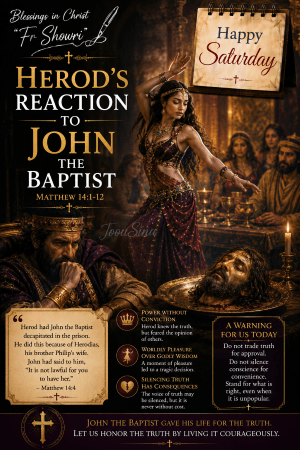
Scripture for today...
August 01
Daily Reflection
Matthew 14:1-12
Herod’s Reaction to John the Baptist
Do you ever feel haunted by a past failure or a guilty conscience? King Herod, the most powerful and wealthy man in Judea, had everything he wanted, except a clear conscience and peace with God. Herod had respected and feared John the Baptist as a great prophet and servant of God.
John, however did not fear to rebuke Herod for his adulterous relationship with his brother’s wife. He ended up in prison because of Herodias’ jealousy. Herod, out of impulse and a desire to please his family and friends, had John beheaded.
Now his conscience is pricked when he hears that all the people are going to Jesus to hear his message of repentance and to see his mighty works. Herod is now haunted by the thought that the prophet he murdered might now be raised from the dead!
A sign of vanity and cowardice
Unfortunately for Herod, he could not rid himself of sin by ridding himself of the man who confronted him with his sin. Herod’s power and influence was badly flawed.
He could take a strong stand on the wrong things when he knew the right. Such a stand, however, was a sign of weakness and cowardice. Where do you get the strength of will and heart to choose what is right and to reject what is bad?
God is our help and our strength
The Lord Jesus gives grace and help to the humble, to those who acknowledge their weaknesses and their sinfulness, and who look to God for his mercy and pardon, wisdom and strength.
His grace and pardon not only frees us from a guilty conscience, it enables us to pursue holiness in every area of our lives, in our thoughts and intentions as well as our words and actions.
Fight fear with faith
God’s grace enables us to fight fear with faith and to overcome the temptation to compromise good with evil. Do you rely on God’s grace and help to choose his way of holiness and to reject whatever would weaken your faith and loyalty to Jesus Christ?
Prayer
“Heavenly Father, form in me the likeness of your Son Jesus that I may imitate him in word and deed. Help me to live the gospel faithfully and give me the strength and courage I need to not shrink back in the face of hardship and temptation.” Amen
Life Story of a Saint
Saint Alphonsus Liguori
September 27, 1696
August 1, 1787
Moral theology, Vatican II said, should be more thoroughly nourished by Scripture, and show the nobility of the Christian vocation of the faithful and their obligation to bring forth fruit in charity for the life of the world.
Alphonsus, declared patron of moral theologians by Pius XII in 1950, would rejoice in that statement. In his day, Alphonsus Liguori fought for the liberation of moral theology from the rigidity of Jansenism.
His moral theology, which went through 60 editions in the century following him, concentrated on the practical and concrete problems of pastors and confessors. If a certain legalism and minimalism crept into moral theology, it should not be attributed to this model of moderation and gentleness.
At the University of Naples, Alphonsus received a doctorate in both canon and civil law by acclamation, at the age of 16, but he soon gave up the practice of law for apostolic activity.
He was ordained a priest, and concentrated his pastoral efforts on popular parish missions, hearing confessions, and forming Christian groups.
Alphonsus Liguori founded the Redemptorist congregation in 1732. It was an association of priests and brothers living a common life, dedicated to the imitation of Christ, and working mainly in popular missions for peasants in rural areas. Almost as an omen of what was to come later, he found himself deserted after a while by all his original companions except one lay brother.
But the congregation managed to survive and was formally approved 17 years later, though its troubles were not over. Alphonsus’ great pastoral reforms were in the pulpit and confessional replacing the pompous oratory of the time with simplicity, and the rigorism of Jansenism with kindness.
His great fame as a writer has somewhat eclipsed the fact that for 26 years he traveled up and down the Kingdom of Naples preaching popular missions.
Alphonsus Liguori was made bishop at age 66 after trying to reject the honor, and at once instituted a thorough reform of his diocese.
His greatest sorrow came toward the end of his life. The Redemptorists, precariously continuing after the suppression of the Jesuits in 1773, had difficulty in getting their Rule approved by the Kingdom of Naples.
Alphonsus acceded to the condition that they possess no property in common, but with the connivance of a high Redemptorist official, a royal official changed the Rule substantially. Alphonsus, old, crippled and with very bad sight, signed the document, unaware that he had been betrayed.
The Redemptorists in the Papal States then put themselves under the pope, who withdrew those in Naples from the jurisdiction of Alphonsus Liguori. It was only after his death that the branches were united.
At 71, Alphonsus was afflicted with rheumatic pains which left incurable bending of his neck. Until it was straightened a little, the pressure of his chin caused a raw wound on his chest.
He suffered a final 18 months of “dark night” scruples, fears, temptations against every article of faith and every virtue, interspersed with intervals of light and relief, when ecstasies were frequent.
Alphonsus Liguori is best known for his moral theology, but he also wrote well in the field of spiritual and dogmatic theology.
His Glories of Mary is one of the great works on that subject, and his book Visits to the Blessed Sacramentwent through 40 editions in his lifetime, greatly influencing the practice of this devotion in the Church.
Reflection
Saint Alphonsus Liguori was known above all as a practical man who dealt in the concrete rather than the abstract. His life is indeed a practical model for the everyday Christian who has difficulty recognizing the dignity of Christian life amid the swirl of problems, pain, misunderstanding and failure.
Alphonsus suffered all these things. He is a saint because he was able to maintain an intimate sense of the presence of the suffering Christ through it all.
Saint Alphonsus Liguori is the Patron Saint of:
Theologians
Vocations
Blessings from
Fr Showri R Narra
JESUS I TRUST IN YOU!
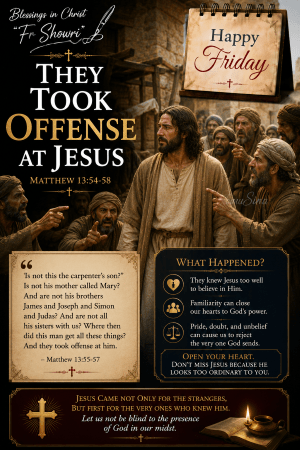
Scripture for today...
July 31
Daily Reflection
Matthew 13:54-58
They Took Offense at Jesus
Are you critical towards others, especially those who are close to you? The most severe critics are often people very familiar to us, a member of our family, a relative, neighbor, student, or worker we rub shoulders with on a regular basis.
Jesus faced a severe testing when he returned to his home town, not simply as the carpenter’s son, but now as a rabbi with disciples.
It would have been customary for Jesus to go to the synagogue each week during the Sabbath, and when his turn came, to read from the scriptures during the Sabbath service. His hometown folks listened with rapt attention on this occasion because they had heard about the miracles he had performed in other towns.
What sign would he do in his hometown? Jesus startled them with a seeming rebuke that no prophet or servant of God can receive honor among his own people. The people of Nazareth took offense at himand refused to listen to what he had to say.
They despised his preaching because he was a carpenter from the working class, and a mere layman untrained by religious scholars. They also despised him because of his family background. After all, Joseph was a tradesman as well and Mary had no special social distinctions.
Familiarity breeds contempt
How easily familiarity breeds contempt. Jesus could do no mighty works in his hometown because the people who were familiar with him were closed-minded and despised his claim to speak and act in the name of God.
If people come together to hate and refuse to understand others different than themselves, then they will see no other point of view than their own and they will refuse to love and accept others. How do you view those who are familiar to you? With kindness and respect or with a critical and judgmental spirit?
The Lord Jesus offers us freedom from sin, prejudice, contempt, and fear. His love and grace sets us free to love others with the same grace and mercy which he has shown to us.
Only Jesus can truly set us free from the worst tyranny possible – slavery to sin and the fear of death. His victory on the cross brings us pardon and healing, and the grace to live holy lives by the power of the Holy Spirit. Do you know the joy and freedom which Christ’s love brings to our hearts?
Prayer
“Lord Jesus, your love conquers every fear and breaks the power of hatred and prejudice. Flood my heart with your mercy and compassion, that I may treat my neighbor with the same favor and kindness which you have shown to me.” Amen
Life Story of a Saint
Saint Ignatius of Loyola
October 23, 1491
July 31, 1556
The founder of the Jesuits was on his way to military fame and fortune when a cannon ball shattered his leg.
Because there were no books of romance on hand during his convalescence, Ignatius whiled away the time reading a life of Christ and lives of the saints. His conscience was deeply touched, and a long, painful turning to Christ began.
Having seen the Mother of God in a vision, he made a pilgrimage to her shrine at Montserrat near Barcelona. He remained for almost a year at nearby Manresa, sometimes with the Dominicans, sometimes in a pauper’s hospice, often in a cave in the hills praying.
After a period of great peace of mind, he went through a harrowing trial of scruples. There was no comfort in anything—prayer, fasting, sacraments, penance. At length, his peace of mind returned.
It was during this year of conversion that Ignatius of Loyola began to write down material that later became his greatest work, the Spiritual Exercises.
He finally achieved his purpose of going to the Holy Land, but could not remain, as he planned, because of the hostility of the Turks.
Ignatius of Loyola spent the next 11 years in various European universities, studying with great difficulty, beginning almost as a child. Like many others, his orthodoxy was questioned; Ignatius was twice jailed for brief periods.
In 1534, at the age of 43, he and six others—one of whom was Saint Francis Xavier—vowed to live in poverty and chastity and to go to the Holy Land. If this became impossible, they vowed to offer themselves to the apostolic service of the pope.
The latter became the only choice. Four years later Ignatius of Loyola made the association permanent. The new Society of Jesus was approved by Pope Paul III, and Ignatius was elected to serve as the first general.
When companions were sent on various missions by the pope, Ignatius remained in Rome, consolidating the new venture, but still finding time to found homes for orphans, catechumens, and penitents. He founded the Roman College, intended to be the model of all other colleges of the Society.
Ignatius of Loyola was a true mystic. He centered his spiritual life on the essential foundations of Christianity—the Trinity, Christ, the Eucharist. His spirituality is expressed in the Jesuit motto, Ad majorem Dei gloriam—“for the greater glory of God.”
In his concept, obedience was to be the prominent virtue, to assure the effectiveness and mobility of his men. All activity was to be guided by a true love of the Church and unconditional obedience to the Holy Father, for which reason all professed members took a fourth vow to go wherever the pope should send them for the salvation of souls.
Reflection
Luther nailed his theses to the church door at Wittenberg in 1517. Seventeen years later, Ignatius of Loyola founded the Society that was to play so prominent a part in the Catholic Reformation.
He was an implacable foe of Protestantism. Yet the seeds of ecumenism may be found in his words: “Great care must be taken to show forth orthodox truth in such a way that if any heretics happen to be present they may have an example of charity and Christian moderation.
No hard words should be used nor any sort of contempt for their errors be shown.” One of the greatest ecumenists was the 20th-century German Jesuit, Cardinal Augustin Bea.
Saint Ignatius of Loyola is the Patron Saint of: Retreats
Blessings from
Fr Showri R Narra
JESUS I TRUST IN YOU!
Scripture for today...
July 22
Daily Reflection
John 20:1-2, 11-18
I Have Seen the Lord!
Do you recognize the presence of the Lord Jesus when you hear his word? How easy it is to miss the Lord Jesus when our focus is on ourselves! Mary Magdalene did not at first recognize the Lord because her focus was on the empty tomb and on her own grief. It took only one word from the Master, when he called her by name, for Mary to recognize him.
The Risen Lord Jesus reveals himself to us as we listen to his word
Mary Magdalene’s message to the disciples, I have seen the Lord, is the very essence of Christianity. It is not enough that a Christian know about the Lord, but that we know him personally. It is not enough to argue about him, but to meet him. In the resurrection we encounter the living Lord Jesus who loves us personally and shares his glory with us.
The Lord Jesus gives us “eyes of faith” to see the truth of his resurrection and his victory over sin and death (Ephesians 1:18). And he opens our ears to recognize his voice as we listen to the “good news” proclaimed in the Gospel message today.
The resurrection of Jesus Christ from the dead is the foundation of our hope – the hope that we, too, who believe in him will see the living God face to face and share in his everlasting glory and joy. “Without having seen him you love him; though you do not now see him you believe in him and rejoice with unutterable and exalted joy.
As the outcome of your faith you obtain the salvation of your souls”(1 Peter 1:8-9). Do you recognize the Lord’s presence with you, in his word, in the “breaking of the bread,” and in his church, the body of Christ?
Prayer
“Lord Jesus, may I never fail to recognize your voice nor lose sight of your presence as you open the Scriptures for me and speak your life-giving word.” Amen
Life Story of a Saint
Saint Mary Magdalene
d. c. 63
Except for the mother of Jesus, few women are more honored in the Bible than Mary Magdalene. Yet she could well be the patron of the slandered, since there has been a persistent legend in the Church that she is the unnamed sinful woman who anointed the feet of Jesus in Luke 7:36-50.
Most Scripture scholars today point out that there is no scriptural basis for confusing the two women. Mary Magdalene, that is, “of Magdala,” was the one from whom Christ cast out “seven demons” (Luke 8:2)—an indication at the worst, of extreme demonic possession or possibly, severe illness.
Writing in the New Catholic Commentary, Father Wilfrid J. Harrington, O.P., says that “seven demons” “does not mean that Mary had lived an immoral life—a conclusion reached only by means of a mistaken identification with the anonymous woman of Luke 7:36.”
In the Jerome Biblical Commentary, Father Edward Mally, S.J., agrees that she “is not…the same as the sinner of Luke 7:37, despite the later Western romantic tradition about her.”
Mary Magdalene was one of the many “who were assisting them [Jesus and the Twelve] out of their means.” She was one of those who stood by the cross of Jesus with his mother. And, of all the “official” witnesses who might have been chosen for the first awareness of the Resurrection, she was the one to whom that privilege was given. She is known as the “Apostle to the Apostles.”
Reflection
Mary Magdalene has been a victim of mistaken identity for almost 20 centuries. Yet she would no doubt insist that it makes no difference. We are all sinners in need of the saving power of God, whether our sins have been lurid or not. More importantly, we are all “unofficial” witnesses of the Resurrection.
Saint Mary Magdalene is the Patron Saint of:
Penitents
Perfumers
Blessings from
Fr Showri R Narra
JESUS I TRUST IN YOU!
Scripture for today...
July 18
Daily Reflection
Matthew 13:24-43
The Righteous Will Shine like the Sun in the Kingdom of Their Father
What can malicious weed-sowing tell us about the kingdom of God (Matthew 13:25)? The image Jesus uses in this parable is a common everyday example of planting, harvesting, and sorting the good fruit from the bad.
Weeds can spoil and even kill a good harvest if they are not separated and destroyed at the proper time. Uprooting them too early, though, can destroy the good plants in the process.
Letting God’s word take deep root in the heart
Just as nature teaches us patience, so God’s patience also teaches us to guard the seed of his word which he has planted in our hearts and to beware of the destructive force of sin and evil that can destroy it.
God’s word brings life, but Satan seeks to destroy the good seed which has been planted in the hearts of those who have heard God’s word. God’s judgment is not hasty, but it does come.
And in the end, God will reward each according to what they have sown and reaped in this life. In that day God will separate the evil from the good. Do you allow God’s word to take deep root in your heart?
Growth and transformation from within
What can mustard seeds and leaven teach us about the kingdom of God? The tiny mustard seed literally grew to be a tree which attracted numerous birds because they loved the little black mustard seed it produced.
God’s kingdom works in a similar fashion. It starts from the smallest beginnings in the hearts of men and women who are receptive to God’s word. And it works unseen and causes a transformation from within.
The Holy Spirit transforms us
Leaven is another powerful agent of change. A lump of dough left to itself remains just what it is, a lump of dough. But when the leaven is added to it a transformation takes place which produces rich and wholesome bread when heated – the staple of life for humans.
The kingdom of God produces a transformation in those who receive the new life which Jesus Christ offers. When we yield to Jesus Christ, our lives are transformed by the power of the Holy Spirit who dwells in us.
Paul the Apostle says,”we have this treasure in earthen vessels, to show that the transcendent power belongs to God and not to us” (2 Corinthians 4:7). Do you believe in the transforming power of the Holy Spirit?
Good and evil are sown in our hearts like tiny seeds which germinate, and in due time yield a harvest of good or bad fruit. Charles Read said: “Sow an act and you reap a habit. Sow a habit and you reap a character.
Sow a character and you reap a destiny.” In the day of judgment each will reap what he or she has sown in this life. Those who sow good will shine in the kingdom of their Father. They will radiate with the beauty, joy, and fullness of God’s love. Do you allow the love of Christ to rule in your heart and in your actions?
Prayer
“Lord Jesus, let your word take root in my heart and may your all-consuming love transform my life that I may sow what is good, worthy, and pleasing to youi.” Amen
Story for reflection
“The vine that ate the South.” Kudzu (Pueraria lobata of the Pea family) was introduced to the United States in 1876 at the Centennial Exposition in Philadelphia, Pennsylvania.
Countries were invited to build exhibits to celebrate the 100th birthday of the U.S. The Japanese government constructed a beautiful garden filled with plants from their country.
The large leaves and sweet-smelling blooms of kudzu captured the imagination of American gardeners who used the plant for ornamental purposes. As an exotic import, it became popular as a shade plant on canopies, and was seen as a God-given solution to the soil-erosion problem, following the Great Depression.
Between 1935 and 1942, government nurseries produced 84 million kudzu seedlings, planting them wherever they would grow. By 1943, there was a Kudzu Club of America with 20,000 members and an annual “Kudzu Queen.”
— So, what’s the problem? I’ll tell you what! Kudzu is a vine with phenomenal growth. Twelve inches in 24 hours is not unusual, and 50 feet in a single growing season is well within the norm. That explains why some have called it “the vine that ate the South.”
People who live in the South say, “If you’re gonna plant kudzu, drop it and run!” Kudzu can cover anything and choke everything. It can twine itself around fruit trees until it kills an entire orchard. That is why the USDA (United States Department of Agriculture), eventually demoted kudzu to “weed status” … with the definition of a weed being “any plant that does more harm than good.”
— The weeds in Matthew’s little parable are “darnel.” Botanists call them Lolium termulentum. They are members of the wheat family, which look like wheat and hide out in wheat-fields, producing poisonous seeds.
Blessings from
Fr Showri R Narra
JESUS I TRUST IN YOU!
Scripture for today...
July 18
Daily Reflection
Matthew 12:14-21
Until Jesus Brings Justice to Victory
How do we achieve success and victory in our lives? In everyone’s life there are key moments or turning points on which the whole of one’s life hinges. The mounting confrontation between the Pharisees and Jesus was such a decisive event and crisis.
The religious leaders became intolerant of Jesus because of their prejudice. Nothing that Jesus would do or say from this point on would be right in their eyes. They conspired, not simply to oppose Jesus but to eliminate him.
Courage and determination to do God’s will
Jesus met this defiance with courage and determination to do his Father’s will. He used the crisis to teach his disciples an important lesson for God’s way to success and victory.
The only way to glory in God’s kingdom is through the cross – the cross of suffering and humiliation – which Jesus endured for our sake and for our salvation. We, too, are called to take up our cross every day – to die to sin, selfishness, envy, pride, strife, and hatred – and to lay down our lives in humble service and love for one another, just as Jesus did for our sake.
Matthew quotes from the “Suffering Servant” prophecies of Isaiah to explain how Jesus the Messiah would accomplish his mission – not through crushing power – but through love and sacrificial service (Isaiah 42:1-4).
In place of a throne Jesus chose to mount the cross and wear a crown of thorns. He was crucified as our Lord and King (John 19:19; Philippians 2:11) There is no greater proof of God’s love for us than the sacrificial death of his only begotten Son for our sake and our salvation (John 3:16).
Jesus died not only for the Jews but for all the Gentile nations as well. Isaiah had prophesied centuries before, that the Messiah would bring justice to the Gentiles. To the Greek mind, justice involved giving to God and to one’s fellow citizen that which is their due (whatever is owed to them).
Jesus taught his disciples to give God not only his due, but to love him without measure just as he loves us unconditionally – without limits or reservation.
Justice tempered with love and mercy
Jesus brings the justice of God’s kingdom tempered with divine love and mercy. He does not bruise the weak or treat them with contempt, but rather shows understanding and compassion. He does not discourage the fainthearted but gives hope, courage, and the strength to persevere through trying circumstances.
No trials, failings, and weaknesses can keep us from the mercy and help which Jesus offers to everyone who asks. His grace is sufficient for every moment, every situation, and every challenge we face. When you meet trials and difficulties, do you rely on God’s help and grace?
Prayer
“Lord Jesus, your love and mercy knows no bounds. Give me strength when I am weak, hope when I am discouraged, peace when I am troubled, consolation when I am sad, and understanding when I am perplexed. Make me an instrument of your love and peace to those who are troubled and without hope.” Amen
Life Story of a Saint
Saint Camillus de Lellis
1550 – July 14, 1614
Humanly speaking, Camillus was not a likely candidate for sainthood. His mother died when he was a child, his father neglected him, and he grew up with an excessive love for gambling.
At 17, he was afflicted with a disease of his leg that remained with him for life. In Rome he entered the San Giacomo Hospital for Incurables as both patient and servant, but was dismissed for quarrelsomeness after nine months. He served in the Venetian army for three years.
Then, in the winter of 1574, when he was 24, Camillus de Lellis gambled away everything he had—savings, weapons, literally down to his shirt. He accepted work at the Capuchin friary at Manfredonia, and was one day so moved by a sermon of the superior that he began a conversion that changed his life.
He entered the Capuchin novitiate, but was dismissed because of the apparently incurable sore on his leg. After another stint of service at San Giacomo, he came back to the Capuchins, only to be dismissed again, for the same reason.
Again, back at San Giacomo, his dedication was rewarded by his being made superintendent. Camillus de Lellis devoted the rest of his life to the care of the sick. Along with Saint John of God he has been named patron of hospitals, nurses, and the sick.
With the advice of his friend Saint Philip Neri, he studied for the priesthood and was ordained at the age of 34. Contrary to the advice of his friend, Camillus left San Giacomo and founded a congregation of his own. As superior, he devoted much of his own time to the care of the sick.
Charity was his first concern, but the physical aspects of the hospital also received his diligent attention. Camillus insisted on cleanliness and the technical competence of those who served the sick. The members of his community bound themselves to serve prisoners and persons infected by the plague as well as those dying in private homes.
Some of his men were with troops fighting in Hungary and Croatia in 1595, forming the first recorded military field ambulance. In Naples, he and his men went onto the galleys that had plague and were not allowed to land. He discovered that there were people being buried alive, and ordered his brothers to continue the prayers for the dying 15 minutes after apparent death.
Camillus de Lellis himself suffered the disease of his leg through his life. In his last illness, he left his own bed to see if other patients in the hospital needed help.
Reflection
Saints are created by God. Parents must indeed nurture the faith in their children; husbands and wives must cooperate to deepen their baptismal grace; friends must support each other. But all human effort is only the dispensing of divine power. We must all try as if everything depended on us. But only the power of God can fulfill the plan of God—to make us like himself.
Saint Camillus de Lellis is the Patron Saint of:
Hospitals
Nurses
Healthcare workers
Sick
Blessings from
Fr Showri R Narra
JESUS I TRUST IN YOU!

Scripture for today...
July 17
Daily Reflection
Matthew 12:1-8
I Desire Mercy and Not Sacrifice
What does the commandment “keep holy the Sabbath” require of us? Or better yet, what is the primary intention behind this command?
The religious leaders confronted Jesus on this issue. The “Sabbath rest” was meant to be a time to remember and celebrate God’s goodness and the goodness of his work, both in creation and redemption.
It was a day set apart for the praise of God, his work of creation, and his saving actions on our behalf. It was intended to bring everyday work to a halt and to provide needed rest and refreshment.
Mercy and not sacrifice
Jesus’ disciples are scolded by the scribes and Pharisees, not for plucking and eating corn from the fields, but for doing so on the Sabbath.
In defending his disciples, Jesus argues from the Scriptures that human need has precedence over ritual custom. In their hunger, David and his men ate of the holy bread offered in the Temple.
Jesus also quoted of the Sabbath work involved in worship in the Temple. This kind of work was usually double the work of worship on weekdays. Jesus then quotes from the prophet Hosea (6:6): I desire mercy, and not sacrifice.
While the claims of ritual sacrifice are important to God, mercy and kindness in response to human need are even more important. Do you honor the Lord in the way you treat your neighbor and celebrate the Lord’s Day?
Prayer
“Lord, make us to walk in your way: Where there is love and wisdom, there is neither fear nor ignorance; where there is patience and humility, there is neither anger nor annoyance; where there is poverty and joy, there is neither greed nor avarice; where there is peace and contemplation, there is neither care nor restlessness; where there is the fear of God to guard the dwelling, there no enemy can enter; where there is mercy and prudence, there is neither excess nor harshness; this we know through your Son, Jesus Christ our Lord. (Prayer of Francis of Assisi, 1182-1226).” Amen
Life Story of a Saint
Saint Francis Solano
March 10, 1549
July 14, 1610
Francis came from a leading family in Andalusia, Spain. Perhaps it was his popularity as a student that enabled Francis Solano in his teens to stop two duelists.
He entered the Friars Minor in 1570, and after ordination enthusiastically sacrificed himself for others. His care for the sick during an epidemic drew so much admiration that he became embarrassed and asked to be sent to the African missions. Instead he was sent to South America in 1589.
While working in what is now Argentina, Bolivia, and Paraguay, Francis quickly learned the local languages and was well received by the indigenous peoples. His visits to the sick often included playing a song on his violin.
Around 1601, he was called to Lima, Peru, where he tried to recall the Spanish colonists to their baptismal integrity. Francis Solano also worked to defend the indigenous peoples from oppression. He died in Lima in 1610 and was canonized in 1726. His liturgical feast is celebrated on July 14.
Reflection
Francis Solano knew from experience that the lives of Christians sometimes greatly hinder the spread of the gospel of Jesus Christ. Francis lived an exemplary life himself, and urged his fellow Spaniards to make their lives worthy of their baptisms.
Blessings from
Fr Showri R Narra
JESUS I TRUST IN YOU!
Scripture for today...
July 16
Daily Reflection
Matthew 11:28-30
Take My Yoke upon You and Learn from Me
What does the yoke of Jesus refer to in the Gospel? The Jews used the image of a yoke to express submission to God. They spoke of the yoke of the law, the yoke of the commandments, the yoke of the kingdom, and the yoke of God. Jesus says his yoke is “easy”. The Greek word for “easy” can also mean “well-fitting”.
Yokes were tailor-made to fit the oxen well. Oxen were yoked two by two. Jesus invites us to be yoked with him, to unite our life with his life, our will with his will, and our heart with his heart. To be yoked with Jesus is to be united with him in a relationship of love, trust, and obedience.
Jesus carries our burdens with us
Jesus also says his “burden is light”. There’s a story of a man who once met a boy carrying a smaller crippled lad on his back. “That’s a heavy load you are carrying there,” exclaimed the man. “He ain’t heavy; he’s my brother!” responded the boy.
No burden is too heavy when it’s given in love and carried in love. When we yoke our lives with Jesus, he also carries our burdens with us and gives us his strength to follow in his way of love. Do you know the joy of resting in Jesus’ presence and walking daily with him along the path he has for you?
Freed from the burden of sin and guilt
Jesus offers us a new kingdom of righteousness, peace, and joy. In his kingdom sins are not only forgiven but removed, and eternal life is poured out for all its citizens. This is not a political kingdom, but a spiritual one.
The yoke of Christ’s kingdom, his kingly rule and way of life, liberates us from the burden of guilt and from the oppression of sinful habits and hurtful desires. Only Jesus can lift the burden of sin and the weight of hopelessness from us.
Jesus used the analogy of a yoke to explain how we can exchange the burden of sin and despair for a weight of glory and victory with him. The yoke which Jesus invites us to embrace is his way of love, grace, and freedom from the power of sin. Do you trust in God’s love and submit to his will and plan for your life?
Prayer
“Lord Jesus, inflame my heart with love for you and for your ways and help me to exchange the yoke of rebellion for the yoke of submission to your holy and loving word. Set me free from the folly of my own sinful ignorance and rebellious pride that I may wholly desire what is good and in accord with your will.” Amen
Life Story of a Saint
The Story of Our Lady of Mount Carmel
Hermits lived on Mount Carmel near the Fountain of Elijah in northern Israel in the 12th century. They had a chapel dedicated to Our Lady.
By the 13th century they became known as “Brothers of Our Lady of Mount Carmel.” They soon celebrated a special Mass and Office in honor of Mary. In 1726, it became a celebration of the universal Church under the title of Our Lady of Mount Carmel.
For centuries the Carmelites have seen themselves as specially related to Mary. Their great saints and theologians have promoted devotion to her and often championed the mystery of her Immaculate Conception.
Saint Teresa of Avila called Carmel “the Order of the Virgin.” Saint John of the Cross credited Mary with saving him from drowning as a child, leading him to Carmel, and helping him escape from prison.
Saint Thérèse of the Child Jesus believed that Mary cured her from illness. On her First Communion day, Thérèse dedicated her life to Mary. During the last days of her life she frequently spoke of Mary.
There is a tradition—which may not be historical—that Mary appeared to Saint Simon Stock, a leader of the Carmelites, and gave him a scapular, telling him to promote devotion to it.
The scapular is a modified version of Mary’s own garment. It symbolizes her special protection and calls the wearers to consecrate themselves to her in a special way. The scapular reminds us of the gospel call to prayer and penance—a call that Mary models in a splendid way.
Reflection
The Carmelites were known from early on as “Brothers of Our Lady of Mount Carmel.” The title suggests that they saw Mary not only as “mother,” but also as “sister.”
The word sister is a reminder that Mary is very close to us. She is the daughter of God and therefore can help us be authentic daughters and sons of God.
She also can help us grow in appreciation of being sisters and brothers to one another. She leads us to a new realization that all human beings belong to the family of God. When such a conviction grows, there is hope that the human race can find its way to peace.
Our Lady of Mount Carmel is the Patron Saint of:
Chile
Blessings from
Fr Showri R Narra
JESUS I TRUST IN YOU!
Scripture for today...
July 15
Daily Reflection
Matthew 11:25-27
Heavenly Things Revealed to Infants
Do you want to know the mind and thoughts of God? Jesus thanks the Father in heaven for revealing to his disciples the wisdom and knowledge of God. What does Jesus’ prayer tell us about God and about ourselves? First, it tells us that God is both Father and Lord of earth as well as heaven.
He is both Creator and Author of all that he has made, the first origin of everything and transcendent authority, and at the same time he shows loving care and goodness toward all his children. All fatherhood and motherhood is derived from him (Ephesians 3:14-15). Pride and inordinate love of self Jesus’ prayer also contains a warning that pride can keep us from the love and knowledge of God. What makes us ignorant and blind to the things of God?
Certainly intellectual pride, coldness of heart, and stubbornness of will shut out God and his kingdom of peace, joy, and righteousness. Pride is the root of all vice and the strongest influence propelling us to sin.
It first vanquishes the heart, making it cold and indifferent towards God. It also closes the mind to God’s truth and wisdom for our lives. What is pride? It is the inordinate love of oneself at the expense of others and the exaggerated estimation of one’s own learning and importance. Simplicity of heart Jesus contrasts intellectual pride with child-like simplicity and humility. The simple of heart are like “infants” in the sense that they see purely without pretense and acknowledge their dependence and trust in the one who is greater, wiser, and more trustworthy.
They seek one thing – the “summum bonum” or “greatest good,” who is God himself. Simplicity of heart is wedded with humility, the queen of virtues, because humility inclines the heart towards grace and truth. Just as pride is the root of every sin and evil, so humility is the only soil in which the grace of God can take root. It alone takes the right attitude before God and allows him, as God, to do all.
God opposes the proud, but gives grace to the humble (Proverbs 3:34, James 4:6). Only the humble in heart can receive true wisdom and understanding of God and his ways. Do you submit to God’s word with simple trust and humility? Jesus reveals the Father to us Jesus makes a claim which no one would have dared to make – he is the perfect revelation of God. One of the greatest truths of the Christian faith is that we can know the living God.
Our knowledge of God is not simply limited to knowing something about God, but we can know God personally. The essence of Christianity, and what makes it distinct from Judaism and other religions, is the knowledge of God as our Father. Jesus makes it possible for each of us to personally know God as our Father. To see Jesus is to see what God is like. In Jesus we see the perfect love of God – a God who cares intensely and who yearns over men and women, loving them to the point of laying down his life for them upon the Cross. Jesus is the perfect revelation of God – a God who loves us completely, unconditionally, and perfectly.
Jesus also promises that God the Father will hear our prayers when we pray in his name. That is why Jesus taught his followers to pray with confidence, Our Father who art in heaven ..give us this day our daily bread. Do you pray to your Father in heaven with joy and confidence in his love and care for you?
Prayer
“Lord Jesus, give me the child-like simplicity and purity of faith to gaze upon your face with joy and confidence in your all-merciful love. Remove every doubt, fear, and proud thought which would hinder me from receiving your word with trust and humble submission.” Amen
Life Story of a Saint
Saint Bonaventure
1221 – July 15, 1274
Perhaps not a household name for most people, Saint Bonaventure, nevertheless, played an important role in both the medieval Church and the history of the Franciscan Order.
A senior faculty member at the University of Paris, Saint Bonaventure certainly captured the hearts of his students through his academic skills and insights. But more importantly, he captured their hearts through his Franciscan love for Jesus and the Church.
Like his model, Saint Francis, Jesus was the center of everything—his teaching, his administration, his writing, and his life. So much so, that he was given the title “Seraphic Doctor.”
Born in Bagnoregio in 1221, Saint Bonaventure was baptized John, but received the name Bonaventure when he became a Franciscan at the age of 22.
Little is known about his childhood, but we do know that his parents were Giovanni di Fidanza and Maria Ritell. It seems that his father was a physician and a man of means. While Saint Francis died about five years after the saint’s birth, he is credited with healing Bonaventure as a boy of a serious illness.
Saint Bonaventure’s teaching career came to a halt when the Friars elected him to serve as their General Minister. His 17 years of service were not easy as the Order was embroiled in conflicts over the interpretation of poverty.
Some friars even ended up in heresy saying that Saint Francis and his community were inaugurating the era of the Holy Spirit which was to replace Jesus, the Church, and Scripture. But because he was a man of prayer and a good administrator, Saint Bonaventure managed to structure the Order through effective legislation.
But more importantly, he offered the Friars an organized spirituality based on the vision and insights of Saint Francis. Always a Franciscan at heart and a mystical writer, Bonaventure managed to unite the pastoral, practical aspects of life with the doctrines of the Church.
Thus, there is a noticeable warmth to his teachings and writings that make him very appealing.
Shortly before he ended his service as General Minister, Pope Gregory X created him a Cardinal and appointed him bishop of Albano.
But a little over a year later, while participating in the Second Council of Lyon, Saint Bonaventure died suddenly on July 15, 1274. There is a theory that he was poisoned.
Saint Bonaventure left behind a structured and renewed Franciscan Order and a body of work all of which glorifies his major love—Jesus.
Reflection
Bonaventure so united holiness and theological knowledge that he rose to the heights of mysticism while remaining a very active preacher and teacher, one beloved by all who met him. To know him was to love him; to read him is still for us today to meet a true Franciscan and a gentleman.
Blessings from
Fr Showri R Narra
JESUS I TRUST IN YOU!

Scripture for today...
July 10
Daily Reflection
Matthew 10:16-23
Sheep in the Midst of Wolves – Wise and Innocent
What does Jesus mean when he says his disciples must be sheep in the midst of wolves (Matthew 10:16)? The prophet Isaiah foretold a time when wolves and lambs will dwell in peace (Isaiah 11:6 and 65:25).
This Old Testament prophecy certainly refers to the second coming of Christ when all will be united under the Lordship of Jesus after he has put down his enemies and established the reign of God over the heavens and the earth (Ephesians 1:10 and Revelation 11:15).
In the meantime, the disciples must expect opposition and persecution from those who oppose the Gospel and the coming of God’s kingdom.
The readiness to serve and face hardship for Christ and his kingdom
Jesus never hesitated to tell his disciples what they might expect if they chose to follow him. Here Jesus says to his disciples: This is my task for you at its grimmest and worst – do you accept it?
This is not the world’s way of recruitment for service and toil with promise of honor and reward. After the British defeat at Dunkirk (June 1940), Churchill offered his country blood, toil, sweat, and tears.
This is not the message we prefer to hear when the Lord Jesus commissions us in his service for the advancement of God’s kingdom and the battle against Satan’s kingdom of darkness and death.
Nonetheless, our privilege is to follow in the footsteps of the Lord and Master who willingly laid down his life for us in order to bring us victory over Satan, sin, and death. Are you willing to accept hardship and suffering in serving the Lord Jesus Christ?
Prayer
“Lord Jesus, help me to patiently and joyfully accept the hardships, adversities, and persecution which come my way in serving you and your kingdom of love, truth,and goodness. Strengthen my faith and give me courage that I may not shrink back from doing your will.” Amen
Life Story of a Saint
Saint Veronica Giuliani
December 27, 1660
July 9, 1727
Veronica Giuliani’s desire to be like Christ crucified was answered with the stigmata.
Veronica was born in Mercatelli, Italy. It is said that when her mother Benedetta was dying she called her five daughters to her bedside and entrusted each of them to one of the five wounds of Jesus. Veronica was entrusted to the wound below Christ’s heart.
At the age of 17, Veronica Giuliani joined the Poor Clares directed by the Capuchins. Her father had wanted her to marry, but she convinced him to allow her to become a nun. In her first years in the monastery, she worked in the kitchen, infirmary, sacristy, and also served as portress.
At the age of 34, she was made novice mistress, a position she held for 22 years. When she was 37, Veronica received the stigmata. Life was not the same after that.
Church authorities in Rome wanted to test Veronica’s authenticity and so conducted an investigation.
She lost the office of novice mistress temporarily and was not allowed to attend Mass except on Sundays or holy days. Through all of this Veronica did not become bitter, and the investigation eventually restored her as novice mistress.
Though she protested against it, at the age of 56 she was elected abbess, an office she held for 11 years until her death. Veronica was very devoted to the Eucharist and to the Sacred Heart. She offered her sufferings for the missions, died in 1727, and was canonized in 1839. Her Liturgical Feast Day is July 9.
Reflection
Why did God grant the stigmata to Francis of Assisi and to Veronica Giuliani? God alone knows the deepest reasons, but as Celano points out, the external sign of the cross is a confirmation of these saints’ commitment to the cross in their lives.
The stigmata that appeared in Veronica’s flesh had taken root in her heart many years before. It was a fitting conclusion for her love of God and her charity toward her sisters.
Blessings from
Fr Showri R Narra
JESUS I TRUST IN YOU!
Scripture for today...
July 09
Daily Reflection
Matthew 10:7-15
Freely Have You Received – Freely Give
Do you believe that the Gospel has power to change your life and the lives of others?Jesus gave his disciples a two-fold commission to speak in his name and to act with his power. The core of the Gospel message is quite simple: the kingdom (or reign) of God is imminent! What is the kingdom of God?
It is that society of men and women who freely submit to God and who honor him as their Lord and King. In the Lord’s prayer we pray for God to reign in our lives and in our world: May your kingdom come and your will be done on earth as it is in heaven.
Doing the works which Jesus did
Jesus also commissioned his disciples to carry on the works which he did – bringing the healing power and mercy of God to the weary and oppressed.
The Gospel has power to set people free from sin, sickness, fear, and oppression. The Lord Jesus will free us from anything that keeps us from loving him and our neighbor with joy and confidence.
Sharing generously what God has given to each one of us
Jesus said to his disciples: Freely you have received, freely give. What they have received from Jesus they must now pass on to others without expecting a favor in return, whether it be in the form of a gift or payment. They must show by their attitude that their first interest is in serving God, not receiving material gain.
They must serve without guile, full of charity and peace, and simplicity. They must give their full attention to the proclamation of God’s kingdom and not be diverted by other lesser things. They must travel light – only take what was essential and leave behind whatever would distract them – in order to concentrate on the task of speaking the word of God.
They must do their work, not for what they can get out of it, but for what they can give freely to others, without expecting special privileges or reward. “Poverty of spirit” frees us from greed and preoccupation with possessions and makes ample room for God’s provision. The Lord wants his disciples to be dependent on him and not on themselves.
Support the work of the Gospel with your resources
Secondly, Jesus said: the worker deserves his sustenance. Here we see a double-truth: the worker of God must not be overly-concerned with material things, but the people of God must never fail in their duty to give the worker of God what he or she needs to sustain themselves in the Lord’s service. Do you pray for the work of the Gospel and do you support it with your material and financial resources?
Jesus ends his instructions with a warning: If people reject God’s invitation and refuse his word, then they bring judgment and condemnation on themselves.
When God gives us his word there comes with it the great responsibility to respond. Indifference will not do. We are either for or against God in how we respond to his word. God gives us his word that we may have life – abundant life in him.
He wills to work in and through each of us for his glory. God shares his word with us and he commissions us to speak it boldly and simply to others. Do you witness the truth and joy of the Gospel by word and example to those around you?
Prayer
“Lord Jesus, may the joy and truth of the Gospel transform my life that I may witness it to those around me. Grant that I may spread your truth and your light wherever I go.” Amen
🟩🟩🟩🟩🟢🟢🟢🟩🟩🟩🟩
🟩Life Story of a Saint🟩
Saint Augustine Zhao Rong’s and Companions
d. 1648 – 1930
Christianity arrived in China by way of Syria in the 600s. Depending on China’s relations with the outside world, Christianity over the centuries was free to grow or was forced to operate secretly.
The 120 martyrs in this group died between 1648 and 1930. Eighty-seven of them were born in China, and were children, parents, catechists, or laborers, ranging in age from nine years to 72.
This group includes four Chinese diocesan priests. The 33 foreign-born martyrs were mostly priests or women religious, especially from the Order of Preachers, the Paris Foreign Mission Society, the Friars Minor, Society of Jesus, Society of St. Francis de Sales (Salesians), and Franciscan Missionaries of Mary.
Augustine Zhao Rong was a Chinese soldier who accompanied Bishop John Gabriel Taurin Dufresse of the Paris Foreign Mission Society to his martyrdom in Beijing. Not long after his baptism, Augustine was ordained as a diocesan priest. He was martyred in 1815.
Beatified in groups at various times, these 120 martyrs were canonized together in Rome on October 1, 2000.
Reflection
The People’s Republic of China and the Roman Catholic Church each have well over a billion members, but there are only about 12 million Catholics in China. The reasons for that are better explained by historical conflicts than by a wholesale rejection of the Good News of Jesus Christ.
The Chinese-born martyrs honored by today’s feast were regarded by their persecutors as dangerous because they were considered allies of enemy, Catholic countries.
The martyrs born outside China often tried to distance themselves from European political struggles relating to China, but their persecutors saw them as Westerners and therefore, by definition, anti-Chinese.
The Good News of Jesus Christ is intended to benefit all peoples; today’s martyrs knew that. May 21st-century Christians live in such a way that Chinese women and men will be attracted to hear that Good News and embrace it.
Blessings from
Fr Showri R Narra
JESUS I TRUST IN YOU!
Scripture for today...
July 01
Daily Reflection
Matthew 8:28-34
Jesus Frees Those Who Are Bound Up
Do you ever feel driven by forces beyond your strength? Two men who were possessed and driven mad by the force of many evil spirits found refuge in the one person who could set them free.
Both Mark and Luke in their Gospel accounts of this incident describe this demonic force as a legion (Mark 5:9 and Luke 8:30). A legion is no small force but an army 6,000 strong!
For the people of Palestine who were often hemmed in by occupied forces, a legion – whether human or supernatural – struck terror! Legions at their wildest committed unmentionable atrocities. Our age has also witnessed untold crimes and mass destruction at the hands of possessed rulers and their armies.
No force can withstand Christ’s power and authority
What is more remarkable – the destructive force of these driven and possessed men, or their bended knee at Jesus’ feet imploring mercy and release (Luke 8:28)?
God’s word reminds us that no destructive force can keep anyone from the peace and safety which God offers to those who seek his help. A thousand may fall at your side, ten thousand at your right hand; but it will not come near you. ..Because you have made the Lord your refuge, the Most High your habitation (Psalm 91:7,9).
Jesus took pity on these men who were overtaken by a legion of evil spirits. The destructive force of these demons is evident for all who can see as they flee and destroy a herd of swine. After Jesus freed the demoniacs the whole city came out to meet him.
No one had demonstrated such power and authority against the forces of Satan as Jesus did. They feared Jesus as a result and begged him to leave them. Why would they not want Jesus to stay? Perhaps the price for such liberation from the power of evil and sin was more than they wanted to pay.
Jesus will free us from anything that binds us
The Lord Jesus is ready and willing to free us from anything that binds us and that keeps us from the love of God. Are you willing to part with anything that might keep you from his love and saving power?
Prayer
“Lord Jesus, unbind me that I may love you wholly and walk in the freedom of your way of love and holiness. May there be nothing which keeps me from the joy of living in your presence.” Amen
Life Story of a Saint
Saint Junipero Serra
November 24, 1713
August 28, 1784
In 1776, when the American Revolution was beginning in the east, another part of the future United States was being born in California. That year a gray-robed Franciscan founded Mission San Juan Capistrano, now famous for its annually returning swallows. San Juan was the seventh of nine missions established under the direction of this indomitable Spaniard.
Born on Spain’s island of Mallorca, Serra entered the Franciscan Order taking the name of Saint Francis’ childlike companion, Brother Juniper. Until he was 35, he spent most of his time in the classroom—first as a student of theology and then as a professor.
He also became famous for his preaching. Suddenly he gave it all up and followed the yearning that had begun years before when he heard about the missionary work of Saint Francis Solano in South America. Junipero’s desire was to convert native peoples in the New World.
Arriving by ship at Vera Cruz, Mexico, he and a companion walked the 250 miles to Mexico City. On the way Junipero’s left leg became infected by an insect bite and would remain a cross—sometimes life-threatening—for the rest of his life.
For 18 years, he worked in central Mexico and in the Baja Peninsula. He became president of the missions there.
Enter politics: the threat of a Russian invasion south from Alaska. Charles III of Spain ordered an expedition to beat Russia to the territory. So the last two conquistadors—one military, one spiritual—began their quest.
José de Galvez persuaded Junipero Serra to set out with him for present-day Monterey, California. The first mission founded after the 900-mile journey north was San Diego in 1769. That year a shortage of food almost canceled the expedition.
Vowing to stay with the local people, Junipero Serra and another friar began a novena in preparation for St. Joseph’s day, March 19, the scheduled day of departure. On that day, the relief ship arrived.
Other missions followed: Monterey/Carmel (1770); San Antonio and San Gabriel (1771); San Luís Obispo (1772); San Francisco and San Juan Capistrano (1776); Santa Clara (1777); San Buenaventura (1782).
Twelve more were founded after Serra’s death.
Junipero made the long trip to Mexico City to settle great differences with the military commander. He arrived at the point of death. The outcome was substantially what Junipero Serra sought: the famous “Regulation” protecting the Indians and the missions.
It was the basis for the first significant legislation in California, a “Bill of Rights” for Native Americans. Because the Native Americans were living a nonhuman life from the Spanish point of view, the friars were made their legal guardians. The Native Americans were kept at the mission after baptism lest they be corrupted in their former haunts—a move that has brought cries of “injustice” from some moderns.
Junipero Serra’s missionary life was a long battle with cold and hunger, with unsympathetic military commanders and even with danger of death from non-Christian native peoples.
Through it all his unquenchable zeal was fed by prayer each night, often from midnight till dawn. He baptized over 6,000 people and confirmed 5,000. His travels would have circled the globe.
He brought the Native Americans not only the gift of faith but also a decent standard of living. He won their love, as witnessed especially by their grief at his death. He is buried at Mission San Carlo Borromeo, Carmel, and was beatified in 1988. Pope Francis canonized him in Washington, D.C., on September 23, 2015.
Reflection
The word that best describes Junipero Serra is zeal. It was a spirit that came from his deep prayer and dauntless will. “Always forward, never back” was his motto.
His work bore fruit for 50 years after his death as the rest of the missions were founded in a kind of Christian communal living by the Indians. When both Mexican and American greed caused the secularization of the missions, the Chumash people went back to what they had been—God again writing straight with crooked lines.
Saint Junipero Serra is the Patron Saint of: California Missions
Blessings from
Fr Showri R Narra
JESUS I TRUST IN YOU!
Scripture for today...
June 30
Daily Reflection
Matthew 8:23-27
Why Are You Afraid, O Men of Little Faith?
How can we fight fear with faith? Jesus’ sleeping presence on the storm-tossed sea reveals the sleeping faith of his disciples (Matthew 8:25).
They feared for their lives even though their Lord and Master was with them in the boat. They were asleep to Christ while he was present to them in their hour of need.
Why are you afraid?
The Lord is ever present to us. And in our time of testing he asks the same question: Why are you afraid? Have you no faith (Matthew 8:26)?
Do you recognize the Lord’s presence with you, especially when you meet the storms of adversity, sorrow, and temptation? Whenever we encounter trouble, the Lord Jesus is there with the same reassuring message: “It is I, do not be afraid” (Matthew 14:27).
Faith nourished with the word of God
What are the characteristics of faith and how can we grow in it?
Faith is an entirely free gift that God makes to us. Believing is only possible by grace and the help of the Holy Spirit, who moves the heart and who opens the eyes of the mind to understand and accept the truth which God has revealed to us.
Faith enables us to relate to God rightly and confidently, with trust and reliance, by believing and adhering to his word, because he is utterly reliable and trustworthy. If we want to live, grow, and persevere in faith, then it must be nourished with the word of God.
Let the love of Christ rule your heart and mind
Fear does not need to cripple us from taking right action or rob us of our trust and reliance on God. Courage working with faith enables us to embrace God’s word of truth and love with confidence and to act on it with firm hope in God’s promises.
The love of God strengthens us in our faith and trust in him and enables us to act with justice and kindness towards our neighbor even in the face of opposition or harm. Do you allow the love of Jesus Christ to rule in your heart and mind, and to move your will to choose what is good in accordance with his will?
Prayer
“Lord Jesus, increase my faith in your redeeming love and power that I may always recognize your abiding presence with me. Give me courage and strength to face every difficulty, trial, and temptation with trust in your saving help and guiding presence.” Amen
Life Story of a Saint
First Martyrs of the Church of Rome
d. 64
There were Christians in Rome within a dozen or so years after the death of Jesus, though they were not the converts of the “Apostle of the Gentiles” (Romans 15:20). Saint Paul had not yet visited them at the time he wrote his great letter in 57-58 A.D.
There was a large Jewish population in Rome. Probably as a result of controversy between Jews and Jewish Christians, the Emperor Claudius expelled all Jews from Rome in 49-50 A.D. Suetonius the historian says that the expulsion was due to disturbances in the city “caused by the certain Chrestus” [Christ]. Perhaps many came back after Claudius’ death in 54 A.D. Paul’s letter was addressed to a Church with members from Jewish and Gentile backgrounds.
In July of 64 A.D., more than half of Rome was destroyed by fire. Rumor blamed the tragedy on Nero, who wanted to enlarge his palace. He shifted the blame by accusing the Christians.
According to the historian Tacitus, many Christians were put to death because of their “hatred of the human race.” Peter and Paul were probably among the victims.
Threatened by an army revolt and condemned to death by the senate, Nero committed suicide in 68 A.D. at the age of 31.
Reflection
Wherever the Good News of Jesus was preached, it met the same opposition as Jesus did, and many of those who began to follow him shared his suffering and death. But no human force could stop the power of the Spirit unleashed upon the world. The blood of martyrs has always been, and will always be, the seed of Christians.
Blessings from
Fr Showri R Narra
JESUS I TRUST IN YOU!

Scripture for today...
June 18
Daily Reflection
Matthew 6:7-15
Your Heavenly Father Knows What You Need
Do you believe that God’s word has power to change and transform your life today? Isaiah says that God’s word is like the rain and melting snow which makes the barren ground spring to life and become abundantly fertile (Isaiah 55:10-11).
God’s word has power to penetrate our dry barren hearts and make them springs of new life. If we let God’s word take root in our heart it will transform us into the likeness of God himself and empower us to walk in his way of love and holiness.
Let God’s word guide and shape the way you judge and act
God wants his word to guide and shape the way we think, act, and pray. Ambrose (339-397 AD), an early church father and bishop of Milan, wrote that the reason we should devote time for reading Scripture is to hear Christ speak to us. “Are you not occupied with Christ? Why do you not talk with him? By reading the Scriptures, we listen to Christ.”
We can approach God our Father with confidence
We can approach God confidently because he is waiting with arms wide open to receive his prodigal sons and daughters. That is why Jesus gave his disciples the perfect prayer that dares to call God, Our Father.
This prayer teaches us how to ask God for the things we really need, the things that matter not only for the present but for eternity as well. We can approach God our Father with confidence and boldness because the Lord Jesus has opened the way to heaven for us through his death and resurrection.
When we ask God for help, he fortunately does not give us what we deserve. Instead, God responds with grace, mercy, and loving-kindness. He is good and forgiving towards us, and he expects us to treat our neighbor the same.
God has poured his love into our hearts through the gift of the Holy Spirit who has been given to us (Romans 5:5). And that love is like a refining fire – it purifies and burns away all prejudice, hatred, resentment, vengeance, and bitterness until there is nothing left but goodness and forgiveness towards those who cause us grief or harm.
The Lord’s Prayer teaches us how to pray
Consider what John Cassian (360-435 AD), an early church father who lived for several years with the monks in Bethlehem and Egypt before founding a monastery in southern Gaul, wrote about the Lord’s Prayer and the necessity of forgiving one another from the heart: “The mercy of God is beyond description. While he is offering us a model prayer he is teaching us a way of life whereby we can be pleasing in his sight.
But that is not all. In this same prayer he gives us an easy method for attracting an indulgent and merciful judgment on our lives. He gives us the possibility of ourselves mitigating the sentence hanging over us and of compelling him to pardon us.
What else could he do in the face of our generosity when we ask him to forgive us as we have forgiven our neighbor? If we are faithful in this prayer, each of us will ask forgiveness for our own failings after we have forgiven the sins of those who have sinned against us, not only those who have sinned against our Master.
There is, in fact, in some of us a very bad habit. We treat our sins against God, however appalling, with gentle indulgence – but when by contrast it is a matter of sins against us ourselves, albeit very tiny ones, we exact reparation with ruthless severity.
Anyone who has not forgiven from the bottom of the heart the brother or sister who has done him wrong will only obtain from this prayer his own condemnation, rather than any mercy.”
Do you treat others as you think they deserve to be treated, or do you treat them as the Lord has treated you – with mercy, steadfast love, and kindness?
Prayer
“Father in heaven, you have given me a mind to know you, a will to serve you, and a heart to love you. Give me today the grace and strength to embrace your holy will and fill my heart with your love that all my intentions and actions may be pleasing to you. Give me the grace to be charitable in thought, kind in deed, and loving in speech towards all.” Amen.
Life Story of a Saint
Venerable Matt Talbot
May 2, 1856 – June 7, 1925
Matt Talbot can be considered the patron of men and women struggling with alcoholism. He was born in Dublin, where his father worked on the docks and had a difficult time supporting his family.
After a few years of schooling, Matt obtained work as a messenger for some liquor merchants; there he began to drink excessively. For 15 years—until he was almost 30—Matt was an active alcoholic.
One day he decided to take “the pledge” for three months, make a general confession and begin to attend daily Mass.
There is evidence that Matt’s first seven years after taking the pledge were especially difficult. Avoiding his former drinking places was hard. He began to pray as intensely as he used to drink. He also tried to pay back people from whom he had borrowed or stolen money while he was drinking.
Most of his life Matt Talbot worked as a builder’s laborer. He joined the Secular Franciscan Order and began a life of strict penance; he abstained from meat nine months a year.
Matt spent hours every night avidly reading Scripture and the lives of the saints. He prayed the rosary conscientiously. Though his job did not make him rich, Matt contributed generously to the missions.
After 1923, Matt’s health failed, and he was forced to quit work. He died on his way to church on Trinity Sunday. Fifty years later, Pope Paul VI gave Matt Talbot the title venerable. His liturgical feast is celebrated on June 19.
Reflection
In looking at the life of Matt Talbot, we may easily focus on the later years when he had stopped drinking for some time and was leading a penitential life.
Only alcoholic men and women who have stopped drinking can fully appreciate how difficult the earliest years of sobriety were for Matt.
He had to take one day at a time. So do the rest of us.
Venerable Matt Talbot is the Patron Saint of:
Alcoholics
Recovery from Substance Abuse and Addictions
Sobriety
Blessings from
Fr Showri R Narra
JESUS I TRUST IN YOU!

Scripture for today...
June 17
Daily Reflection
Matthew 6:1-6, 16-18
When You Pray, Fast, and Give Alms
Why did Jesus single out prayer, fasting, and almsgiving for his disciples? The Jews considered these three as the cardinal works of the religious life. These were seen as the key signs of a pious person, the three great pillars on which the good life was based.
Jesus pointed to the heart of the matter. Why do you pray, fast, and give alms? To draw attention to yourself so that others may notice and think highly of you? Or to give glory to God?
True piety and devotion to God
The Lord warns his disciples of self-seeking glory – the preoccupation with looking good and seeking praise from others. True piety is something more than feeling good or looking holy.
True piety is loving devotion to God. It is an attitude of awe, reverence, worship and obedience. It is a gift and working of the Holy Spirit that enables us to devote our lives to God with a holy desire to please him in all things (Isaiah 11:1-2).
Completely united with God our Father
What is the sure reward which Jesus points out to his disciples? It is communion with God our Father. In him alone we find the fullness of life and happiness, truth and beauty, love and joy.
Saint Augustine of Hippo (354-430 AD) wrote the following prayer in his Confessions: When I am completely united to you, there will be no more sorrows or trials; entirely full of you, my life will be complete.
The Lord rewards those who seek him with humble and repentant hearts. He renews us each day and he gives us new hearts of love and compassion that we may serve him and our neighbor with glad and generous hearts. Do you want to grow in your love for God and for your neighbor? Seek him expectantly in prayer, with fasting, and in generous giving to those in need.
Prayer
“Lord Jesus, give me a lively faith, a firm hope, a fervent charity, and a great love for you. Take from me all lukewarmness in meditating on your word, and dullness in prayer. Give me fervor and delight in thinking of you and your grace. Fill my heart with compassion for others, especially those in need, that I may respond with generosity.” Amen.
Life Story of Saint
Saint Joseph Cafasso
January 15, 1811
June 23, 1860
Even as a young man, Joseph Cafasso loved to attend Mass and was known for his humility and fervor in prayer.
After his ordination, he was assigned to a seminary in Turin. There he worked especially against the spirit of Jansenism—an excessive preoccupation with sin and damnation.
He used the works of Saint Francis de Sales and Saint Alphonsus Liguori to moderate the rigorism popular at the seminary.
Joseph Cafasso recommended membership in the Secular Franciscan Order to priests. He urged devotion to the Blessed Sacrament and encouraged daily Communion.
In addition to his teaching duties, Joseph was an excellent preacher, confessor, and retreat master. Noted for his work with condemned prisoners, he helped many of them die at peace with God.
Joseph Cafasso urged one of his former pupils—Saint John Bosco —to establish the Salesians congregation to work with the youth of Turin. Joseph died in 1860, and was canonized in 1947. His liturgical feast is celebrated on June 23.
Reflection
Devotion to the Eucharist gave energy to all Joseph’s other activities. Long prayer before the Blessed Sacrament has been characteristic of many Catholics who have lived out the gospel well: Saint Francis, Bishop Fulton Sheen, Cardinal Joseph Bernardin, and Saint Teresa of Calcutta among them.
Saint Joseph Cafasso is the Patron Saint of:
Prisoners
Prussia
Blessings from
Fr Showri R Narra
JESUS I TRUST IN YOU!

Scripture for today...
June 16
Daily Reflection
Matthew 5:43-48
Love Your Enemies and Pray for Them
What makes the disciples of Jesus different from others and what makes Christianity distinct from any other religion? It is grace – treating others, not as they deserve, but as God wishes them to be treated – with loving-kindness, forbearance, and mercy.
God is good to the unjust as well as the just. His love embraces saint and sinner alike. God seeks our highest good and teaches us to seek the greatest good of others, even those who hate and abuse us.
Overcome evil with good
Our love for others, even those who are ungrateful and selfish towards us, must be marked by the same kindness and mercy which God has shown to us. It is easier to show kindness and mercy when we can expect to benefit from doing so.
How much harder when we can expect nothing in return. Our prayer for those who do us ill both breaks the power of revenge and releases the power of love to do good in the face of evil.
Christ’s redeeming love and mercy frees us from all hatred and malice towards others
How can we possibly love those who cause us harm or ill-will? With God all things are possible. He gives power and grace to those who believe and accept the gift of the Holy Spirit. His love conquers all, even our hurts, fears, prejudices and griefs.
Only the cross of Jesus Christ can free us from the tyranny of malice, hatred, revenge, and resentment and gives us the courage to return evil with good. Such love and grace has power to heal and to save from destruction. Do you know the power of Christ’s redeeming love and mercy?
Allow the Holy Spirit to change and transform the way you think, judge, and treat others
Was Jesus exaggerating when he said we must be perfect as our heavenly Father is perfect? The original meaning of “perfect” in Aramaic is “completeness” or “wholeness – not lacking in what is essential.”
God gives us every good gift in Jesus Christ so that we may not lack anything we need to do his will and to live as his sons and daughters (2 Peter 1:3). He knows our weakness and sinfulness better than we do. And he assures us of his love, mercy, and grace to follow in his ways.
Do you want to grow in your love for God and for your neighbor? Ask the Holy Spirit to change and transform you in the image of the Father that you may walk in the joy and freedom of the Gospel.
🟢🙏🏻Prayer🙏🏻🟢
“Lord Jesus, your love brings freedom and pardon. Fill me with your Holy Spirit and set my heart ablaze with your love that nothing may make me lose my temper, ruffle my peace, take away my joy, nor make me bitter towards anyone.” Amen.
The life Story of the saint
January 31, 1597 – December 30, 1640
Saint John Francis Regis’ Story
Born into a family of some wealth, John Francis Regis was so impressed by his Jesuit educators that he himself wished to enter the Society of Jesus.
He did so at age 18. Despite his rigorous academic schedule, he spent many hours in chapel, often to the dismay of fellow seminarians who were concerned about his health. Following his ordination to the priesthood, John Francis undertook missionary work in various French towns.
While the formal sermons of the day tended toward the poetic, his discourses were plain. But they revealed the fervor within him and attracted people of all classes. Father Regis especially made himself available to the poor. Many mornings were spent in the confessional or at the altar celebrating Mass; afternoons were reserved for visits to prisons and hospitals.
The bishop of Viviers, observing the success of John Francis Regis in communicating with people, sought to draw on his many gifts, especially needed during the prolonged civil and religious strife then rampant throughout France. With many prelates absent and priests negligent, the people had been deprived of the sacraments for 20 years or more.
Various forms of Protestantism were thriving in some cases while a general indifference toward religion was evident in other instances. For three years, Father Regis traveled throughout the diocese, conducting missions in advance of a visit by the bishop. He succeeded in converting many people and in bringing many others back to religious observances.
Though John Francis Regis longed to work as a missionary among the Native Americans in Canada, he was to live out his days working for the Lord in the wildest and most desolate part of his native France. There he encountered rigorous winters, snowdrifts and other deprivations.
Meanwhile he continued preaching missions and earned a reputation as a saint. Upon entering the town of Saint-Andé, one man came upon a large crowd in front of a church and was told that people were waiting for “the saint” who was coming to preach a mission.
The last four years of John Francis Regis’ life were spent preaching and organizing social services, especially for prisoners, the sick and the poor.
In the autumn of 1640, Father Regis sensed that his days were coming to a conclusion. He settled some of his affairs and prepared for the end by continuing to do what he did so well: speaking to the people about the God who loved them.
On December 31, he spent most of the day with his eyes on the crucifix. That evening, he died. His final words were: “Into thy hands I commend my spirit.”
John Francis Regis was canonized in 1737.
Reflection
John Francis Regis longed to travel to the New World and become a missionary to the Native Americans, but he was called instead to work among his own compatriots.
Unlike many famous preachers, he isn’t remembered for golden-tongued oratory. What people who listened to him heard was his own fervent faith, and it had a powerful effect on them. We can recall homilists who impressed us for the same reason.
More importantly for us, we can also remember ordinary people, neighbors and friends, whose faith and goodness touched us and brought us to deeper faith. That is the calling most of us must follow. Let us take a moment to thank luminaries like John Francis Regis who show us the way to grace.
Blessings from
Fr Showri R Narra
JESUS I TRUST IN YOU!
Scripture for today...
June 15
Daily Reflection
Matthew 5:38-42
Do Not Return Evil for Evil
If someone insults you or tries to take advantage of you, how do you respond? Do you repay in kind? Jesus approached the question of just retribution with a surprising revelation of God’s intention for how we should treat others, especially those who mistreat us.
When Jesus spoke about God’s law, he did something no one had done before. He gave a new standard based not just on the requirements of justice – giving each their due – but based on the law of grace, love, and freedom.
Law of grace and love
Jesus knew the moral law and its intention better than any jurist or legal expert could imagine. He quoted from the oldest recorded law in the world:
If any harm follows, then you shall give life for life, eye for eye, tooth for tooth, hand for hand, foot for foot, burn for burn, wound for wound, stripe for stripe (Exodus 21:23-25).
Such a law today seems cruel, but it was meant to limit vengeance as a first step towards mercy. This law was not normally taken literally but served as a guide for a judge in a law court for assessing punishment and penalty (see Deuteronomy 19:18).
The Old Testament is full of references to the command that we must be merciful: You shall not take vengeance or bear any grudge against the sons of your own people, but you shall love your neighbor as yourself: I am the LORD (Leviticus 19:18).
If your enemy is hungry, give him bread to eat; and if he is thirsty, give him water to drink (Proverbs 25:21). Do not say, “I will do to him as he has done to me; I will pay the man back for what he has done” (Proverbs 24:29). Let him give his cheek to the smiter, and be filled with insults (Lamentations 3:30).
Jesus does something quite remarkable and unheard of. He transforms the law of mercy with grace, forbearance, and loving-kindness. Jesus also makes clear that there is no room for retaliation. We must not only avoid returning evil for evil, but we must seek the good of those who wish us ill.
Do you accept insults, as Jesus did, with no resentment or malice? When you are compelled by others to do more than you think you deserve, do you insist on your rights, or do you respond with grace and cheerfulness?
Grace of the Holy Spirit
What makes a disciple of Jesus Christ different from everyone else? What makes Christianity distinct from any other religion?
It is grace – treating others, not as they deserve, but as God wishes them to be treated – with loving-kindness and mercy. Only the cross of Jesus Christ can free us from the tyranny of malice, hatred, revenge, and resentment and gives us the courage to return evil with good.
Such love and grace has power to heal and to save from destruction. The Lord Jesus suffered insult, abuse, injustice, and death on a cross for our sake. Scripture tells us that the blood of Jesus Christ cleanses us from all sin and guilt (Matthew 26:28; Ephesians 1:7, I John 1:7, Revelation 1:5).
Since God has been merciful towards us through the offering of his Son, Jesus Christ, we in turn are called to be merciful towards our neighbor, even those who cause us grief and harm. Do you know the power and freedom of Christ’s redeeming love and mercy?
Prayer
“O merciful God, fill our hearts, we pray, with the graces of your Holy Spirit; with love, joy, peace, patience, gentleness, goodness, faithfulness, humility, and self-control. Teach us to love those who hate us; to pray for those who despitefully use us; that we may be the children of your love, our Father, who makes the sun to rise on the evil and the good, and sends rain on the just and on the unjust. In adversity grant us grace to be patient; in prosperity keep us humble; may we guard the door of our lips; may we lightly esteem the pleasures of this world, and thirst after heavenly things; through Jesus Christ our Lord.(Prayer of Anselm, 1033-1109 AD)” Amen.
The life Story of the saint
Saint Marguerite d’Youville
October 15, 1701
December 23, 1771
We learn compassion from allowing our lives to be influenced by compassionate people, by seeing life from their perspectives, and reconsidering our own values.
Born in Varennes, Canada, Marie Marguerite Dufrost de Lajemmerais had to interrupt her schooling at the age of 12 to help her widowed mother.
Eight years later she married François d’Youville; they had six children, four of whom died young. Despite the fact that her husband gambled, sold liquor illegally to Native Americans, and treated her indifferently, she cared for him compassionately until his death in 1730.
Even though she was caring for two small children and running a store to help pay off her husband’s debts, Marguerite d’Youville still helped the poor. Once her children were grown, she and several companions rescued a Quebec hospital that was in danger of failing.
She called her community the Institute of the Sisters of Charity of Montreal; the people called them the “Grey Nuns” because of the color of their habits. OIn time, a proverb arose among the poor people of Montreal, “Go to the Grey Nuns; they never refuse to serve.” In time, five other religious communities traced their roots to the Grey Nuns.
The General Hospital in Montreal became known as the Hôtel Dieu (House of God) and set a standard for medical care and Christian compassion.
When the hospital was destroyed by fire in 1766, Mère Marguerite knelt in the ashes, led the Te Deum—a hymn to God’s providence in all circumstances—and began the rebuilding process. She fought the attempts of government officials to restrain her charity, and established the first foundling home in North America.
Pope Saint John XXIII, who beatified Mère Marguerite d’Youville in 1959, called her the “Mother of Universal Charity.” She was canonized in 1990, and her liturgical feast is celebrated on October 16.
Reflection
Saints deal with plenty of discouragement, plenty of reasons to say, “Life isn’t fair” and wonder where God is in the rubble of their lives. We honor saints like Marguerite d’Youville because they show us that with God’s grace and our cooperation, suffering can lead to compassion rather than bitterness.
Blessings from
Fr Showri R Narra
JESUS I TRUST IN YOU!
Scripture for today...
June 14
Daily Reflection
Matthew 9:36-38, 10:1-8
Jesus Gives His Disciples Authority to Heal and Set Free
The main theme of today’s readings is that we are commissioned or sent, to transform others with the “Good News” of God’s love, mercy, forgiveness, and salvation through Jesus His Son.
The first reading gives Israel the “Good News” that the God of Mount Sinai loves and cares for his people. God showed His continuing care for Israel by liberating the people from slavery in Egypt and by offering them a relationship in which they would be God’s “special possession,”– “a kingdom of priests, a holy nation.”
Paul, in today’s second reading, reflects on how Jesus in his life, death, and resurrection made manifest God’s love and care for mankind. According to Paul, the greatest proof of God’s love and care for us is Jesus’ willingness to die on behalf of sinful mankind and so make possible a new and better relationship with God.
Today’s Gospel is, in effect, a reminder from God to each one of us: “You have received grace and talents from Me without charge, and so you have to give without charge through your simple, responsible, sharing lives.”
Do you believe in the life-changing power of the Gospel and experience its transforming effect in your life? The core of the Gospel message is quite simple: the kingdom (or reign) of God is very near!What is the kingdom of God?
It is that society of men and women who know God’s love and mercy, and who willingly obey and honor God as their Lord and King. In the prayer which Jesus gave to his disciples (the Lord’s Prayer or Our Father), he taught them to pray for God to reign in their daily lives and in the world around them: May your kingdom come and your will be done on earth as it is in heaven.
The power of the Gospel to heal and set free
When Jesus proclaimed the good news of God’s kingdom he also demonstrated the power of the Gospel with supernatural signs and wonders.
Jesus healed people who suffered physical, emotional, and mental illnesses. He freed people from spiritual bondage to sin and demonic powers. Jesus gave his disciples the same authority he had to heal and set people free from spiritual bondage.
The Gospel (which literally means “good news”) which Jesus proclaimed is just as relevant and real today, the kingdom of heaven is at hand.
If we believe in the Lord Jesus, the Word of God made flesh, and in the power of the Gospel, we will know and experience the freedom, joy, and power he gives us that enables us to live and witness as his disciples.
No one can buy heaven; but if we know the love and mercy of Jesus Christ, then we already possess heaven in our hearts! Do you believe that Jesus can change and transform your life and share with you the power and authority of God’s kingdom?
Jesus chose ordinary people to do extraordinary work
Jesus commissioned his disciples to carry on the works which he did – to speak God’s word and to bring his healing power to the weary and oppressed.
In the choice of the twelve apostles we see a characteristic feature of God’s work – Jesus chose very ordinary people. They were non-professionals, had no wealth or privileged position. They were chosen from the common people who did ordinary things, had no special education, and no social advantages.
Jesus wanted ordinary people who could take an assignment and do it extraordinarily well. He chose these men, not for what they were, but for what they would be capable of becoming under his direction and power. When the Lord calls us to serve, we must not think we have nothing or very little to offer.
The Lord takes what ordinary people, like us, can offer and uses it for greatness in his kingdom. Do you believe that God wants to work in and through you for his glory?
Lord Jesus, you have chosen me to be your disciple. Take and use what I can offer, however meager it may seem, for the greater glory of your name.
1) Be Jesus-Presenters: Jesus continues to be active in our lives through the Bible and the Sacraments. In addition, the Lord God gives us the Holy Spirit, the One Who teaches us, and reminds us of all that Jesus has said to us.
We are invited to become one with God and Jesus, and to let the Holy Spirit work through us. We are asked to perform the works of Jesus, and through these works to reveal the power and character of God to the world. If we accept this invitation and live it out wholeheartedly, with God’s grace people will look at us and say, “Jesus!”
2) Be healers in the modern world: People are sick in body as well as mind. As Christians sharing Jesus’ mission, we can bring healing and wholeness to people with whom we come into contact. Although we cannot raise the dead, we can help people to recover interest and a zest for living.
People can be physically alive but dead in many other respects. “Cleansing the lepers” means rehabilitating and bringing back fully into our communities all those who, for one reason or another, are marginalized, rejected, despised, or ostracized on the basis of race, nationality, marital status, financial condition, religion, gender or sexual orientation.
We have to help casting out from our people the demons who possess them by means of addictions to alcohol, nicotine, drugs, pornography, sexual deviations, and the like, first by asking God and others (think Ten-Step Programs) for help to free ourselves from our own chains of evil addictions, and then turning to helping others to remove theirs in the same way.
Prayer
“Set a watch, Lord, upon my tongue, that I may never speak the cruel word which is not true; or being true, is not the whole truth; or being wholly true, is merciless; for the love of Jesus Christ our Lord.” Amen.
Story for the Reflection
Homer Sewell was given the “Lincoln of the Year” award in April of 1999. Total strangers tend to call him “Abe” because Homer bears a striking resemblance to Abraham Lincoln in appearance, dress, beard and speech.
This all started about 30 years ago in Orlando, Florida, when Sewell grew a beard and schoolchildren suddenly began to call him “Abe.” He completed the effect by adding a black suit and stovepipe, and hat. Then he developed a show called Abe Lincoln’s America.
Sewell has already made over 2,500 appearances as the 16th president, in which he has performed live before more than two million people. “As soon as I get my suit on and my hat,” he explains, “I become Abraham Lincoln.” Even without makeup you’ve got to admire his attention to details. The car he drives is a Lincoln, of course.
Sewell is part of a group called the “Association of Lincoln Presenters,” a union of men and women dedicated to bringing Abraham and Mary Lincoln to life. There are currently 117 Abes and 32 Marys across the U.S. Together they form a group of passionate Lincoln-lovers, committed to presenting the former president and his wife to the world in costume and in words.
In today’s lesson from the Gospel of Matthew, it certainly seems that Jesus is laying the foundation for an “Association of Jesus-Presenters” by choosing his apostles and training them in their preaching and healing mission.
Blessings from
Fr Showri R Narra
JESUS I TRUST IN YOU!
Scripture for today...
June 13
Daily Reflection
Matthew 5:33-37
Let What You Say Be Simply Yes or No
How forceful are honest words! (Job 6:25) Jesus addressed the issue of honesty and truthfulness in one’s conduct and speech. What does it mean to be true to one’s word? To be true to oneself and to others requires character. Unfortunately many people today miserably fail here. No wonder we don’t trust many in positions of leadership and influence.
God is the source of all truth and there is nothing false or deceitful in him. His word is truth and his law is truth. His truth liberates us from illusion, deceit, and hypocrisy. Jesus told his disciples that the truth will make you free (John 8:32).
We can count on God’s word because he is faithful and true to his word and promises
Why is it so hard to be true and to speak the truth?
Truth demands commitment – that we live our lives according to it and be faithful witnesses of the truth. Jesus teaches his disciples the unconditional love of truth. He speaks against bearing false witness and all forms of untruthfulness and swearing unnecessary oaths to God.
A disciple’s word should be capable of being trusted without verbal rituals to give it validity. Christ’s disciple must speak truthfully without “stretching” the truth by adding to it or by compromising the truth by speaking untruth or by leaving out what is necessary to convey what is truthful.
Do you allow God’s word of truth to rule your mind and heart?
Thomas Aquinas said: People could not live with one another if there were not mutual confidence that they were being truthful to one another… (In justice) as a matter of honor, one person owes it to another to manifest the truth.
Are you true to God, to yourself, and to others? And do you allow God’s word of truth to penetrate your mind and heart and to form your conscience – the way you think, judge, act, and speak?
Prayer
“Set a watch, Lord, upon my tongue, that I may never speak the cruel word which is not true; or being true, is not the whole truth; or being wholly true, is merciless; for the love of Jesus Christ our Lord.” Amen.
The life Story of the saint
Saint Anthony of Padua
1195 – June 13, 1231
The gospel call to leave everything and follow Christ was the rule of Saint Anthony of Padua’s life. Over and over again, God called him to something new in his plan. Every time Anthony responded with renewed zeal and self-sacrificing to serve his Lord Jesus more completely.
His journey as the servant of God began as a very young man when he decided to join the Augustinians in Lisbon, giving up a future of wealth and power to be a servant of God. Later when the bodies of the first Franciscan martyrs went through the Portuguese city where he was stationed, he was again filled with an intense longing to be one of those closest to Jesus himself: those who die for the Good News.
So, Saint Anthony of Padua entered the Franciscan Order and set out to preach to the Moors. But an illness prevented him from achieving that goal. He went to Italy and was stationed in a small hermitage where he spent most of his time praying, reading the Scriptures and doing menial tasks.
The call of God came again at an ordination where no one was prepared to speak. The humble and obedient Anthony hesitantly accepted the task. The years of searching for Jesus in prayer, of reading sacred Scripture and of serving him in poverty, chastity, and obedience had prepared Saint Anthony of Padua to allow the Spirit to use his talents.
Anthony’s sermon was astounding to those who expected an unprepared speech and knew not the Spirit’s power to give people words. Recognized as a great man of prayer and a great Scripture and theology scholar, Saint Anthony of Padua became the first friar to teach theology to the other friars.
Soon he was called from that post to preach to the Albigensians in France, using his profound knowledge of Scripture and theology to convert and reassure those who had been misled by their denial of Christ’s divinity and of the sacraments.
After he led the friars in northern Italy for three years, he made his headquarters in the city of Padua. He resumed his preaching and began writing sermon notes to help other preachers.
In the spring of 1231 Saint Anthony of Padua withdrew to a friary at Camposampiero where he had a sort of treehouse built as a hermitage. There he prayed and prepared for death.
On June 13, he became very ill and asked to be taken back to Padua, where he died after receiving the last sacraments. Saint Anthony of Padua was canonized less than a year later and named a Doctor of the Church in 1946.
Reflection
Saint Anthony of Padua should be the patron of those who find their lives completely uprooted and set in a new and unexpected direction. Like all saints, he is a perfect example of turning one’s life completely over to Christ.
God did with Anthony as God pleased—and what God pleased was a life of spiritual power and brilliance that still attracts admiration today. He whom popular devotion has nominated as finder of lost objects found himself by losing himself totally to the providence of God.
May Saint Anthony’s holy life help us see with renewed faith God’s forgiveness and unconditional love for each of us! If we as believers understood as clearly as Anthony the depth of God’s love for each of us, surely our love for Christ would grow stronger.
Saint Anthony of Padua is the Patron Saint of:
Lost items
Poor
Travelers
Blessings from
Fr Showri R Narra
JESUS I TRUST IN YOU!
Scripture for today...
June 11
Daily Reflection
Matthew 5:20-26
Be Reconciled to Your Brother
Are you ever driven by anger, rage, or revenge? The first person to hate his brother was Cain, the son of Adam and Eve. God warned Cain: Why are you angry?
..Sin is couching at the door; its desire is for you, but you must master it (Genesis 4:6-7). Sin doesn’t just happen to us – it first grows as a tiny seed in our heart. Unless it is uprooted by God’s grace, it grows like a weed and chokes the vine and all its fruit.
Forbidden anger must be uprooted from our heart
Jesus addressed the issue of keeping the commandments with his disciples. The scribes and Pharisees equated righteousness with satisfying the outward observance of the law.
Jesus showed them how short they had come. Jesus points to the heart as the seat of desire and choice. Unless evil and forbidden desires are eradicated, the heart will be corrupted.
Jesus points to forbidden anger with one’s brother. This is a selfish anger that broods and is long-lived, that nurses a grudge and keeps wrath warm, and that refuses to die. Harboring anger in the heart as well as anger in speech and action are equally forbidden by God.
God’s love and truth sets us free from anger and malice
What is the antidote to anger and rage? Mercy, kindness, and forbearance spring from a heart full of love and forgiveness. God has forgiven us and he calls us to extend mercy and forgiveness towards those who cause us grief and harm.
In the cross of Jesus we see the supreme example of love and forgiveness and the power of goodness for overcoming evil. Only God’s love and grace can set our hearts and minds free from the tyranny of wounded pride and spiteful revenge.
Do you harbor any anger towards another person? And are you quick to be reconciled when a rupture has been caused in your relationships? Ask God to set you free and to fill your heart and mind with his love and goodness.
Paul the Apostle reminds us that “God’s love has been poured into our hearts through the Holy Spirit which has been given to us” (Romans 5:5). Through the grace and help of the Holy Spirit we can overcome malice with good, hatred with kindness, and injury with pardon.
May I be no man’s enemy, and may I be the friend of that which is eternal and abides. May I never quarrel with those nearest me: and if I do, may I be reconciled quickly. May I love, seek, and attain only that which is good. May I wish for all men’s happiness and envy none.
May I never rejoice in the ill-fortune of one who has wronged me. When I have done or said what is wrong, may I never wait for the rebuke of others, but always rebuke myself until I make amends. May I win no victory that harms either me or my opponent.
May I reconcile friends who are angry with one another. May I never fail a friend who is in danger. When visiting those in grief may I be able by gentle and healing words to soften their pain. May I respect myself. May I always keep tame that which rages within me.
May I accustom myself to be gentle, and never be angry with people because of circumstances. May I never discuss who is wicked and what wicked things he has done, but know good men and follow in their footsteps. (Prayer of Eusebius, 3rd century)
Prayer
“Lord Jesus, grant this day, to direct and sanctify, to rule and govern our hearts, minds, and bodies, so that all our thoughts, words, and deeds may be in accord with your Father’s law and wisdom. And thus may we be saved and protected through your mighty help.” Amen.
The life Story of the saint
Saint Barnabas
c. 75
Saint Barnabas, a Jew of Cyprus, comes as close as anyone outside the Twelve to being a full-fledged apostle. He was closely associated with Saint Paul—he introduced Paul to Peter and the other apostles—and served as a kind of mediator between the former persecutor and the still suspicious Jewish Christians.
When a Christian community developed at Antioch, Barnabas was sent as the official representative of the church of Jerusalem to incorporate them into the fold. He and Paul instructed in Antioch for a year, after which they took relief contributions to Jerusalem.
Later Paul and Barnabas, now clearly seen as charismatic leaders, were sent by Antioch officials to preach to the gentiles. Enormous success crowned their efforts.
After a miracle at Lystra, the people wanted to offer sacrifice to them as gods—Barnabas being Zeus, and Paul, Hermes—but the two said, “We are of the same nature as you, human beings. We proclaim to you good news that you should turn from these idols to the living God” (see Acts 14:8-18).
But all was not peaceful. They were expelled from one town, they had to go to Jerusalem to clear up the ever-recurring controversy about circumcision, and even the best of friends can have differences.
When Paul wanted to revisit the places they had evangelized, Saint Barnabas wanted to take along his cousin John Mark, author of the Gospel, but Paul insisted that since Mark had deserted them once, he was not fit to take along now.
The disagreement that followed was so sharp that Barnabas and Paul separated: Barnabas taking Mark to Cyprus, Paul taking Silas to Syria. Later they were reconciled—Paul, Barnabas and Mark.
When Paul stood up to Peter for not eating with gentiles for fear of his Jewish friends, we learn that “even Barnabas was carried away by their hypocrisy” (see Galatians 2:1-13).
Reflection
Saint Barnabas is spoken of simply as one who dedicated his life to the Lord. He was a man “filled with the Holy Spirit and faith. Thereby, large numbers were added to the Lord.” Even when he and Paul were expelled from Antioch in Pisidia—modern-day Turkey—they were “filled with joy and the Holy Spirit.”
Saint Barnabas is the Patron Saint of: Cyprus
Blessings from
Fr Showri R Narra
JESUS I TRUST IN YOU!
Scripture for today...
June 09
Daily Reflection
Matthew 5:13-16
The Salt of the Earth and Light of the World
Jesus used ordinary images, such as salt and light, to convey extraordinary truths that transform our minds, hearts, and lives. What does salt and light have to teach us about God and the transforming power of his kingdom?
Salt was a valuable commodity in the ancient world. People traded with it, like we trade with valuable goods, such as gold and stock. Salt also served a very useful purpose, especially in warmer climates before the invention of electricity and refrigeration. Salt not only gave rich flavor to food, it also preserved food from going bad and being spoiled.
God’s power at work within us purifies and enriches our lives
Jesus used the image of salt to describe the transforming effect of God’s work in our lives – and how the Holy Spirit wants to work in and through us to bring the power and blessing of God’s kingdom to others.
As salt purifies, preserves, and produces rich flavor for our daily food, we, too, as disciples of Jesus, are “salt” for the world of human society. The Lord wants to work in and through us to purify, preserve, and spread the rich flavor of God’s kingdom everywhere – his “kingdom of righteousness, peace, and joy in the Holy Spirit” (Romans 14:17).
Don’t lose your saltiness
What did Jesus mean by the expression “if salt has lost its taste… it is no longer good for anything except to be thrown out and trodden under foot” (Matthew 5:13)?
Salt in the ancient world was often put into ovens to intensify the heat. When the salt was burned off and no longer useful it was thrown out on the ground where it would get stepped on and swept away (Matthew 5:13).
How can we lose our “saltiness” – the power of God’s rich grace and strength at work in us? If we allow the world (which is opposed to God’s truth and moral goodness), and sinful habits, and Satan’s lies and deception to corrupt our minds and hearts, then we will lose the rich flavor and strength of God which preserves us from moral and spiritual corruption.
The Lord wants us to preserve and enrich our “saltiness” – through Godly living and the rejection of sin – not only for our own sake but also for the sake of others who will be impacted by our witness and behavior.
Paul the Apostle reminds us that we are called to be “the aroma of Christ to God among those who are being saved and among those who are perishing, to one a fragrance from death to death, to the other a fragrance from life to life” (2 Corinthians 2:15-16 ).
Do you allow the fragrance of Christ’s love, truth, and holiness to permeate every area of your life, your thoughts, words, actions, and relationships?
Let the light of Christ shine brightly in and through you for all to see
Jesus used the image of light and a lamp to further his illustration of God’s transforming work in and through us. Lamps in the ancient world served a vital function, much like they do today.
They enable people to see and work in the dark and to avoid stumbling. The Jews also understood “light” as symbol or expression of the inner beauty, truth, and goodness of God. In his light we see light ( Psalm 36:9). His word is a lamp that guides our steps (Psalm 119:105). God’s grace not only dispels the darkness in our lives, it also fills us with the light of Christ’s truth, wisdom, joy, and peace.
Jesus used the image of a lamp to describe how his disciples are to live in the light of his truth and love. Just as natural light illuminates the darkness and enables one to see cleary, so the light of Christ shines in the hearts of believers and enables us to see the heavenly reality of God’s kingdom (Ephesians 5:13-14).
Our mission is to be light-bearers of Jesus Christ so that others may see the truth of the Gospel and be freed from the blindness of sin and deception.
There is great freedom and joy for those who live in the light of God’s truth and goodness. Do you know the joy and freedom of living in God’s light?
Prayer
“Lord Jesus, you guide me by the light of your saving truth. Fill my heart and mind with your light and truth and free me from the blindness of sin and deception that I may see your ways clearly and understand your will for my life. May I radiate your light and truth to others in word and deed” Amen.
The life Story of the saint
Saint Ephrem
c. 306 – June 9, 373
Poet, teacher, orator, and defender of the faith, Saint Ephrem is the only Syriac Christian recognized as a doctor of the Church. He took upon himself the special task of opposing the many false doctrines rampant at his time, always remaining a true and forceful defender of the Catholic Church.
Born in Nisibis, Mesopotamia, he was baptized as a young man and became famous as a teacher in his native city. When the Christian emperor had to cede Nisibis to the Persians, Ephrem fled as a refugee to Edessa, along with many other Christians.
He is credited with attracting great glory to the biblical school there. He was ordained a deacon but declined becoming a priest. Ephrem was said to have avoided presbyteral consecration by feigning madness!
Saint Ephrem had a prolific pen, and his writings best illumine his holiness. Although he was not a man of great scholarship, his works reflect deep insight and knowledge of the Scriptures.
In writing about the mysteries of humanity’s redemption, Ephrem reveals a realistic and humanly sympathetic spirit and a great devotion to the humanity of Jesus. It is said that his poetic account of the Last Judgment inspired Dante.
It is surprising to read that he wrote hymns against the heretics of his day. He would take the popular songs of the heretical groups and using their melodies, compose beautiful hymns embodying orthodox doctrine.
Saint Ephrem became one of the first to introduce song into the Church’s public worship as a means of instruction for the faithful. His many hymns have earned him the title “Harp of the Holy Spirit.”
Saint Ephrem preferred a simple, austere life, living in a small cave overlooking the city of Edessa. It was here that he died around 373.
Reflection
Many Catholics still find singing in church a problem, probably because of the rather individualistic piety that they inherited. Yet singing has been a tradition of both the Old and the New Testaments. It is an excellent way of expressing and creating a community spirit of unity as well as of joy.
An ancient historian testifies that Saint Ephrem’s hymns “lent luster to the Christian assemblies.” We need some modern Ephrems—and cooperating singers—to do the same for our Christian assemblies today.
Blessings from
Fr Showri R Narra
JESUS I TRUST IN YOU!
Scripture for today...
June 03
Daily Reflection
Mark 12:18-27
You Know Neither the Scriptures nor the Power of God
How reliable is the belief that all will be raised from the dead? The Sadducees, who were a group of religious leaders from the upper classes in Jesus’ time, did not believe in the bodily resurrection of the dead to eternal life.
They could not conceive of heaven beyond what they could see with their naked eyes! Aren’t we often like them? We don’t recognize spiritual realities because we try to make heaven into an earthly image we can touch and see.
The Sadducees came to Jesus with a test question to make the resurrection look ridiculous. The Sadducees, unlike the Pharisees, did not believe in the existence of immortal beings – whether humans, angels, or evil spirits.
Their religion was literally grounded in an earthly image of heaven which ended in death.
Jesus offers proof to immortality – life without end
Jesus responds to their argument by dealing with the fact of the resurrection and immortal life. Jesus shows that God is a living God of a living people.
The Scriptures give proof of it. In Exodus 3:6, God calls himself the God of Abraham, the God of Isaac, and the God of Jacob. God was the friend of Abraham, Isaac, and Jacob when they lived on the earth. That friendship with God could not cease with death.
David in the Psalms also speaks of the reality of immortal life with God. In Psalm 73:23-24 we pray through the words of David: “I am continually with you; you hold my right hand. You guide me with your counsel, and afterward you will receive me to glory.”
Through Christ’s resurrection we, too, can rise again to eternal life with God
The Holy Spirit reveals to us the eternal truths of God’s unending love and the life he desires to share with us for all eternity. Paul the Apostle, quoting from the prophet Isaiah (Isaiah 64:4; 65:17) states:”What no eye has seen, nor ear heard, nor the heart of man conceived, what God has prepared for those who love him,” God has revealed to us through the Spirit (1 Corinthians 2:9-10).
The promise of paradise – heavenly bliss and unending life with an all-loving God – is beyond human reckoning. We have only begun to taste the first-fruits! Do you believe the Scriptures and do you know the power of the Holy Spirit who raised Jesus from the dead and who gives us the assurance of everlasting life as well?
Prayer
“May the Lord Jesus put his hands on our eyes also, for then we too shall begin to look not at what is seen but at what is not seen. May he open the eyes that are concerned not with the present but with what is yet to come, may he unseal the heart’s vision, that we may gaze on God in the Spirit, through the same Lord, Jesus Christ, whose glory and power will endure throughout the unending succession of ages. (Prayer of Origen, 185-254 AD)” Amen.
Story for the Reflection
Saint Charles Lwanga and Companions
d. between November 15, 1885 – January 27, 1887
One of 22 Ugandan martyrs, Saint Charles Lwanga is the patron of youth and Catholic action in most of tropical Africa.
He protected his fellow pages, aged 13 to 30, from the sexual demands of the Bagandan ruler, Mwanga, and encouraged and instructed them in the Catholic faith during their imprisonment for refusing the ruler’s demands.
Saint Charles Lwanga first learned of Christ’s teachings from two retainers in the court of Chief Mawulugungu. While a catechumen, he entered the royal household as assistant to Joseph Mukaso, head of the court pages.
On the night of Mukaso’s martyrdom for encouraging the African youths to resist Mwanga, Saint Charles Lwanga requested and received baptism. Imprisoned with his friends, Charles’ courage and belief in God inspired them to remain chaste and faithful.
For his own unwillingness to submit to the immoral acts and his efforts to safeguard the faith of his friends, Charles was burned to death at Namugongo on June 3, 1886, by Mwanga’s order.
When Pope Paul VI canonized these 22 martyrs on October 18, 1964, he also made reference to the Anglican pages martyred for the same reason.
Reflection
Like Saint Charles Lwanga, we are all teachers and witnesses to Christian living by the examples of our own lives. We are all called upon to spread the word of God, whether by word or deed. By remaining courageous and unshakable in our faith during times of great moral and physical temptation, we live as Christ lived.
Blessings from
Fr Showri R Narra
JESUS I TRUST IN YOU!
Scripture for today...
June 01
Daily Reflection
Mark 12:1-12
They Will Respect My Beloved Son
What does Jesus’ parable about an absentee landlord and his tenants say to us? The hills of Galilee were lined with numerous vineyards, and it was quite normal for the owners to let out their estates to tenants.
Many did it for the sole purpose of collecting rent. Why did Jesus’ story about wicked tenants cause offense to the scribes and Pharisees?
It contained both a prophetic message and a warning. Isaiah had spoken of the house of Israel as “the vineyard of the Lord” (Isaiah 5:7). Jesus’ listeners would likely understand this parable as referring to God’s dealing with a stubborn and rebellious people.
Jesus faithfully does his Father’s will even in the face of severe opposition
This parable speaks to us today as well. It richly conveys some important truths about God and the way he deals with his people. First, it tells us of God’s generosity and trust.
The vineyard is well equipped with everything the tenants need. The owner went away and left the vineyard in the hands of the tenants. God, likewise trusts us enough to give us freedom to run life as we choose.
This parable also tells us of God’s patience and justice. Not once, but many times he forgives the tenants their debts. But while the tenants take advantage of the owner’s patience, his judgment and justice prevail in the end.
Jesus foretold both his death and his ultimate triumph. He knew he would be rejected and be killed, but he also knew that would not be the end. After rejection would come glory – the glory of resurrection and ascension to the right hand of the Father.
If we trust in the Lord our labor is not in vain
How do we share in this glory? By submitting to Jesus’ kingly rule in our lives.
Jesus promises that we will bear much fruit (certainly the fruit of peace, righteousness, and joy, and much more besides) if we abide in him (see John 15:1-11). The Lord also entrusts his gifts to each of us and he gives us work to do in his vineyard – the body of Christ.
He promises that our labor will not be in vain if we persevere with faith to the end (see 1 Corinthians 15:58). We can expect trials and even persecution. But in the end we will see triumph. Do you labor for the Lord with joyful hope and with confidence in his triumph?
Prayer
“Thank you, Lord Jesus Christ, for all the benefits which you have given us; for all the pains and insults which you have borne for us. O most merciful redeemer, friend, and brother, may we know you more clearly, love you more dearly, and follow you more nearly, for your own sake! (Prayer of St. Richard of Chichester, 13th century)” Amen.
Story for the Reflection
Saint Justin Martyr
c. 100 – 165
Saint Justin Martyr never ended his quest for religious truth even when he converted to Christianity after years of studying various pagan philosophies.
As a young man, he was principally attracted to the school of Plato. However, he found that the Christian religion answered the great questions about life and existence better than the philosophers.
Upon his conversion he continued to wear the philosopher’s mantle, and became the first Christian philosopher. He combined the Christian religion with the best elements in Greek philosophy.
In his view, philosophy was a pedagogue of Christ, an educator that was to lead one to Christ.
Saint Justin Martyr is known as an apologist, one who defends in writing the Christian religion against the attacks and misunderstandings of the pagans.
Two of his so-called apologies have come down to us; they are addressed to the Roman emperor and to the Senate.
For his staunch adherence to the Christian religion, Justin was beheaded in Rome in 165.
Reflection
As patron of philosophers, Saint Justin Martyr may inspire us to use our natural powers—especially our power to know and understand—in the service of Christ, and to build up the Christian life within us.
Since we are prone to error, especially in reference to the deep questions concerning life and existence, we should also be willing to correct and check our natural thinking in light of religious truth. Thus we will be able to say with the learned saints of the Church: I believe in order to understand, and I understand in order to believe.
Blessings from
Fr Showri R Narra
JESUS I TRUST IN YOU!
Scripture for today...
May 31
Daily Reflection
John 3:16-18
God’s Incredible Gift of Love for the World
What does Scripture tell us about God and how he relates to us? When God met with Moses on Mount Sinai and made a covenant with the people of Israel, he revealed the nature of his character and his personal love for them:
“The LORD passed before him, and proclaimed, “The LORD, the LORD, a God merciful and gracious, slow to anger, and abounding in mercy and faithfulness'”(Exodus 34:6).
God is all-loving, faithful, merciful, and forgiving by nature. God’s love is supreme because it directs, orders, and shapes everything he does.
Love and judgment
Scripture tells us that God is all just and all loving. How does his love and justice go together? God opposes sin and evil with his just wrath (his righteous anger) and right judgment – and he approaches sinful people and evil doers with mercy (“slow to anger” and “ready to forgive”) and discipline (“fatherly correction” and “training in righteousness”).
John the Evangelist tells us that the Father sent his Son into the world – not to condemn but to redeem – not to destroy but to heal and restore.
Paul the Apostle tells us that “the wages of sin is death, but the free gift of God is eternal life in Christ Jesus our Lord” (Romans 6:23). God does not desire the death of anyone (Ezekiel 18:23,32, Ezekiel 33:11, Wisdom of Solomon 1:13). Instead he gives us the freedom to choose between life and death – good and evil.
When we choose to sin and to go our own way apart from God, we bring condemnation upon ourselves. Sin draws us away from God and leads to a spiritual death – a death that is worse than physical loss of life because it results in a hopeless life of misery and separation from God’s peace and joy.
Jesus was sent on a rescue mission to free us from slavery to sin and death and to bring us the abundant life which will never end. His death brought us true freedom and abundant new life in his Spirit – as well as pardon, reconciliation and adoption as sons and daughters of God.
Jesus took upon himself all of our sins and nailed them to the cross (Colossians 2:14). His death was an atoning sacrifice for our sins and a perfect offering to the Father on our behalf.
We can find no greater proof of God’s love for fallen sinful humanity than the cross of Jesus Christ. “To ransom a slave God gave away his Son” (from an early Christian hymn for the Easter vigil liturgy). Jesus’ mission was motivated by love and obedience. That is why he willingly laid down his life for us.
Jesus told his disciples that there is no greater love than for a person to willingly lay down his or her life for a friend (John 15:13). Jesus loved us first – even while we were captives to sin and Satan – in order to set us free and make us friends and beloved children of God.
Believing in the Son of God
Do you believe that Jesus personally died for you – for you alone – simply because he loved you? Scripture tells us that God knew each one of us even before we were knit in our mother’s womb (Psalm 139:13, Jeremiah 1:5).
We were created for a purpose – to be united with God and to share in his love and glory now and forever. Augustine of Hippo wrote: “God loves each one of us as if there were only one of us to love.”
God’s love is complete and perfect because it is wholly directed towards our greatest good – to make us whole and to unite us in a perfect bond of love and peace. That is why God was willing to go to any length necessary to save us from slavery to sin and death.
How does God’s love bring healing, pardon, and wholeness to our lives? God’s love has power to set each one of us free from every form of bondage to sin – whether it be bondage to fear and guilt, pride and greed, envy and hatred.
We can only know the love of God and experience his healing power to the degree that we put our faith in him and surrender our lives to his will. Faith is the key that opens the door to Christ and to his healing power in our lives. But for faith to be effective we must act and do our part.
That is why faith requires repentance and obedience – turning away from unbelief and disobedience – and turning to the Lord with a believing heart and listening ear. That is why Jesus said, “whoever believes in me is not condemned” (John 3:18).
To believe that Jesus is the only Son of God who died for our sins is the key that opens the door to his presence and work in our lives. Jesus said, “Behold, I stand at the door and knock.
If anyone hears my voice and opens the door, I will come in and eat with him, and he with me” (Revelation 3:20). The Lord Jesus knocks at the door of your heart – will you listen today and open at once?
Triune nature of God
The Lord Jesus has revealed to his disciples the great mystery of our faith – the triune nature of God and the inseparable union of the eternal Father, Son, and Holy Spirit.
Jesus’ mission is to reveal the glory of God to us – a Trinity of persons – God the Father, Son, and Holy Spirit – and to unite us with God in a community of love. The ultimate end, the purpose for which God created us, is the entry of God’s creatures into the perfect unity of the blessed Trinity.
The Jews understood God as Creator and Father of all that he made (Deuteronomy 32:6) and they understood the nation of Israel as God’s firstborn son (Exodus 4:22).
Jesus reveals the Father in an unheard of sense. He is eternally Father by his relationship to his only Son, who, reciprocally, is Son only in relation to his Father (see Matthew 11:27). The Spirit, likewise, is inseparably one with the Father and the Son.
The mission of Jesus and of the Holy Spirit are the same. That is why Jesus tells his disciples that the Spirit will reveal the glory of the Father and the Son and will speak what is true.
Before his Passover, Jesus revealed the Holy Spirit as the “Paraclete” and Helper who will be with Jesus’ disciples to teach and guide them “into all the truth” (John 14:17,26; 16:13). In baptism we are called to share in the life of the Holy Trinity here on earth in faith and after death in eternal light.
Clement of Alexandria, a third century church father, wrote:”What an astonishing mystery! There is one Father of the universe, one Logos (Word) of the universe, and also one Holy Spirit, everywhere one and the same; there is also one virgin become mother, and I should like to call her ‘Church’.”
We can know God personally
How can we grow in our understanding and experience of God the Father, Son, and Holy Spirit? It is the Holy Spirit who reveals the Father and the Son to us and who gives us the gift of faith to know and understand the truth of God’s word. Through baptism we receive the gift of the Holy Spirit.
The Lord renews the gift of the Spirit in each one of us as we open our hearts with expectant faith and yield to his work in our lives. Jesus promised his disciples that he would send them the Spirit of truth who would be their Teacher and Guide.
Ask the Lord Jesus to renew in you the gift of the Holy Spirit who strengthens us in the seven-fold gifts of wisdom and understanding, right judgment and courage, knowledge and reverence, and holy fear in God’s presence (Isaiah 11:2-3).
May the Lord Jesus put his hands on our eyes also, for then we too shall begin to look not at what is seen but at what is not seen.
May he open the eyes that are concerned not with the present but with what is yet to come, may he unseal the heart’s vision, that we may gaze on God in the Spirit, through the same Lord, Jesus Christ, whose glory and power will endure throughout the unending succession of ages. (prayer of Origin, 185-254 AD)
🌕🙏🏻Prayer🙏🏻🌕
“May the Lord Jesus put his hands on our eyes also, for then we too shall begin to look not at what is seen but at what is not seen. May he open the eyes that are concerned not with the present but with what is yet to come, may he unseal the heart’s vision, that we may gaze on God in the Spirit, through the same Lord, Jesus Christ, whose glory and power will endure throughout the unending succession of ages. (prayer of Origin, 185-254 AD).” Amen.
🟨🟨🟨🟨🌕🌕🌕🟨🟨🟨🟨
🟨Story for the Reflection🟨
The Story of the Visitation of the Blessed Virgin Mary
This is a fairly late feast, going back only to the 13th or 14th century. It was established widely throughout the Church to pray for unity. The present date of celebration was set in 1969, in order to follow the Annunciation of the Lord and precede the Nativity of Saint John the Baptist.
Like most feasts of Mary, it is closely connected with Jesus and his saving work. The more visible actors in the visitation drama (see Luke 1:39-45) are Mary and Elizabeth. However, Jesus and John the Baptist steal the scene in a hidden way. Jesus makes John leap with joy—the joy of messianic salvation.
Elizabeth, in turn, is filled with the Holy Spirit and addresses words of praise to Mary—words that echo down through the ages.
It is helpful to recall that we do not have a journalist’s account of this meeting. Rather Luke, speaking for the Church, gives a prayerful poet’s rendition of the scene.
Elizabeth’s praise of Mary as “the mother of my Lord” can be viewed as the earliest Church’s devotion to Mary. As with all authentic devotion to Mary, Elizabeth’s (the Church’s) words first praise God for what God has done to Mary. Only secondly does she praise Mary for trusting God’s words.
Then comes the Magnificat (Luke 1:46-55). Here, Mary herself—like the Church—traces all her greatness to God.
Reflection
One of the invocations in Mary’s litany is “Ark of the Covenant.” Like the Ark of the Covenant of old, Mary brings God’s presence into the lives of other people. As David danced before the Ark, John the Baptist leaps for joy.
As the Ark helped to unite the 12 tribes of Israel by being placed in David’s capital, so Mary has the power to unite all Christians in her son. At times, devotion to Mary may have occasioned some divisiveness, but we can hope that authentic devotion will lead all to Christ and therefore, to one another.
Blessings from
Fr Showri R Narra
JESUS I TRUST IN YOU!
Scripture for today...
May 31
Daily Reflection
John 3:16-18
God’s Incredible Gift of Love for the World
What does Scripture tell us about God and how he relates to us? When God met with Moses on Mount Sinai and made a covenant with the people of Israel, he revealed the nature of his character and his personal love for them:
“The LORD passed before him, and proclaimed, “The LORD, the LORD, a God merciful and gracious, slow to anger, and abounding in mercy and faithfulness'”(Exodus 34:6).
God is all-loving, faithful, merciful, and forgiving by nature. God’s love is supreme because it directs, orders, and shapes everything he does.
Love and judgment
Scripture tells us that God is all just and all loving. How does his love and justice go together? God opposes sin and evil with his just wrath (his righteous anger) and right judgment – and he approaches sinful people and evil doers with mercy (“slow to anger” and “ready to forgive”) and discipline (“fatherly correction” and “training in righteousness”).
John the Evangelist tells us that the Father sent his Son into the world – not to condemn but to redeem – not to destroy but to heal and restore.
Paul the Apostle tells us that “the wages of sin is death, but the free gift of God is eternal life in Christ Jesus our Lord” (Romans 6:23). God does not desire the death of anyone (Ezekiel 18:23,32, Ezekiel 33:11, Wisdom of Solomon 1:13). Instead he gives us the freedom to choose between life and death – good and evil.
When we choose to sin and to go our own way apart from God, we bring condemnation upon ourselves. Sin draws us away from God and leads to a spiritual death – a death that is worse than physical loss of life because it results in a hopeless life of misery and separation from God’s peace and joy.
Jesus was sent on a rescue mission to free us from slavery to sin and death and to bring us the abundant life which will never end. His death brought us true freedom and abundant new life in his Spirit – as well as pardon, reconciliation and adoption as sons and daughters of God.
Jesus took upon himself all of our sins and nailed them to the cross (Colossians 2:14). His death was an atoning sacrifice for our sins and a perfect offering to the Father on our behalf.
We can find no greater proof of God’s love for fallen sinful humanity than the cross of Jesus Christ. “To ransom a slave God gave away his Son” (from an early Christian hymn for the Easter vigil liturgy). Jesus’ mission was motivated by love and obedience. That is why he willingly laid down his life for us.
Jesus told his disciples that there is no greater love than for a person to willingly lay down his or her life for a friend (John 15:13). Jesus loved us first – even while we were captives to sin and Satan – in order to set us free and make us friends and beloved children of God.
Believing in the Son of God
Do you believe that Jesus personally died for you – for you alone – simply because he loved you? Scripture tells us that God knew each one of us even before we were knit in our mother’s womb (Psalm 139:13, Jeremiah 1:5).
We were created for a purpose – to be united with God and to share in his love and glory now and forever. Augustine of Hippo wrote: “God loves each one of us as if there were only one of us to love.”
God’s love is complete and perfect because it is wholly directed towards our greatest good – to make us whole and to unite us in a perfect bond of love and peace. That is why God was willing to go to any length necessary to save us from slavery to sin and death.
How does God’s love bring healing, pardon, and wholeness to our lives? God’s love has power to set each one of us free from every form of bondage to sin – whether it be bondage to fear and guilt, pride and greed, envy and hatred.
We can only know the love of God and experience his healing power to the degree that we put our faith in him and surrender our lives to his will. Faith is the key that opens the door to Christ and to his healing power in our lives. But for faith to be effective we must act and do our part.
That is why faith requires repentance and obedience – turning away from unbelief and disobedience – and turning to the Lord with a believing heart and listening ear. That is why Jesus said, “whoever believes in me is not condemned” (John 3:18).
To believe that Jesus is the only Son of God who died for our sins is the key that opens the door to his presence and work in our lives. Jesus said, “Behold, I stand at the door and knock.
If anyone hears my voice and opens the door, I will come in and eat with him, and he with me” (Revelation 3:20). The Lord Jesus knocks at the door of your heart – will you listen today and open at once?
Triune nature of God
The Lord Jesus has revealed to his disciples the great mystery of our faith – the triune nature of God and the inseparable union of the eternal Father, Son, and Holy Spirit.
Jesus’ mission is to reveal the glory of God to us – a Trinity of persons – God the Father, Son, and Holy Spirit – and to unite us with God in a community of love. The ultimate end, the purpose for which God created us, is the entry of God’s creatures into the perfect unity of the blessed Trinity.
The Jews understood God as Creator and Father of all that he made (Deuteronomy 32:6) and they understood the nation of Israel as God’s firstborn son (Exodus 4:22).
Jesus reveals the Father in an unheard of sense. He is eternally Father by his relationship to his only Son, who, reciprocally, is Son only in relation to his Father (see Matthew 11:27). The Spirit, likewise, is inseparably one with the Father and the Son.
The mission of Jesus and of the Holy Spirit are the same. That is why Jesus tells his disciples that the Spirit will reveal the glory of the Father and the Son and will speak what is true.
Before his Passover, Jesus revealed the Holy Spirit as the “Paraclete” and Helper who will be with Jesus’ disciples to teach and guide them “into all the truth” (John 14:17,26; 16:13). In baptism we are called to share in the life of the Holy Trinity here on earth in faith and after death in eternal light.
Clement of Alexandria, a third century church father, wrote:”What an astonishing mystery! There is one Father of the universe, one Logos (Word) of the universe, and also one Holy Spirit, everywhere one and the same; there is also one virgin become mother, and I should like to call her ‘Church’.”
We can know God personally
How can we grow in our understanding and experience of God the Father, Son, and Holy Spirit? It is the Holy Spirit who reveals the Father and the Son to us and who gives us the gift of faith to know and understand the truth of God’s word. Through baptism we receive the gift of the Holy Spirit.
The Lord renews the gift of the Spirit in each one of us as we open our hearts with expectant faith and yield to his work in our lives. Jesus promised his disciples that he would send them the Spirit of truth who would be their Teacher and Guide.
Ask the Lord Jesus to renew in you the gift of the Holy Spirit who strengthens us in the seven-fold gifts of wisdom and understanding, right judgment and courage, knowledge and reverence, and holy fear in God’s presence (Isaiah 11:2-3).
May the Lord Jesus put his hands on our eyes also, for then we too shall begin to look not at what is seen but at what is not seen.
May he open the eyes that are concerned not with the present but with what is yet to come, may he unseal the heart’s vision, that we may gaze on God in the Spirit, through the same Lord, Jesus Christ, whose glory and power will endure throughout the unending succession of ages. (prayer of Origin, 185-254 AD)
🌕🙏🏻Prayer🙏🏻🌕
“May the Lord Jesus put his hands on our eyes also, for then we too shall begin to look not at what is seen but at what is not seen. May he open the eyes that are concerned not with the present but with what is yet to come, may he unseal the heart’s vision, that we may gaze on God in the Spirit, through the same Lord, Jesus Christ, whose glory and power will endure throughout the unending succession of ages. (prayer of Origin, 185-254 AD).” Amen.
🟨🟨🟨🟨🌕🌕🌕🟨🟨🟨🟨
🟨Story for the Reflection🟨
The Story of the Visitation of the Blessed Virgin Mary
This is a fairly late feast, going back only to the 13th or 14th century. It was established widely throughout the Church to pray for unity. The present date of celebration was set in 1969, in order to follow the Annunciation of the Lord and precede the Nativity of Saint John the Baptist.
Like most feasts of Mary, it is closely connected with Jesus and his saving work. The more visible actors in the visitation drama (see Luke 1:39-45) are Mary and Elizabeth. However, Jesus and John the Baptist steal the scene in a hidden way. Jesus makes John leap with joy—the joy of messianic salvation.
Elizabeth, in turn, is filled with the Holy Spirit and addresses words of praise to Mary—words that echo down through the ages.
It is helpful to recall that we do not have a journalist’s account of this meeting. Rather Luke, speaking for the Church, gives a prayerful poet’s rendition of the scene.
Elizabeth’s praise of Mary as “the mother of my Lord” can be viewed as the earliest Church’s devotion to Mary. As with all authentic devotion to Mary, Elizabeth’s (the Church’s) words first praise God for what God has done to Mary. Only secondly does she praise Mary for trusting God’s words.
Then comes the Magnificat (Luke 1:46-55). Here, Mary herself—like the Church—traces all her greatness to God.
Reflection
One of the invocations in Mary’s litany is “Ark of the Covenant.” Like the Ark of the Covenant of old, Mary brings God’s presence into the lives of other people. As David danced before the Ark, John the Baptist leaps for joy.
As the Ark helped to unite the 12 tribes of Israel by being placed in David’s capital, so Mary has the power to unite all Christians in her son. At times, devotion to Mary may have occasioned some divisiveness, but we can hope that authentic devotion will lead all to Christ and therefore, to one another.
Blessings from
Fr Showri R Narra
JESUS I TRUST IN YOU!
Scripture for today...
May 28
Daily Reflection
Mark 10:46-52
What Do You Want Me to Do for You?
Have you ever encountered a once in a life-time opportunity you knew you could not pass up? Such a moment came for a blind and destitute man, named Bartimaeus.
He was determined to get near the one person who could meet his need. He knew who Jesus was and had heard of his fame for healing, but until now had no means of making contact with the Son of David, a clear reference and title for the Messiah.
Seeking Jesus with effort and persistence pays off
It took a lot of “guts” (courage) and persistence for Bartimaeus to get the attention of Jesus over the din of a noisy throng who crowded around Jesus as he made his way out of town.
Why was the crowd annoyed with the blind man’s persistent shouts? He was disturbing their peace and interrupting Jesus’ discourse. It was common for a rabbi to teach as he walked with others.
Jesus was on his way to celebrate the Passover in Jerusalem and a band of pilgrims followed him. When the crowd tried to silence the blind man he overpowered them with his emotional outburst and thus caught the attention of Jesus.
Goodness and mercy follows those who put their trust in God
This incident reveals something important about how God interacts with us.
The blind man was determined to get Jesus’ attention and he was persistent in the face of opposition. Jesus could have ignored or rebuffed him because he was disturbing his talk and his audience. Jesus showed that acting was more important than talking.
This man was in desperate need and Jesus was ready, not only to empathize with his suffering, but to relieve it as well. A great speaker can command attention and respect, but a man or woman with a helping hand and a big heart is loved more.
What do you want Jesus to do for you?
Why did Jesus put a question to Bartimaeus – “What do you want me to do for you?” Jesus wanted to draw out of him a personal response of faith and trust in his power to heal and make whole.
Jesus commends Bartimaeus for recognizing who he is with the eyes of faith and grants him physical sight as well. Do you recognize the Lord Jesus with “eyes of faith” as your merciful Lord and healer? Ask the Lord Jesus to strengthen your faith that you may draw near to him and receive his grace and mercy.
Prayer
“Lord Jesus, may I never fail to recognize my need for your grace and mercy. Strengthen my faith and trust in you that I may seek your presence daily and listen to your word with a readiness to follow you who are my All.” Amen.
Life Story of the Saint
Venerable Pierre Toussaint
June 27, 1766 – June 30, 1853
Born in modern-day Haiti and brought to New York City as a slave, Pierre Toussaint died a free man, a renowned hairdresser, and one of New York City’s most well-known Catholics.
Plantation owner Pierre Bérard made Toussaint a house slave and allowed his grandmother to teach her grandson how to read and write.
In his early 20s, Pierre, his younger sister, his aunt, and two other house slaves accompanied their master’s son to New York City because of political unrest at home. Apprenticed to a local hairdresser, Pierre learned the trade quickly and eventually worked very successfully in the homes of rich women in New York City.
When his master died, Pierre Toussaint was determined to support himself, his master’s widow, and the other house slaves. He was freed shortly before the widow’s death in 1807.
Four years later, he married Marie Rose Juliette, whose freedom he had purchased. They later adopted Euphémie, his orphaned niece. Both preceded Pierre in death. He attended daily Mass at St. Peter’s Church on Barclay Street, the same parish that Saint Elizabeth Ann Seton had attended.
Pierre Toussaint donated to various charities, generously assisting blacks and whites in need. He and his wife opened their home to orphans and educated them. The couple also nursed abandoned people who were suffering from yellow fever.
Urged to retire and enjoy the wealth he had accumulated, Pierre responded, “I have enough for myself, but if I stop working I have not enough for others.”
Pierre originally was buried outside St. Patrick’s Old Cathedral, where he was once refused entrance because of his race.
His sanctity and the popular devotion to him caused his body to be moved to the present location of St. Patrick’s Cathedral on Fifth Avenue.
Pierre Toussaint was declared Venerable in 1996.
Reflection
Pierre was internally free long before he was legally free. Refusing to become bitter, he daily chose to cooperate with God’s grace, eventually becoming a compelling sign of God’s wildly generous love.
Venerable Pierre Toussaint is the Patron Saint of:
Barbers
Hair Stylists
Blessings from
Fr Showri R Narra
JESUS I TRUST IN YOU!
Scripture for today...
May 27
Daily Reflection
Mark 10:32-45
Are You Able to Drink the Cup That I Drink?
Why did Jesus, the Messiah, have to suffer and die for us? Jesus called himself the “Son of Man” both to identify himself with our human condition, subjected to pain and death, and with his divine mission to restore the world to the glory God had intended from the beginning of creation.
The ‘Son of Man’ is a prophetic title for the Messiah recorded in the prophecy of Daniel (see the Book of Daniel 7:13-14). In Jesus’ time the Jewish people were looking for a Messiah who would set them free from the oppressive rule of Rome.
Jesus came to set people free from the worst oppression of all – the tyranny of endless slavery to sin, Satan, and death. Jesus came to bring us into a new covenant relationship with God that would not end with death but lead to everlasting peace, joy, and abundant new life.
Why did the Messiah have to suffer rejection, condemnation, and death on a cross?
On no less than three different occasions the Gospel accounts record that Jesus predicted he would endure great suffering through betrayal, rejection, and condemnation to tortuous death.
The Jews resorted to stoning and the Romans to crucifixion – the most painful and humiliating death they could devise for criminals they wanted to eliminate. No wonder the apostles were greatly distressed at such a prediction! If Jesus their Master were put to death, then they would likely receive the same treatment by their enemies.
Why did Jesus freely and willingly lay down his life for us? Did not God promise that his ‘Anointed One’ (the literal meaning of ‘Messiah’ and ‘Christ’ in Hebrew and Greek) would deliver his people from their oppression and establish a kingdom of peace and justice?
The prophet Isaiah had foretold that it was God’s will that the “Suffering Servant” make atonement for sins through his suffering and death (Isaiah 53:5-12). Jesus paid the price for our redemption with his own blood.
The ransom Jesus paid sets us free from the worst tyranny possible – the tyranny of sin and the fear of death. Jesus’ victory did not end with death but triumphed over the tomb when he rose again on the third day.
Jesus defeated the powers of death through his resurrection. Do you want the greatest freedom possible, the freedom to live as God truly meant us to live as his sons and daughters?
Jesus weds authority with sacrificial love and service
Jesus did the unthinkable! He wedded authority with selfless service and with loving sacrifice. Authority without sacrificial love is brutish and self-serving.
Jesus also used stark language to explain what kind of sacrifice he had in mind. His disciples must drink his cup if they expect to reign with him in his kingdom. The cup he had in mind was a bitter one involving crucifixion. What kind of cup does the Lord have in mind for us?
For some disciples such a cup entails physical suffering and the painful struggle of martyrdom. But for many, it entails the long routine of the Christian life, with all its daily sacrifices, disappointments, set-backs, struggles, and temptations.
Through death to self we serve and reign with Christ our victorious Lord
A follower of Jesus must be ready to lay down his or her life in martyrdom and be ready to lay it down each and every day in the little and big sacrifices required.
An early church father summed up Jesus’ teaching with the expression: to serve is to reign with Christ. We share in God’s reign by laying down our lives in humble service as Jesus did for our sake. Are you willing to lay down your life and to serve others as Jesus did?
Prayer
“Lord Jesus, your death brought life and freedom. Make me a servant of your love, that I may seek to serve rather than be served, and share in your victory over sin, suffering, and death.” Amen.
Life Story of the Saint
Saint Augustine of Canterbury’s
? – May 26, 605
In the year 596, some 40 monks set out from Rome to evangelize the Anglo-Saxons in England. Leading the group was Augustine, the prior of their monastery.
Hardly had he and his men reached Gaul when they heard stories of the ferocity of the Anglo-Saxons and of the treacherous waters of the English Channel.
Augustine returned to Rome and to Gregory the Great—the pope who had sent them—only to be assured by him that their fears were groundless.
Augustine of Canterbury set out again.
This time the group crossed the English Channel and landed in the territory of Kent, ruled by King Ethelbert, a pagan married to a Christian, Bertha. Ethelbert received them kindly, set up a residence for them in Canterbury and within the year, on Pentecost Sunday 597, was himself baptized.
After being consecrated a bishop in France, Augustine returned to Canterbury, where he founded his see. He constructed a church and monastery near where the present cathedral, begun in 1070, now stands. As the faith spread, additional sees were established at London and Rochester.
Work was sometimes slow and Augustine of Canterbury did not always meet with success.
Attempts to reconcile the Anglo-Saxon Christians with the original Briton Christians—who had been driven into western England by Anglo-Saxon invaders—ended in dismal failure.
Augustine failed to convince the Britons to give up certain Celtic customs at variance with Rome and to forget their bitterness, helping him evangelize their Anglo-Saxon conquerors.
Laboring patiently, Augustine of Canterbury wisely heeded the missionary principles—quite enlightened for the times—suggested by Pope Gregory: purify rather than destroy pagan temples and customs; let pagan rites and festivals be transformed into Christian feasts; retain local customs as far as possible.
The limited success Augustine achieved in England before his death in 605, a short eight years after his arrival, would eventually bear fruit long after in the conversion of England. Augustine of Canterbury can truly be called the “Apostle of England.”
Reflection
Augustine of Canterbury comes across today as a very human saint, one who could suffer like many of us from a failure of nerve. For example, his first venture to England ended in a big U-turn back to Rome. He made mistakes and met failure in his peacemaking attempts with the Briton Christians.
He often wrote to Rome for decisions on matters he could have decided on his own had he been more self-assured. He even received mild warnings against pride from Pope Gregory, who cautioned him to “fear lest, amidst the wonders that are done, the weak mind be puffed up by self-esteem.”
Augustine’s perseverance amidst obstacles and only partial success teaches today’s apostles and pioneers to struggle on despite frustrations and be satisfied with gradual advances.
Saint Augustine of Canterbury is the Patron Saint of:
England
Blessings from
Fr Showri R Narra
JESUS I TRUST IN YOU!

Scripture for today...
May 26
Daily Reflection
Mark 10:28-31
We Have Left Everything and Followed You
What’s the best investment you can make with your life? The gospel presents us with a paradox: we lose what we keep, and we gain what we give away.
When we lose our lives for Jesus Christ, we gain a priceless treasure and an inheritance which lasts forever. Whatever we give to God comes back a hundredfold.
Generosity flows from a heart full of gratitude for the abundant mercy and grace which God grants. Do you give freely and generously? And why do you give, for reward or for love?
The Lord Jesus rewards those who follow him
Right after a wealthy young man refused to follow Jesus, Peter, somewhat crudely wanted to know what he and the other disciples would get out of it since they had freely accepted Jesus’ offer to follow him unconditionally.
Jesus spoke with utter honesty: Those who left all for him would receive a hundred times more now, even in this life, as well as unending life in the age to come. Jesus’ disciples can expect opposition and persecution from those who are opposed to Jesus Christ and his Gospel.
The joy and treasure of God’s everlasting kingdom
Should we be surprised if we lose favor and experience ridicule, intimidation, and injury when we take a stand for truth and righteousness?
In place of material wealth, Jesus promised his disciples the blessing and joy of rich fellowship with the community of believers.
No earthly good or possession can rival the joy and bliss of knowing God and the peace and unity he grants to his disciples. The Lord Jesus wants to fill our hearts with the vision of the heavenly kingdom – a kingdom of righteousness, peace, and joy in the Holy Spirit (Romans 14:17).
Do you know the joy of following the Lord Jesus and serving him? Ask the Holy Spirit to fill you with the joy and peace of God which does not pass away and with the assurance of his personal love for you which never fails.
Prayer
“Lord Jesus, I want to follow you as your disciple and to love you wholeheartedly with all that I have. Fill my heart with faith, hope, and love that I may always find peace and joy in your presence.” Amen.
Life Story of the Saint
Saint Philip Neri
July 21, 1515 – May 26, 1595
Philip Neri was a sign of contradiction, combining popularity with piety against the background of a corrupt Rome and a disinterested clergy: the whole post-Renaissance malaise.
At an early age, Philip abandoned the chance to become a businessman, moved to Rome from Florence, and devoted his life and individuality to God. After three years of philosophy and theology studies, he gave up any thought of ordination.
The next 13 years were spent in a vocation unusual at the time—that of a layperson actively engaged in prayer and the apostolate.
As the Council of Trent (1545-63) was reforming the Church on a doctrinal level, Philip Neri’s appealing personality was winning him friends from all levels of society, from beggars to cardinals. He rapidly gathered around himself a group of laypersons won over by his audacious spirituality.
Initially, they met as an informal prayer and discussion group, and also served poor people in Rome.
At the urging of his confessor, Philip Neri was ordained a priest and soon became an outstanding confessor himself, gifted with the knack of piercing the pretenses and illusions of others, though always in a charitable manner and often with a joke.
He arranged talks, discussions, and prayers for his penitents in a room above the church. He sometimes led “excursions” to other churches, often with music and a picnic on the way.
Some of Philip’s followers became priests and lived together in community. This was the beginning of the Oratory, the religious institute he founded. A feature of their life was a daily afternoon service of four informal talks, with vernacular hymns and prayers.
Giovanni Palestrina was one of Philip’s followers, and composed music for the services. The Oratory was finally approved after suffering through a period of accusations of being an assembly of heretics, where laypersons preached and sang vernacular hymns!
Philip’s advice was sought by many of the prominent figures of his day. He is one of the influential figures of the Counter-Reformation, mainly for converting to personal holiness many of the influential people within the Church itself. His characteristic virtues were humility and gaiety.
After spending a day hearing confessions and receiving visitors, Philip Neri suffered a hemorrhage and died on the feast of Corpus Christi in 1595. He was beatified in 1615 and canonized in 1622.
Three centuries later, Cardinal John Henry Newman founded the first English-speaking house of the Oratory in London.
Reflection
Many people wrongly feel that such an attractive and jocular personality as Philip’s cannot be combined with an intense spirituality. Philip’s life melts our rigid, narrow views of piety. His approach to sanctity was truly catholic, all-embracing, and accompanied by a good laugh. Philip always wanted his followers to become not less but more human through their striving for holiness.
Blessings from
Fr Showri R Narra
JESUS I TRUST IN YOU!
Scripture for today...
May 25
Daily Reflection
Mark 10:17-27
Give – and You Will Have Treasure in Heaven
What gives hope and satisfaction to our desire for happiness and security? A young man who had the best the world could offer – wealth and security – came to Jesus because he lacked one thing.
He wanted the kind of lasting peace and happiness which money could not buy him. The answer he got, however, was not what he was looking for. He protested that he kept all the commandments – but Jesus spoke to the trouble in his heart. One thing kept him from giving himself whole-heartedly to God.
While he lacked nothing in material goods, he was nonetheless possessive of what he had. He placed his hope and security in what he possessed. So when Jesus challenged him to make God his one true possession and treasure, he became sad.
Misplaced hope and treasure
Why did he go away from Jesus with great sorrow and sadness rather than with joy? His treasure and his hope for happiness were misplaced. Jesus challenged the young man because his heart was possessive.
He was afraid to give to others for fear that he would lose what he had gained. He sought happiness and security in what he possessed rather than in who he could love and serve and give himself in undivided devotion.
The greatest joy possible
Why does Jesus tell his disciples to “sell all” for the treasure of his kingdom? Treasure has a special connection to the heart, the place of desire and longing, the place of will and focus. The thing we most set our heart on is our highest treasure.
The Lord himself is the greatest treasure we can have. Giving up everything else to have the Lord as our treasure is not sorrowful, but the greatest joy. [See Jesus’ parable about the treasure hidden in a field in Matthew 13:44.
Selling all that we have could mean many different things – letting go of attachments, friendships, influences, jobs, entertainments, styles of life – really anything that might stand in the way of our loving God first and foremost in our lives and giving him the best we can with our time, resources, gifts, and service.
The priceless treasure of God’s kingdom
Those who are generous towards God and towards their neighbor find that they cannot outmatch God in his generosity towards us.
God blesses us with the priceless treasures of his kingdom – freedom from fear and the griping power of sin, selfishness and pride which block his love and grace in our lives; freedom from loneliness.
Isolation and rejection which keep his children from living together in love, peace, and unity; and freedom from hopelessness, despair, and disillusionment which blind our vision of God’s power to heal every hurt, bind every wound, and remove every blemish which mar the image of God within us.
God offers us treasure which money cannot buy. He alone can truly satisfy the deepest longing and desires of our heart. Are you willing to part with anything that might keep you from seeking true joy with Jesus?
Why does Jesus issue such a strong warning to the rich (as well as to the rest of us who desire to be rich)? Was he really against wealth? We know that Jesus was not opposed to wealth per se, nor was he opposed to the wealthy. He had many friends who were well-to-do, including some notorious tax collectors! One even became an apostle!
Jesus’ warning reiterated the teaching of the Old Testament wisdom: Better is a poor man who walks in his integrity than a rich man who is perverse in his ways(Proverbs 28:6; see also Psalm 37:16). Do not wear yourself out to get rich; be wise enough to desist(Proverbs 23:4).
Where do we find true security?
Jesus seems to say that it is nearly impossible for the rich to live as citizens of God’s kingdom. The camel was regarded as the largest animal in Palestine.
The “eye of the needle” could be interpreted quite literally or it could figuratively describe the narrow and low gate of the city walls which was used by travelers when the larger public gate was locked after dark. A normal sized man had to “lower” himself to enter that gate. A camel would literally have to kneel and crawl through it.
Why is Jesus so cautious about wealth? Wealth can make us falsely independent. The church at Laodicea was warned about their attitude towards wealth and a false sense of security: “For you say, I am rich, I have prospered, and I need nothing” (Revelation 3:17).
Wealth can also lead us into hurtful desires and selfishness (see 1 Timothy 6:9-10). Look at the lesson Jesus gave about the rich man and his sons who refused to aid the poor man Lazarus (see Luke 16:19ff). They also neglected to serve God.
We lose what we keep – we gain what we give away
The Scriptures give us a paradox: we lose what we keep and we gain what we give away. Generosity will be amply repaid, both in this life and in eternity (Proverbs 3:9-10, Luke 6:38).
Jesus offers us an incomparable treasure which no money can buy and no thief can steal. The thing we most set our heart on is our highest treasure. Material wealth will shackle us to this earth unless we guard our hearts and set our treasure on God and his everlasting kingdom. Where is your treasure?
Prayer
“Lord Jesus, you have captured our hearts and opened to us the treasures of heaven. May you always be my treasure and delight and may nothing else keep me from giving you my all.” Amen.
Life Story of the Saint
Saint Bede the Venerable
c. 672 – May 25, 735
Bede the Venerable is one of the few saints honored as such even during his lifetime. His writings were filled with such faith and learning that even while he was still alive, a Church council ordered them to be read publicly in the churches. At an early age, Bede was entrusted to the care of the abbot of the Monastery of St. Paul, Jarrow.
The happy combination of genius and the instruction of scholarly, saintly monks, produced a saint and an extraordinary scholar, perhaps the most outstanding one of his day. He was deeply versed in all the sciences of his times: natural philosophy, the philosophical principles of Aristotle, astronomy, arithmetic, grammar, ecclesiastical history, the lives of the saints and especially, holy Scripture.
From the time of his ordination to the priesthood at 30—he had been ordained a deacon at 19—till his death, Bede the Venerable was ever occupied with learning, writing, and teaching.
Besides the many books that he copied, he composed 45 of his own, including 30 commentaries on books of the Bible.
His Ecclesiastical History of the English People is commonly regarded as of decisive importance in the art and science of writing history.
A unique era was coming to an end at the time of Bede’s death: It had fulfilled its purpose of preparing Western Christianity to assimilate the non-Roman barbarian North. Bede recognized the opening to a new day in the life of the Church even as it was happening.
Although eagerly sought by kings and other notables, even Pope Sergius, Bede the Venerable managed to remain in his own monastery until his death.
Only once did he leave for a few months in order to teach in the school of the archbishop of York. Bede died in 735 praying his favorite prayer: “Glory be to the Father, and to the Son, and to the Holy Spirit. As in the beginning, so now, and forever.”
Reflection
Though his History is the greatest legacy Bede the Venerable has left us, his work in all the sciences, especially in Scripture, should not be overlooked.
During his last Lent, Bede worked on a translation of the Gospel of Saint John into English, completing it the day he died. But of this work “to break the word to the poor and unlearned” nothing remains today.
Saint Bede the Venerable is the Patron Saint of:
Scholars
Blessings from
Fr Showri R Narra
JESUS I TRUST IN YOU!
Scripture for today...
May 24
John 20:19-23
They Were All Filled with the Holy Spirit!
Do you know and experience in your own life the gift and power of the Holy Spirit? After his death and resurrection Jesus promised to give his disciples the gift of the Holy Spirit. He said to them, Receive the Holy Spirit! (John 20:22) Jesus knew that his disciples would need the power of the Holy Spirit to carry out the mission entrusted to them.
The gift of the Holy Spirit was conditional upon the ascension of Jesus to the right hand of the Father. That is why Jesus instructed the apostles to wait in Jerusalem until you are clothed with power from on high (Luke 24:49). Why did they need power from on high?
The Gospels tell us that Jesus was filled with the Holy Spirit when he was baptized at the Jordan River:
“And John bore witness, ‘I saw the Spirit descend as a dove from heaven, and it remained on him… this is he who baptizes with the Holy Spirit'” (John 1:32,33; Mark 1:8; Matthew 3:11).
“And Jesus, full of the Holy Spirit, returned from the Jordan, and was led by the Spirit for forty days in the wilderness… and Jesus returned in the power of the Spirit into Galilee” (Luke 4:1,14).
Just as Jesus was anointed with the Spirit at the beginning of his ministry, so the disciples needed the anointing of the Holy Spirit to carry out the mission entrusted to them by Jesus.
The Holy Spirit is given to all who are baptized into Jesus Christ to enable us to live a new way of life – a life of love, peace, joy, and righteousness (Romans 14:17). The Holy Spirit fills our hearts with the love of God (Romans 5:7), and he gives us the strength and courage we need in order to live as faith-filled disciples of the Lord Jesus.
The Spirit helps us in our weakness (Romans 8:26), and enables us to grow in spiritual freedom – freedom from doubt, fear, and from slavery to our unruly desires (2 Corinthians 3:17; Romans 8:21). The Spirit instructs us in the ways of God, and guides us in living according to God’s will.
The Spirit is the source and giver of all holiness. Isaiah foretold the seven-fold gifts that the Spirit would give: wisdom, understanding, counsel, fortitude, knowledge, piety, and fear of the Lord (Isaiah 11:2).
The gift of Pentecost – the outpouring of the Holy Spirit, and the spiritual gifts and blessings of God – are made possible through the death, resurrection, and ascension of the Lord Jesus. After his resurrection Jesus “breathed” on his disciples and gave them the Holy Spirit.
Just as God breathed life into Adam, so the gift of the Holy Spirit is an impartation of “new life” for his people. With the gift of the Holy Spirit a new creation begins. God recreates us for his glory. Jesus’ gift of peace to his disciples was more than an absence of trouble.
His peace included the forgiveness of sins and the fullness of everything good. Do you want power to live a faith-filled life as a disciple of Jesus? Ask the Father to fill you with the power of his Holy Spirit (Luke 11:13).
Basil the Great (329-379 AD), an early church father, explains the role of the Holy Spirit in our lives:
“The Spirit restores paradise to us and the way to heaven and adoption as children of God; he instills confidence that we may call God truly Father and grants us the grace of Christ to be children of the light and to enjoy eternal glory.
In a word, he bestows the fullness of blessings in this world and the next; for we may contemplate now in the mirror of faith the promised things we shall someday enjoy. If this is the foretaste, what must the reality be? If these are the first fruits, what must be the harvest?” (From the treatise by Basil on The Holy Spirit)
The Lord Jesus offers each one of us the gift and power of his Holy Spirit. He wants to make our faith strong, give us hope that endures, and a love that never grows cold. He never refuses to give his Spirit to those who ask with expectant faith.
Jesus instructed his disciples to ask confidently for the gift of the Spirit: “If you then, who are evil, know how to give good gifts to your children, how much more will the heavenly Father give the Holy Spirit to those who ask him!” (Luke 11:13). Do you thirst for God and for the abundant life he offers through the gift of his Spirit?
On the day of Pentecost:
1) The Holy Spirit descended upon the apostles and the Blessed Virgin Mary as tongues of fire.
2) The frightened apostles were transformed into fiery preachers and evangelizers and were given the gift of tongues by a special anointing of the Holy Spirit.
3) The listeners experienced a fresh anointing of the Holy Spirit through the apostles’ gift of tongues: they heard Peter speaking in their native languages.
4) The early Christians became powerful witnesses and brave martyrs for their Faith in Jesus.
The role of the Holy Spirit in Christian life:
1) As an indwelling God, the Holy Spirit makes us His Living Temples (I Cor 3:16).
2) As a strengthening God, He strengthens us in our fight against temptations and in our mission of bearing witness to Christ by our transparent Christian lives.
3) As a sanctifying God, He makes us holy through the Sacraments:
a) Through Baptism He makes us children of God and heirs of Heaven.
b) Through Confirmation, He makes us temples of God, warriors, and defenders of the Faith.
c) Through the Sacraments of Reconciliation and Last Anointing, He enables us to be reconciled with God by pardoning our sins.
d) Through the Sacrifice and Sacrament of the Holy Eucharist, He gives us spiritual nourishment by changing bread and wine into Jesus’ Body, Blood, Soul, and Divinity, through Epiclesis.
e)Through the Sacraments of the priesthood (Ordination) and matrimony (Marriage), He makes the Church community holy.
4) As a teaching and guiding God, He clarifies and constantly reminds us of Christ’s teachings and guides the Magisterium of the Church in presenting Christ’s teachings correctly.
5) As a listening and speaking God, He listens to our prayers, enables us to pray, and speaks to us, mainly through the Bible.
6) As a Giver of gifts, He pours out on us His gifts, fruits, and charisms, thus enriching the Church.
We need to permit the Holy Spirit to take control of our lives:
1) by constantly remembering His Holy Presence and behaving well;
2) by praying for His daily anointing so that we may fight against our temptations and control our evil tendencies, evil habits, and addictions;
3) by asking His daily assistance to pray, listening to God through meditative Bible reading, and talking to Him in personal, family, and liturgical prayers; and
4) byasking the help of the Holy Spirit to do good for others and to be reconciled with God and others every day.
Prayer
“Lord Jesus, I thank you for the gift of Pentecost and for the new life you offer in the Holy Spirit. Fill me with your Holy Spirit and set my heart ablaze with the fire of your love that I may serve you in joy and freedom.” Amen.
Life Story of the Saint
It happened in Galveston, TX.
A woman was cleaning the bottom of the cage of her parrot Chippie with the canister vacuum cleaner. She was not using an attachment on the tube.
When the telephone rang, she turned her head to pick it up, continuing to vacuum the cage as she said, “Hello,” into the phone. Then she heard the horrible noise of Chippie being sucked into the vacuum. Immediately she put down the phone, ripped open the vacuum bag, and found Chippie in there, stunned but still alive.
Since the bird was covered with dust and dirt, she grabbed it, ran it into the bathroom, turned on the faucet, and held the bird under the water to clean it off. When she finished that, she saw the hair dryer on the bathroom sink. She turned it on and held the bird in front of the blast of hot air to dry him off.
A few weeks later, a reporter from the newspaper that originally published the story went out to the house to ask the woman, “How’s Chippie doing now?”She said, “He just sort of sits and stares.” — Today’s Gospel tells us that was what happened to the apostles.
They all were traumatized by the arrest and crucifixion of their master and bewildered by his post-Resurrection appearances and his command to prepare for the coming of his Holy Spirit. Many of us can identify with Chippie and the apostles.
Life has sucked us up, thrown cold water on us, and blown us away. Somewhere in the trauma, we have lost our song. Hence, we, too, need the daily anointing of the Holy Spirit to keep us singing songs of Christian witnessing through agápe love.
Blessings from
Fr Showri R Narra
JESUS I TRUST IN YOU!

Scripture for today...
May 12
Daily Reflection
John 16:5-11
I Will Send the Counselor to You
Why does God seem far from us at times? Separation and loss of relationship often lead to grief and pain. The apostles were filled with sorrow when Jesus spoke about his imminent departure.
Jesus explained that it was for their sake that he must leave them and return to his Father. He promised, however, that they would never be left alone. He will send in his place the best of friends, the Holy Spirit.
Paul reminds us that “nothing can separate us from the love of God in Christ Jesus” (Romans 8:39). By sending the Holy Spirit to his followers, the Lord Jesus makes his presence known to us in a new and on-going way. We are not left as orphans, but the Lord himself dwells within us through the power of the Holy Spirit (2 Corinthians 4:9; 6:16b).
The work of the Holy Spirit
Jesus tells his disciples three very important things about the work of the Holy Spirit – to convince the world of sin and of righteousness and of judgment.
The original word for convince also means convict. The Holy Spirit is our Sanctifier. He makes us holy as God is holy. He does this first by convicting us of our unbelief and sin and by bringing us humbly to the foot of the Cross.
The Spirit convinces us of God’s love and forgiveness and of our utter dependence on God for his mercy and grace. We need the power of the Holy Spirit to lead us from the error of our unbelief and sinful ways and to show us the way of love and truth.
The Jews who had condemned Jesus as a blasphemer and false messiah thought they were serving God rather than sinning when they crucified Jesus.
When the Gospel was later preached on the day of Pentecost (Acts 2:37), many were pricked in their heart and convicted of their sin. What made them change their mind about Jesus? The Holy Spirit opened their hearts to recognize Jesus as the true Messiah sent by the Father in heaven.
It is the work of the Holy Spirit to both convict us of our unbelief and wrongdoing and to convince us of God’s truth.
The Spirit convinces us of the righteousness (moral truth and goodness) of Christ, backed by the fact that Jesus rose again and went to his Father. The Holy Spirit also convicts us of judgment. The Spirit gives us the inner and unshakable conviction that we shall all stand before the judgment seat of God.
God’s judgments are just and good. He not only forgives those who repent of their wrongdoing, he also vindicates the innocent who have been unjustly treated and restores their rights and he rewards those who have done what is just and good.
When we heed his judgments we find true peace, joy and reconciliation with God. Do you allow the Holy Spirit free rein in your life that he may set you free from the grip of sin and set you ablaze with the fire of God’s love?
Prayer
“Come Holy Spirit, and let the fire of your love burn in my heart. Let me desire only what is pure, lovely, holy and good and in accord with the will of God and give me the courage to put away all that is not pleasing in your sight.”” Amen.
Life Story of the Saint
Saint Leopold Mandic
May 12, 1866 – July 30, 1942
Western Christians who are working for greater dialogue with Orthodox Christians may be reaping the fruits of Father Leopold’s prayers.
A native of Croatia, Leopold Mandic joined the Capuchin Franciscans and was ordained several years later in spite of several health problems. He could not speak loudly enough to preach publicly. For many years he also suffered from severe arthritis, poor eyesight, and a stomach ailment.
For several years Leopold Mandic taught patrology, the study of the Church Fathers, to the clerics of his province, but he is best known for his work in the confessional, where he sometimes spent 13-15 hours a day. Several bishops sought out his spiritual advice.
Leopold’s dream was to go to the Orthodox Christians and work for the reunion of Roman Catholicism and Orthodoxy. His health never permitted it. Leopold often renewed his vow to go to the Eastern Christians; the cause of unity was constantly in his prayers.
At a time when Pope Pius XII said that the greatest sin of our time is “to have lost all sense of sin,” Leopold Mandic had a profound sense of sin and an even firmer sense of God’s grace awaiting human cooperation.
Leopold Mandic, who lived most of his life in Padua, died on July 30, 1942, and was canonized in 1982. In the Roman liturgy his feast is celebrated on July 30.
Reflection
Saint Francis of Assisi advised his followers to “pursue what they must desire above all things, to have the Spirit of the Lord and His holy manner of working” (Rule of 1223, Chapter 10)—words that Leopold lived out.
When the Capuchin minister general wrote his friars on the occasion of Leopold’s beatification, he said that this friar’s life showed “the priority of that which is essential.”
Blessings from
Fr Showri R Narra
JESUS I TRUST IN YOU!
Scripture for today...
May 11
Daily Reflection
John 15:26-16:4
When the Counselor Comes, the Spirit of Truth
Where do you find help and support when you most need it? True friendship is strengthened in adversity. Jesus offers his disciples the best and truest of friends. Who is this promised friend?
Jesus calls the Holy Spirit our Counselor and Advocate (also translated Paraclete or Helper). How does the Holy Spirit help us as the counselor?
Counselor is a legal term for the person who defends someone against an adversary and who guides that person during the ordeal of trial.
The Holy Spirit is our Advocate and Helper who guides and strengthens us and brings us safely through the challenges and adversities we must face in this life.
Person and role of the Holy Spirit
As Jesus approaches the hour he was to be glorified – through his death on the cross and his resurrection – he revealed more fully to his disciples the person and role of the Holy Spirit.
What does Jesus tell us about the Holy Spirit? First, the Holy Spirit is inseparably one with the Father and the Son. It is the Holy Spirit who gives life – the very life of God – and who makes faith come alive in hearts and minds of people who are receptive to God’s word.
The Holy Spirit makes it possible for us to know God personally. He gives us experiential knowledge of God as our Father. The Spirit witnesses to our spirit that the Father has indeed sent his only begotten Son into the world to redeem it and has raised his Son, Jesus Christ, from the dead and has seated him at his right hand in glory and power.
The Holy Spirit reveals to us the knowledge, wisdom and plan of God for the ages and the Spirit enables us to see with the “eyes of faith” what the Father and the Son are doing. Through the gift and working of the Holy Spirit we become witnesses to the great work of God in Christ Jesus.
Spirit strengthens us in faith and courage
Jesus warned his disciples that they could expect persecution just as Jesus was opposed and treated with hostility. We have been given the Holy Spirit to help us live as disciples of Jesus Christ.
The Spirit gives us courage and perseverance when we meet adversities and challenges. Do you pray for the Holy Spirit to strengthen you in faith, hope and love and to give you courage and perseverance when you meet adversities and challenges?
y for those who despitefully use us; that we may be the children of your love, our Father, who makes the sun to rise on the evil and the good, and sends rain on the just and on the unjust. In adversity grant us grace to be patient; in prosperity keep us humble; may we guard the door of our lips; may we lightly esteem the pleasures of this world, and thirst after heavenly things; through Jesus Christ our Lord.
Prayer
“Lord Jesus, may the fire of your love fill my heart with an eagerness to please you in all things. May there be no rivals to my love and devotion to you who are my all.” Amen.
Life Story of the Saint
Saint Ignatius of Laconi
December 17, 1701
May 11, 1781
Ignatius of Laconi is another sainted begging brother.
He was the second of seven children of peasant parents in Sardinia.
His path to the Franciscans was unusual. During a serious illness, Ignatius vowed to become a Capuchin if he recovered. He regained his health but ignored the promise. When he was 20, a riding accident prompted Ignatius to renew the pledge, which he acted on the second time.
Ignatius’s reputation for self-denial and charity led to his appointment as the official beggar for the friars in Cagliari. He fulfilled that task for 40 years, despite being blind for the last two years.
While on his rounds, Ignatius of Laconi would instruct the children, visit the sick, and urge sinners to repent. The people of Cagliari were inspired by his kindness and his faithfulness to his work. Ignatius was canonized in 1951.
Reflection
Why did the people of Cagliari support the friars? These followers of Saint Francis worked hard but rarely at jobs that paid enough to live on.
The life of Ignatius of Laconi reminds us that everything God considers worthwhile does not have a high-paying salary attached to it.
Blessings from
Fr Showri R Narra
Reflect today on the ways the Holy Spirit might be calling you to give witness to Christ. Are there moments when fear or complacency holds you back from testifying to the truth? Pray for the courage and grace to live boldly as His witness. To be used by God is the greatest honor we can receive. Embrace that honor by allowing the Holy Spirit, the Spirit of Truth, to dwell in you and bear witness through you that Jesus is the Savior of the world and the sole path to eternal life.
JESUS I TRUST IN YOU!
Scripture for today...
February 06
Daily Reflection
Mark 6:14-29
Herod’s Guilty Conscience
Do you ever feel haunted by a past failure or a guilty conscience? The Lord Jesus came to set us free from the oppression of sin and guilt. King Herod, the most powerful and wealthy man in Judea, had everything he wanted, except a clear conscience and peace with God.
Herod had respected and feared John the Baptist as a great prophet and servant of God. John, however did not fear to rebuke Herod for his adulterous relationship with his brother’s wife, Herodias.
John ended up in prison because of Herodias’ hatred and jealousy. Herod, out of impulse and a desire to please his family and friends, had John beheaded. Now Herod’s conscience is pricked when he hears that some think that the Baptist has risen.
Guilt and pride cripples – repentance and pardon heals
When Herod heard the fame of Jesus he supposed that John the Baptist, whom he had beheaded, had returned from the dead.
Unfortunately for Herod, he could not rid himself of sin by ridding himself of the man who confronted him with his sin. Herod was a weak man.
He could take a strong stand on the wrong things when he knew the right. Such a stand, however, was a sign of weakness and cowardice. The Lord gives grace to the humble, to those who acknowledge their sins and who seek God’s mercy and pardon.
His grace and pardon not only frees us from a guilty conscience, it enables us to pursue holiness in thought and action as well. God’s grace enables us to fight fear with faith and to overcome the temptation to compromise goodness and truth with wrongdoing and falsehood.
John Chrysostom describes John’s death as a crown:
In what way, then, was this just man harmed by this demise, this violent death, these chains, this imprisonment?
Who are those he did not set back on their feet – provided they had a penitent disposition – because of what he spoke, because of what he suffered, because of what he still proclaims in our own day – the same message he preached while he was living.
Therefore, do not say: “Why was John allowed to die?” For what occurred was not a death, but a crown, not an end, but the beginning of a greater life. Learn to think and live like a Christian. You will not only remain unharmed by these events, but will reap the greatest benefits.(ON THE PROVIDENCE OF GOD 22.10)
Do you rely on God’s grace and help to choose his way of holiness and to reject whatever would compromise your faith and loyalty to Jesus Christ?
Prayer
“Heavenly Father, form in me the likeness of your Son that I may imitate him in word and deed. Help me to live the Gospel faithfully and give me the strength and courage I need to not shrink back in the face of adversity and temptation.” Amen
Life Story of the Saint
Saint Paul Miki and Companions
d. 1597
Nagasaki, Japan, is familiar to Americans as the city on which the second atomic bomb was dropped, immediately killing over 37,000 people. Three and a half centuries before, 26 martyrs of Japan were crucified on a hill, now known as the Holy Mountain, overlooking Nagasaki.
Among them were priests, brothers, and laymen, Franciscans, Jesuits, and members of the Secular Franciscan Order; there were catechists, doctors, simple artisans, and servants, old men and innocent children—all united in a common faith and love for Jesus and his Church.
Brother Paul Miki, a Jesuit and a native of Japan, has become the best known among the martyrs of Japan.
While hanging upon a cross, Paul Miki preached to the people gathered for the execution: “The sentence of judgment says these men came to Japan from the Philippines, but I did not come from any other country. I am a true Japanese. The only reason for my being killed is that I have taught the doctrine of Christ. I certainly did teach the doctrine of Christ.
I thank God it is for this reason I die. I believe that I am telling only the truth before I die. I know you believe me and I want to say to you all once again: Ask Christ to help you to become happy. I obey Christ.
After Christ’s example I forgive my persecutors. I do not hate them. I ask God to have pity on all, and I hope my blood will fall on my fellow men as a fruitful rain.”
When missionaries returned to Japan in the 1860s, at first they found no trace of Christianity.
But after establishing themselves they found that thousands of Christians lived around Nagasaki and that they had secretly preserved the faith. Beatified in 1627, the martyrs of Japan were finally canonized in 1862.
Reflection
Today, a new era has come for the Church in Japan. Although the number of Catholics is not large, the Church is respected and has total religious freedom. The spread of Christianity in the Far East is slow and difficult. Faith such as that of the 26 martyrs is needed today as much as in 1597.
Blessings from
Fr Showri R Narra
JESUS I TRUST IN YOU!
Scripture for today...
February 06
Daily Reflection
Mark 6:14-29
Herod’s Guilty Conscience
Do you ever feel haunted by a past failure or a guilty conscience? The Lord Jesus came to set us free from the oppression of sin and guilt. King Herod, the most powerful and wealthy man in Judea, had everything he wanted, except a clear conscience and peace with God.
Herod had respected and feared John the Baptist as a great prophet and servant of God. John, however did not fear to rebuke Herod for his adulterous relationship with his brother’s wife, Herodias.
John ended up in prison because of Herodias’ hatred and jealousy. Herod, out of impulse and a desire to please his family and friends, had John beheaded. Now Herod’s conscience is pricked when he hears that some think that the Baptist has risen.
Guilt and pride cripples – repentance and pardon heals
When Herod heard the fame of Jesus he supposed that John the Baptist, whom he had beheaded, had returned from the dead.
Unfortunately for Herod, he could not rid himself of sin by ridding himself of the man who confronted him with his sin. Herod was a weak man.
He could take a strong stand on the wrong things when he knew the right. Such a stand, however, was a sign of weakness and cowardice. The Lord gives grace to the humble, to those who acknowledge their sins and who seek God’s mercy and pardon.
His grace and pardon not only frees us from a guilty conscience, it enables us to pursue holiness in thought and action as well. God’s grace enables us to fight fear with faith and to overcome the temptation to compromise goodness and truth with wrongdoing and falsehood.
John Chrysostom describes John’s death as a crown:
In what way, then, was this just man harmed by this demise, this violent death, these chains, this imprisonment?
Who are those he did not set back on their feet – provided they had a penitent disposition – because of what he spoke, because of what he suffered, because of what he still proclaims in our own day – the same message he preached while he was living.
Therefore, do not say: “Why was John allowed to die?” For what occurred was not a death, but a crown, not an end, but the beginning of a greater life. Learn to think and live like a Christian. You will not only remain unharmed by these events, but will reap the greatest benefits.(ON THE PROVIDENCE OF GOD 22.10)
Do you rely on God’s grace and help to choose his way of holiness and to reject whatever would compromise your faith and loyalty to Jesus Christ?
Prayer
“Heavenly Father, form in me the likeness of your Son that I may imitate him in word and deed. Help me to live the Gospel faithfully and give me the strength and courage I need to not shrink back in the face of adversity and temptation.” Amen
Life Story of the Saint
Saint Paul Miki and Companions
d. 1597
Nagasaki, Japan, is familiar to Americans as the city on which the second atomic bomb was dropped, immediately killing over 37,000 people. Three and a half centuries before, 26 martyrs of Japan were crucified on a hill, now known as the Holy Mountain, overlooking Nagasaki.
Among them were priests, brothers, and laymen, Franciscans, Jesuits, and members of the Secular Franciscan Order; there were catechists, doctors, simple artisans, and servants, old men and innocent children—all united in a common faith and love for Jesus and his Church.
Brother Paul Miki, a Jesuit and a native of Japan, has become the best known among the martyrs of Japan.
While hanging upon a cross, Paul Miki preached to the people gathered for the execution: “The sentence of judgment says these men came to Japan from the Philippines, but I did not come from any other country. I am a true Japanese. The only reason for my being killed is that I have taught the doctrine of Christ. I certainly did teach the doctrine of Christ.
I thank God it is for this reason I die. I believe that I am telling only the truth before I die. I know you believe me and I want to say to you all once again: Ask Christ to help you to become happy. I obey Christ.
After Christ’s example I forgive my persecutors. I do not hate them. I ask God to have pity on all, and I hope my blood will fall on my fellow men as a fruitful rain.”
When missionaries returned to Japan in the 1860s, at first they found no trace of Christianity.
But after establishing themselves they found that thousands of Christians lived around Nagasaki and that they had secretly preserved the faith. Beatified in 1627, the martyrs of Japan were finally canonized in 1862.
Reflection
Today, a new era has come for the Church in Japan. Although the number of Catholics is not large, the Church is respected and has total religious freedom. The spread of Christianity in the Far East is slow and difficult. Faith such as that of the 26 martyrs is needed today as much as in 1597.
Blessings from
Fr Showri R Narra
JESUS I TRUST IN YOU!
Scripture for today...
January 28
Daily Reflection
Mark 4:1-20
Jesus Taught People Using Parables
Why did Jesus speak to people in parables? Like the rabbis of his time, Jesus used simple word-pictures, called parables, to help people understand who God is and what his kingdom or reign is like.
Jesus used images and characters taken from everyday life to create a miniature play or drama to illustrate his message. This was Jesus’ most common way of teaching. His stories appealed to the young and old, poor and rich, and to the learned and unlearned as well. Over a third of the Gospels by Matthew, Mark, and Luke contain parables told by Jesus.
Cyril of Alexandria (150-215 AD ), an early church teacher, described the purpose of Jesus’ parables:
“Parables are word pictures not of visible things, but rather of things of the mind and the spirit.
That which cannot be seen with the eyes of the body, a parable will reveal to the eyes of the mind, informing the subtlety of the intellect by means of things perceivable by the senses, and as it were tangible.” (COMMENTARY ON THE GOSPEL OF LUKE 8.5.4)
Parable of the sower
What does the parable about seeds and roots say to us about the kingdom of God? Any farmer will attest to the importance of good soil for supplying nutrients for growth. And how does a plant get the necessary food and water it needs except by its roots?
The Scriptures frequently use the image of fruit-bearing plants or trees to convey the principle of spiritual life and death. Blessed is the man who trusts in the Lord, whose trust is the Lord. He is like a tree planted by water, that sends out its roots by the stream, and does not fear when heat comes, for its leaves remain green, and is not anxious in the year of drought, for it does not cease to bear fruit (Jeremiah 17:7-8; see also Psalm 1:3).
Jesus’ parable of the sower is aimed at the hearers of his word. There are different ways of accepting God’s word and they produce different kinds of fruit accordingly. There is the prejudiced hearer who has a shut mind. Such a person is unteachable and blind to what he or she doesn’t want to hear.
Then there is the shallow hearer. He or she fails to think things out or think them through; they lack depth. They may initially respond with an emotional reaction; but when it wears off their mind wanders to something else.
Another type of hearer is the person who has many interests or cares, but who lacks the ability to hear or comprehend what is truly important. Such a person is too busy to pray or too preoccupied to study and meditate on God’s word.
Then there is the one whose mind is open. Such a person is at all times willing to listen and to learn. He or she is never too proud or too busy to learn. They listen in order to understand. God gives grace to those who hunger for his word that they may understand his will and have the strength to live according to it. Do you hunger for God’s word?
Secrets of the kingdom
Why does Jesus say that the secrets of the kingdom of God will be revealed to some while others will not be able to recognize nor understand the kingdom of God (Mark 4:11-12)?
Origen (185-254 AD), an early church Bible scholar, comments on why Jesus makes a distinction between those who are ready to hear and understand his message with those who are not ready to hear nor understand:
“Sometimes it does not turn out to be an advantage for one to be healed quickly or superficially, especially if the disease by this means becomes even more shut up in the internal organs where it rages more fiercely.
Therefore God, who perceives secret things and who knows all things before they come to be, in his great goodness delays the healing of such persons and defers the remedy to a later time. If I may speak paradoxically, God heals them by not healing them, lest a premature recovery of health should render them incurable.
This pertains to those whom our Lord and Savior addressed as ‘those outside,’ whose hearts and reins he searches out. Jesus covered up the deeper mysteries of the faith in veiled speech to those who were not yet ready to receive his teaching in straightforward terms.
The Lord wanted to prevent the unready from being too speedily converted and only cosmetically healed. If the forgiveness of their sins were too easily obtained, they would soon fall again into the same disorder of sin which they imagined could be cured without any difficulty.” (ON FIRST PRINCIPLES 3.1.7)
The Lord Jesus will give us perceiving eyes and listening ears to understand the message of his kingdom if we approach him with faith and humility and the readiness to be taught.
The proud cannot see nor hear the truth of God’s kingdom because they trust in their own opinion and perception of what is true or real. They have shut their minds to the supernatural truth of God and his word. Do you approach God’s word with trust and humility or with doubtful pride and skepticism?
Prayer
“Lord Jesus, faith in your word is the way to wisdom, and to ponder your divine plan is to grow in the truth. Open my eyes to your deeds, and my ears to the sound of your call, that I may understand your will for my life and live according to it” Amen
Life Story of the Saint
Saint Thomas Aquinas
1225 – March 7, 1274
By universal consent, Thomas Aquinas is the preeminent spokesman of the Catholic tradition of reason and of divine revelation. He is one of the great teachers of the medieval Catholic Church, honored with the titles Doctor of the Church and Angelic Doctor.
At five he was given to the Benedictine monastery at Monte Cassino in his parents’ hopes that he would choose that way of life and eventually became abbot. In 1239, he was sent to Naples to complete his studies. It was here that he was first attracted to Aristotle’s philosophy.
By 1243, Thomas abandoned his family’s plans for him and joined the Dominicans, much to his mother’s dismay. On her order, Thomas was captured by his brother and kept at home for over a year. Once free, he went to Paris and then to Cologne, where he finished his studies with Albert the Great.
He held two professorships at Paris, lived at the court of Pope Urban IV, directed the Dominican schools at Rome and Viterbo, combated adversaries of the mendicants, as well as the Averroists, and argued with some Franciscans about Aristotelianism.
His greatest contribution to the Catholic Church is his writings.
The unity, harmony, and continuity of faith and reason, of revealed and natural human knowledge, pervades his writings. One might expect Thomas, as a man of the gospel, to be an ardent defender of revealed truth. But he was broad enough, deep enough, to see the whole natural order as coming from God the Creator, and to see reason as a divine gift to be highly cherished.
The Summa Theologiae, his last and, unfortunately, uncompleted work, deals with the whole of Catholic theology. He stopped work on it after celebrating Mass on December 6, 1273.
When asked why he stopped writing, he replied, “I cannot go on…. All that I have written seems to me like so much straw compared to what I have seen and what has been revealed to me.” He died March 7, 1274.
Reflection
We can look to Thomas Aquinas as a towering example of Catholicism in the sense of broadness, universality, and inclusiveness.
We should be determined anew to exercise the divine gift of reason in us, our power to know, learn, and understand. At the same time we should thank God for the gift of his revelation, especially in Jesus Christ.
Saint Thomas Aquinas is a Patron Saint of:
Catholic Colleges and Universities
Educators/Teachers
Philosophers/Theologians
Students
Blessings from
Fr Showri R Narra
JESUS I TRUST IN YOU!
Scripture for today...
January 13
Daily Reflection
Mark 1:21-28
Jesus Taught with Authority
Mark 1:21-28
Do you believe that God’s word has power to set you free and to transform your life? When Jesus taught he spoke with authority. He spoke the word of God as no one had spoken it before. When the Rabbis taught they supported their statements with quotes from other authorities.
The prophets spoke with delegated authority – “Thus says the Lord.” When Jesus spoke he needed no authorities to back his statements. He was authority incarnate – the Word of God made flesh. When he spoke, God spoke. When he commanded even the demons obeyed.
Faith works through love and abounds in hope
Augustine of Hippo (354-430 AD) remarked that “faith is mighty, but without love it profits nothing. The devils confessed Christ, but lacking charity it availed nothing. They said, ‘What have we to do with you’ (Mark 1:24)? They confessed a sort of faith, but without love. Hence they were devils.”
Faith is powerful, but without love it profits nothing (1 Corinthians 13). Scripture tells us that true faith works through love (Galatians 5:6) and abounds in hope (Romans 15:13).
Our faith is made perfect in love because love orients us to the supreme good which is God himself as well as the good of our neighbor who is created in the image and likeness of God (Genesis 1:26,27).
Hope anchors our faith in the promises of God and purifies our desires for the things which will last for eternity. That is why the word of Christ has power to set us free from all that would keep us bound up in sin, deception, and despair.
Bede the venerable abbot of an English monastery (672-735) contrasted the power and authority of Jesus’ word with the word of the devil: “The devil, because he had deceived Eve with his tongue, is punished by the tongue, that he might not speak” [Homilies on the Gospels 1.8].
Faith must be nourished with the Word of God
Faith is both a free gift of God and the free assent of our will to the whole truth that God has revealed.
To live, grow, and persevere in the faith to the end, we must nourish it with the word of God. The Lord gives us his Holy Spirit to enlighten our minds that we may grow in his truth and in the knowledge of his great love for each of us.
If we approach God’s word with trust and submission, and with an eagerness to do what the Lord desires for us, then we are in a much better position to learn what God wants to teach us through his word. Are you eager to be taught by the Lord and to conform your mind, heart, attitude, and intentions according to his word of truth, goodness, and love?
Prayer
“Lord Jesus, your word is power and life. May I never doubt your love and mercy, and the power of your word that sets us free, and brings healing and restoration to body, mind, heart, and spirit.” Amen
Story for reflection
c. 315 – c. 368
Saint Hilary of Poitiers’ Story
This staunch defender of the divinity of Christ was a gentle and courteous man, devoted to writing some of the greatest theology on the Trinity, and was like his Master in being labeled a “disturber of the peace.” In a very troubled period in the Church, his holiness was lived out in both scholarship and controversy. He was bishop of Poitiers in France.
Raised a pagan, he was converted to Christianity when he met his God of nature in the Scriptures. His wife was still living when he was chosen, against his will, to be the bishop of Poitiers in France. He was soon taken up with battling what became the scourge of the fourth century, Arianism, which denied the divinity of Christ.
The heresy spread rapidly. Saint Jerome said “The world groaned and marveled to find that it was Arian.” When Emperor Constantius ordered all the bishops of the West to sign a condemnation of Athanasius, the great defender of the faith in the East, Hilary refused and was banished from France to far off Phrygia. Eventually he was called the “Athanasius of the West.”
While writing in exile, he was invited by some semi-Arians (hoping for reconciliation) to a council the emperor called to counteract the Council of Nicea.
But Hilary predictably defended the Church, and when he sought public debate with the heretical bishop who had exiled him, the Arians, dreading the meeting and its outcome, pleaded with the emperor to send this troublemaker back home. Hilary was welcomed by his people.
Reflection
Christ said his coming would bring not peace but a sword (see Matthew 10:34). The Gospels offer no support for us if we fantasize about a sunlit holiness that knows no problems. Christ did not escape at the last moment, though he did live happily ever after—after a life of controversy, problems, pain and frustration. Hilary, like all saints, simply had more of the same.
Blessings from
Fr Showri R Narra
JESUS I TRUST IN YOU!
Scripture for today...
January 12
Daily Reflection
Mark 1:14-20
The Kingdom of God Is at Hand
What is the Gospel of God which Jesus came to preach? The word “gospel” literally means “good news”. When a king had good news to deliver to his subjects he sent messengers or heralds throughout the land to make a public announcement – such as the birth of a newborn king or the victory over an invading army or occupied force.
God sent his prophets to announce the coming of God’s anointed King and Messiah. After Jesus was baptized in the River Jordan and anointed by the Spirit he begins his ministry of preaching the Gospel – the good news that the kingdom of God was now at hand for all who were ready to receive it.
God rules over all
What is the kingdom of God? The word “kingdom” means something more than a territory or an area of land. It literally means “sovereignty” or “reign” and the power to “rule” and exercise authority. The prophets announced that God would establish a kingdom not just for one nation or people but for the whole world.
The Scriptures tell us that God’s throne is in heaven and his rule is over all (Psalm 103:19). His kingdom is bigger and more powerful than anything we can imagine because it is universal and everlasting (Daniel 4:3). His kingdom is full of glory, power, and splendor (Psalm 145:11-13).
In the Book of Daniel we are told that this kingdom is given to the Son of Man (Daniel 7:14,18,22,27). The Son of Man is a Messianic title for God’s anointed King. The New Testament word for “Messiah” is “Christ” which literally means the “Anointed One” or the “Anointed King”.
God sent us his Son not to establish an earthly kingdom but to bring us into his heavenly kingdom – a kingdom ruled by truth, justice, peace, and holiness. The kingdom of God is the central theme of Jesus’ mission. It’s the core of his gospel message.
As soon as John the Baptist had finished his testimony, Jesus began his in Galilee, his home district. John’s enemies had sought to silence him, but the gospel cannot be silenced. Jesus proclaimed that the time is fulfilled and the kingdom of God is at hand. Jesus takes up John’s message of repentance and calls disciples to believe in the gospel – the good news he has come to deliver. What is the good news which Jesus delivers?
It is the good news of peace (restoration of relationship with God – Ephesians 6:15), of hope (the hope of heaven and everlasting life – Colossians 1:23 ), of truth (God’s word is true and reliable – Colossians 1:5), of promise (he rewards those who seek him – Ephesians 3:6)), of immortality (God gives everlasting life – 2 Timothy 1:10), and the good news of salvation (liberty from sin and freedom to live as sons and daughters of God – Ephesians 1:13).
Two conditions for the kingdom – repent and believe
How do we enter the kingdom of God? In announcing the good news, Jesus gave two explicit things each of us must do in order to receive the kingdom of God: repent and believe. When we submit to Christ’s rule in our lives and believe the gospel message the Lord Jesus gives us the grace and power to live a new way of life as citizens of his kingdom.
He gives us grace to renounce the kingdom of darkness ruled by sin and Satan, the father of lies (John 8:44) and the ruler of this present world (John 12:31). That is why repentance is the first step.
Repentance means to change – to change my way of thinking, my attitude, disposition, and life choices so that Christ can be the Lord and Master of my heart rather than sin, selfishness, and greed.
If we are only sorry for the consequences of our sins, we will very likely keep repeating the sin that is mastering us. True repentance requires a contrite heart (Psalm 51:17) and sorrow for sin and a firm resolution to avoid it in the future.
The Lord Jesus gives us grace to see sin for what it really is – a rejection of his love and wisdom for our lives and a refusal to do what is good and in accord with his will. His grace brings pardon and help for turning away from everything that would keep us from his love and truth.
To believe is to take Jesus at his word and to recognize that God loved us so much that he sent his only begotten Son to free us from bondage to sin and harmful desires. God made the supreme sacrifice of his Son on the cross to bring us back to a relationship of peace and friendship with himself.
He is our Father and he wants us to live as his sons and daughters. God loved us first and he invites us in love to surrender our lives to him. Do you believe that the gospel -the good news of Jesus – has power to free you from bondage to sin and fear?
Like fishermen – we are called to gather in people for the kingdom of Christ
When Jesus preached the gospel message he called others to follow as his disciples and he gave them a mission – “to catch people for the kingdom of God.”
What kind of disciples did he choose? Smelly fishermen! In the choice of the first apostles we see a characteristic feature of Jesus’ work: he chose very ordinary people. They were non-professionals, had no wealth or position.
They were chosen from the common people who did ordinary things, had no special education, and no social advantages. Jesus wanted ordinary people who could take an assignment and do it extraordinarily well. He chose these individuals, not for what they were, but for what they would be capable of becoming under his direction and power.
When the Lord calls us to serve, we must not think we have nothing to offer. The Lord takes what ordinary people, like us, can offer and uses it for greatness in his kingdom. Do you believe that God wants to work in and through you for his glory?
Jesus speaks the same message to us today: we will “catch people” for the kingdom of God if we allow the light of Jesus Christ to shine through us. God wants others to see the light of Christ in us in the way we live, speak, and witness the joy of the gospel.
Paul the Apostles says, But thanks be to God, who in Christ Jesus always leads us in triumph, and through us spreads the fragrance of the knowledge of him everywhere. For we are the aroma of Christ to God among those who are being saved and among those who are perishing (2 Corinthians 2:15).
Do you witness to those around you the joy of the Gospel and do you pray for your neighbors, co-workers, and relatives that they may come to know the Lord Jesus Christ and grow in the knowledge of his love?
Prayer
“Lord Jesus, fill me with your Holy Spirit and with the fire of your love and goodness. May I always find joy and delight in seeking to please you in doing your will just as you have delighted in the joy of pleasing your Father and doing his will.” Amen.
Story for reflection
Saint Marguerite Bourgeoy
April 17, 1620
January 12, 1700
“God closes a door and then opens a window,” people sometimes say when dealing with their own disappointment or someone else’s.
That was certainly true in Marguerite’s case. Children from European as well as Native American backgrounds in 17th-century Canada benefited from her great zeal and unshakable trust in God’s providence.
Born the sixth of 12 children in Troyes, France, Marguerite at the age of 20 believed that she was called to religious life. Her applications to the Carmelites and Poor Clares were unsuccessful. A priest friend suggested that perhaps God had other plans for her.
In 1654, the governor of the French settlement in Canada visited his sister, an Augustinian canoness in Troyes. Marguerite belonged to a sodality connected to that convent. The governor invited her to come to Canada and start a school in Ville-Marie (eventually the city of Montreal). When she arrived, the colony numbered 200 people with a hospital and a Jesuit mission chapel.
Soon after starting a school, she realized her need for coworkers. Returning to Troyes, she recruited a friend, Catherine Crolo, and two other young women. In 1667, they added classes at their school for Indian children.
A second trip to France three years later resulted in six more young women and a letter from King Louis XIV, authorizing the school. The Congregation of Notre Dame was established in 1676 but its members did not make formal religious profession until 1698 when their Rule and constitutions were approved.
Marguerite established a school for Indian girls in Montreal. At the age of 69, she walked from Montreal to Quebec in response to the bishop’s request to establish a community of her sisters in that city. By the time she died, she was referred to as the “Mother of the Colony.” Marguerite was canonized in 1982.
Reflection
It’s easy to become discouraged when plans that we think that God must endorse are frustrated. Marguerite was called not to be a cloistered nun but to be a foundress and an educator. God had not ignored her after all.
Blessings from
Fr Showri R Narra
JESUS I TRUST IN YOU!
Scripture for today...
January 09
Daily Reflection
Luke 5:12-16
Lord, You Can Make Me Clean
Do you seek the Lord Jesus with expectant faith? No one who sought Jesus out was refused his help. Even the untouchables and the outcasts of Jewish society found help in him.
Unlike the people of Jesus’ time who fled at the sight of a leper, Jesus touched the leper who approached him and he made him whole and clean. Why was this so remarkable?
Lepers were outcasts of society. They were driven from their homes and communities and left to fend for themselves. Their physical condition was terrible as they slowly lost the use of their limbs and withered away.
They were not only shunned but regarded as “already dead” even by their relatives. The Jewish law forbade anyone from touching or approaching a leper, lest ritual defilement occur.
This leper did something quite remarkable. He approached Jesus confidently and humbly, expecting that Jesus could and would heal him.
Normally a leper would be stoned or at least warded off if he tried to come near a rabbi. Jesus not only grants the man his request, but he demonstrates the personal love, compassion, and tenderness of God in his physical touch. The medical knowledge of his day would have regarded such contact as grave risk for incurring infection.
Jesus met the man’s misery with compassion and tender kindness. He communicated the love and mercy of God in a sign that spoke more eloquently than words. He touched the man and made him clean – not only physically but spiritually as well.
How do you approach those who seem difficult to love, or who are shunned by others because they are deformed or have some physical or mental weakness?
Do you show them kindness and offer them mercy and help as Jesus did? The Lord Jesus is always ready to show us his mercy and to free us from whatever makes us unclean, unapproachable, or unloving.
Prayer
“Lord Jesus, inflame my heart with your love and make me clean and whole in body, mind, and spirit. May I never doubt your love nor cease to tell others of your mercy and compassion.” Amen
Life Story of the saint
Saint Adrian of Canterbury
January 9, 710
Though Saint Adrian turned down a papal request to become Archbishop of Canterbury, England, Pope Saint Vitalian accepted the rejection on the condition that Adrian serve as the Holy Father’s assistant and adviser. Adrian accepted, but ended up spending most of his life and doing most of his work in Canterbury.
Born in Africa, Adrian was serving as an abbot in Italy when the new Archbishop of Canterbury appointed him abbot of the monastery of Saints Peter and Paul in Canterbury.
Thanks to his leadership skills, the facility became one of the most important centers of learning. The school attracted many outstanding scholars from far and wide and produced numerous future bishops and archbishops.
Students reportedly learned Greek and Latin and spoke Latin as well as their own native languages.
Adrian taught at the school for 40 years. He died there, probably in the year 710, and was buried in the monastery.
Several hundred years later, when reconstruction was being done, Adrian’s body was discovered in an incorrupt state. As word spread, people flocked to his tomb, which became famous for miracles. Rumor had it that young schoolboys in trouble with their masters made regular visits there.
Reflection
Saint Adrian spent most of his time in Canterbury not as bishop, but as abbot and teacher. Often the Lord has plans for us that are obvious only on hindsight. How often have we said no to something or someone only to end up in much the same place anyway. The Lord knows what’s good for us. Can we trust him?
Blessings from
Fr Showri R Narra
JESUS I TRUST IN YOU!
Scripture for today...
January 06
Daily Reflection
Mark 6:34-44
They All Ate and Were Satisfied
Nothing can satisfy the deepest longing and desire of the heart – except God alone. Do you believe that is true? Of all the miracles Jesus did, the multiplication of loaves and fishes is the only one which is repeated in all four Gospels.
A great crowd of people had gathered to hear Jesus because they were hungry for God’s word. Jesus’ disciples had wanted to send the crowd away at the end of the day because they did not have the resources to feed them. They even complained how much money it would take to feed such a large crowd – at least six month’s wages!
Jesus satisfies our hunger – both physically and spiritually
Jesus did the unthinkable. He took the little food they had – only five loaves and two fish – and giving thanks to his Father in heaven, he blessed and distributed this meager portion to the vast crowd.
To the amazement of all, there was more than enough food for everyone present. And they ate until there were satisfied of their hunger. The twelve disciples took up what was left over – twelve baskets full of fish and loaves – so that nothing would be wasted.
Jesus is the true bread of heaven – which produces abundant life
What is the significance of this miracle? The miraculous feeding of such a great multitude pointed to God’s provision of manna in the wilderness for the people of Israel under Moses’ leadership.
This food foreshadowed the true heavenly bread which Jesus would offer his followers. Jesus makes a claim only God can make: He is the true bread of heaven that can satisfy the deepest hunger we experience.
The feeding of the five thousand shows the remarkable generosity of God and his great kindness towards us. In the multiplication of the loaves and fishes we see a sign and a symbol of what God always does. When God gives – he gives abundantly. He gives more than we need for ourselves so that we may have something to share with others as well, especially those who lack what they need.
God takes the little we have and multiplies it for the good of others. Do you trust in God’s provision for your life and do you freely share what you have with others, especially those who lack what they need?
Prayer
“Lord Jesus Christ, you satisfy the deepest longings of our hearts and you feed us with the finest of wheat (Psalm 81:16). Fill me with gratitude for your blessings and give me a generous heart that I may freely share with others what you have given to me.” Amen
Life Story of the saint
Saint André Bessette
August 9, 1845
January 6, 1937
Brother André expressed a saint’s faith by a lifelong devotion to Saint Joseph. Sickness and weakness dogged André from birth. He was the eighth of 12 children born to a French Canadian couple near Montreal.
Adopted at 12, when both parents had died, he became a farmhand. Various trades followed: shoemaker, baker, blacksmith—all failures. He was a factory worker in the United States during the boom times of the Civil War.
At 25, André applied for entrance into the Congregation of Holy Cross. After a year’s novitiate, he was not admitted because of his weak health. But with an extension and the urging of Bishop Bourget, he was finally received.
He was given the humble job of doorkeeper at Notre Dame College in Montreal, with additional duties as sacristan, laundry worker and messenger. “When I joined this community, the superiors showed me the door, and I remained 40 years,” he said.
In his little room near the door, he spent much of the night on his knees. On his windowsill, facing Mount Royal, was a small statue of Saint Joseph, to whom he had been devoted since childhood. When asked about it he said, “Some day, Saint Joseph is going to be honored in a very special way on Mount Royal!”
When he heard someone was ill, he visited to bring cheer and to pray with the sick person. He would rub the sick person lightly with oil taken from a lamp burning in the college chapel. Word of healing powers began to spread.
When an epidemic broke out at a nearby college, André volunteered to nurse. Not one person died. The trickle of sick people to his door became a flood.
His superiors were uneasy; diocesan authorities were suspicious; doctors called him a quack. “I do not cure,” he said again and again. “Saint Joseph cures.” In the end he needed four secretaries to handle the 80,000 letters he received each year.
For many years the Holy Cross authorities had tried to buy land on Mount Royal. Brother André and others climbed the steep hill and planted medals of Saint Joseph.
Suddenly, the owners yielded. André collected $200 to build a small chapel and began receiving visitors there—smiling through long hours of listening, applying Saint Joseph’s oil. Some were cured, some not. The pile of crutches, canes and braces grew.
The chapel also grew. By 1931, there were gleaming walls, but money ran out. “Put a statue of Saint Joseph in the middle. If he wants a roof over his head, he’ll get it.” The magnificent Oratory on Mount Royal took 50 years to build. The sickly boy who could not hold a job died at 92.
He is buried at the Oratory. He was beatified in 1982 and canonized in 2010. At his canonization in October 2010, Pope Benedict XVI said that Saint Andre “lived the beatitude of the pure of heart.”
Reflection
Rubbing ailing limbs with oil or a medal? Planting a medal to buy land? Isn’t this superstition? Aren’t we long past that superstitious people rely only on the “magic” of a word or action. Brother André’s oil and medals were authentic sacramentals of a simple, total faith in the Father who lets his saints help him bless his children.
Blessings from
Fr Showri R Narra
JESUS I TRUST IN YOU!
Scripture for today...
January 05
Daily Reflection
Matthew 4:12-17,23-25
From Darkness and Death to Light and Life
Do you know the joy and freedom of the good news (Gospel) of the kingdom of God? John the Baptist’s enemies had sought to silence him, but the good news of God’s kingdom of salvation cannot be silenced. As soon as John had finished his testimony Jesus began his in Galilee.
Galilee was at the crossroads of the world and much traffic passed through this little region. It had been assigned to the tribes of Asher, Naptali and Zebulum when the Israelites first came into the land (see Joshua 9). For a long time it had been under Gentile occupation (non-Jewish nations).
Jesus brings the light and truth of salvation to the world
The prophet Isaiah foretold that the good news of salvation would reach Jews and Gentiles in the “land beyond the Jordan, Galilee of the nations” (Isaiah 9:1).
Jesus begins the proclamation of the Gospel here to fulfill the word of God. The Old Testament prophets spoke of God’s promise to send a Redeemer who would establish God’s rule. That time is now fulfilled in Jesus who brings the light and truth of the Gospel to the world.
The “good news” brings peace, hope, truth, promise, immortality, and salvation
Jesus takes up John’s message of repentance and calls his hearers to believe in the good news he has come to deliver. What is the good news which Jesus brings? It is the good news of peace – the Lord comes to reconcile and restore us to friendship with God. The good news of hope – the Lord comes to dwell with us and to give us a home with him in his heavenly kingdom.
The good news of truth – the Lord Jesus sets us free from the lies and deception of Satan and opens our mind to understand the truth and revelation of God’s word (John 8:32). The good news of promise – Jesus fulfills the promise of God to reward those who seek him with the treasure of heaven.
The good news of immortality – Jesus overcomes sin and death for us in order to raise our lowly bodies to be like his glorious body which will never die again. And the good news of salvation – the Lord Jesus delivers us from every fear, every sin, and every obstacle that would keep us from entering his everlasting kingdom of righteousness, peace, and joy.
The Gospel is the power and the wisdom of God – both power to change and transform our lives and wisdom to show us how to live as sons and daughters of our Father in heaven. Through the gift of the Holy Spirit the Lord makes it possible for us to receive his word with faith and to act upon it with trust and obedience.
The Gospel demands a response of faith and obedience to God’s gift of salvation
In announcing the good news, Jesus makes two demands: repent and believe! Repentance requires a change of course – a turning away from sin and disobedience and a turning towards the Lord with faith and submission to his word of truth and righteousness (right living according to God’s truth and moral goodness).
The Holy Spirit gives us a repentant heart, a true sorrow and hatred for sin and its bad consequences (the wages of sin is death – Romans 6:23), and a firm resolution to avoid whatever would lead us into sin. The Holy Spirit gives us grace to see our sin for what it is – rebellion and a rejection of the love of God. God’s grace helps us to turn away from all that would keep us from his love.
Faith or belief is an entirely free gift which God makes to us. Believing is only possible by grace and the help of the Holy Spirit who moves the heart and converts it to God.
The Holy Spirit opens the eyes of the mind and makes it possible for us to accept and to grow in our understanding of the truth. Through the gift of the Holy Spirit we can know God personally and the truth he reveals to us through his only begotten Son, the Lord Jesus Christ.
To believe that Jesus is Lord and Savior is to accept God’s revelation of his Son as the eternal Word of God and the Redeemer who delivers us from the tyranny of sin, Satan, and death. God the Father made the supreme sacrifice of his Son on the cross to atone for our sins and to bring us back to himself.
Do you want to grow in the knowledge of God’s love and truth? Ask the Holy Spirit to renew in you the gift of faith, the love of wisdom, and the heart of a disciple who desires to follow the Lord Jesus and his will for your life.
Lord Jesus, your ways are life and light! Let your word penetrate my heart and transform my mind that I may see your power and glory. Help me to choose your ways and to do what is pleasing to you.
Prayer
“Lord Jesus, your ways are life and light! Let your word penetrate my heart and transform my mind that I may see your power and glory. Help me to choose your ways and to do what is pleasing to you.” Amen
Life Story of the saint
Saint John Neumann
March 28, 1811
January 5, 1860
Perhaps because the United States got a later start in the history of the world, it has relatively few canonized saints, but their number is increasing.
John Neumann was born in what is now the Czech Republic. After studying in Prague, he came to New York at 25 and was ordained a priest.
He did missionary work in New York until he was 29, when he joined the Redemptorists and became its first member to profess vows in the United States. He continued missionary work in Maryland, Virginia and Ohio, where he became popular with the Germans.
At 41, as bishop of Philadelphia, he organized the parochial school system into a diocesan one, increasing the number of pupils almost twentyfold within a short time.
Gifted with outstanding organizing ability, he drew into the city many teaching communities of sisters and the Christian Brothers. During his brief assignment as vice provincial for the Redemptorists, he placed them in the forefront of the parochial movement.
Well-known for his holiness and learning, spiritual writing and preaching, on October 13, 1963, John Neumann became the first American bishop to be beatified. Canonized in 1977, he is buried in St. Peter the Apostle Church in Philadelphia.
Reflection
Neumann took seriously our Lord’s words, “Go and teach all nations.” From Christ he received his instructions and the power to carry them out. For Christ does not give a mission without supplying the means to accomplish it.
The Father’s gift in Christ to John Neumann was his exceptional organizing ability, which he used to spread the Good News. Today the Church is in dire need of men and women to continue in our times the teaching of the Good News.
The obstacles and inconveniences are real and costly. Yet when Christians approach Christ, he supplies the necessary talents to answer today’s needs. The Spirit of Christ continues his work through the instrumentality of generous Christians.
Saint John Neumann is a Patron Saint of:
Educators/Teachers
Blessings from
Fr Showri R Narra
JESUS I TRUST IN YOU!
Scripture for today...
January 04
Daily Reflection
Matthew 2:1-12
They Fell down and Worshiped Jesus
The Greek word Epiphany (επιφάνεια), means appearance or manifestation. Multiple revelations of Jesus as God are celebrated on this Feast of the Epiphany.
In the Western Church, the Feast of the Epiphany celebrates Jesus’ first appearance to the Gentiles, represented by the Magi, while in the Eastern Church, the Epiphany event is celebrated in the commemoration of the Baptism of Christ when the Father and the Holy Spirit gave combined testimony to Jesus’ identity as Son of God.
Later, in the synagogue at Nazareth, Jesus revealed Himself as the promised Messiah, and at Cana Jesus revealed His Divinity by transforming water into wine. The Church celebrates all these epiphany events on this Feast of Epiphany.
If Jesus truly is who he claims to be, the eternal Son of God and Savior of the world, then why is he not recognized by everyone who hears his word and sees his works?
John the Evangelist states that when Jesus came into the world the world knew him not and his own people received him not (John 1:10-11). Jesus was born in obscurity. Only the lowly shepherds recognized him at his birth. Some wise men also found their way to Bethlehem to pay homage to the newborn King of Israel.
These men were not Israelites, but foreigners. They likely had read and discussed the Messianic prophecies and were anxious to see when this Messianic King would appear. God led them by means of an extraordinary star across the desert to the little town of Bethlehem where Jesus was born.
John Chrysostom (347-407), in his homily on this passage from Matthew 2, explains the significance of the star of Bethlehem:
“Note how fitting was the order of events: the wise men saw the star, were received by the Jews and their king; they heard prophecy to explain what had appeared; the angel instructed them; and then they journeyed from Jerusalem to Bethlehem by the guidance of the star.
From all this we learn that this was not an ordinary star, for no other star has this capacity to guide, not merely to move but to beckon, to “go before them,” drawing and guiding them along their way. The star remained after bringing them to the place, in order that the child might also be seen.
For there is nothing conspicuous about the place. The inn was ordinary. The mother was not celebrated or notable. The star was needed to manifest and illumine the lowly place, until they had reached their destination at the manger.” [The Gospel of Matthew, Homily 7:3]
In their thirst for knowledge of God, the wise men from the East willingly left everything, their home and country, in pursuit of that quest. In their diligent search they were led to the source of true knowledge – to Jesus Christ, the Light and Wisdom of God. When they found the newborn King they humbly worshiped him and gave him gifts fitting for a king.
The Lord of the universe who revealed the star of Bethlehem to the Gentiles of the East so they could come and worship Jesus, the Prince of Peace (Isaiah 9:6) and King of Kings (Revelations 19:16), gives each one of us the same light of revelation to recognize and accept Jesus as our Lord and Savior.
Faith is an entirely free gift that God makes to us. It is through the help of the Holy Spirit, who moves the heart and opens the eyes of the mind, that we are able to understand, accept, and believe the truth which God has revealed to us through his Son, Jesus Christ.
In faith, the human will and intellect cooperate with grace. “Believing is an act of the intellect assenting to the divine truth by command of the will moved by God through grace” (Thomas Aquinas).
To know and to encounter Jesus Christ is to know God personally. In the encounter of the wise men with Jesus we see the plan of God to give his only Son as King and Savior, not just for the Jewish people but for all the nations as well.
The Lord Jesus came that both Jew and Gentile might find true and lasting peace with God. Let us pray today that Jew and Gentile alike will find the Lord and Savior on their journey of life. Do you bring the light of Jesus Christ to those you meet through the witness of your life and testimony?
Prayer
“Lord Jesus Christ, we thank you for bringing salvation to all the nations. May the gospel of salvation be proclaimed to every nation today and to every person on the face of the earth. Help me to be a good witness of the joy of the gospel to all I meet.” Amen
Story for reflection
We spot what looks like a mom, a dad, and three teenage daughters. The girls and their mom are each holding a bouquet of roses. We are wondering what the story is. Whom are they expecting? The dad keeps looking at his watch. The mom keeps turning her head to make sure she hears each airport announcement. Finally, the door opens.
First come the “rushers”–men and women in suits with briefcases and bags over their shoulders, rushing towards phones, bathrooms, and their cars or rent-a-cars. We’re still wondering and watching to learn whom this family we’ve been studying is there to meet. Then out come a young Marine, his wife, and their obviously brand-new baby. The three girls run to the couple and the baby.
Then Mom. Dad. Hugs. Kisses. Embraces. “OOPS! The flowers!” But the baby is the center of attention. Each member of the family gets closer and closer to the mother and each opens the bundle in pink to have a first peek at this new life on the planet. We’re seeing it from a distance. It’s better than the evening news. Then we notice several other smiling people also watching the same scene.
There are many other hugging scenes, people meeting people, but this is the big one. — We’re smiling too. A tear of joy. What wonderful moment e are photographing into our memory!We’re thinking, “Family! Children! Grandchildren!” This is what life is all about. We’re experiencing an epiphany. Life is filled with them. Praise God!
Blessings from
Fr Showri R Narra
JESUS I TRUST IN YOU!
Scripture for today...
Christmas Octave
December 30
Daily Reflection
Luke 2:36-40
Anna Recognized the Coming of Christ and Gave Thanks to God
Where do you place your trust and hope for a life of peace, freedom and happiness? Scripture tells us that those who place their trust in God will not be disappointed (Isaiah 49:23, Psalm 62:8, Proverbs 3:5-6).
In every age, God has placed in the hearts of his people, from the descendants of Adam, Noah, Abraham, the prophets, and King David, a longing and a hope for a Redeemer who will bring us God’s kingdom of peace, joy, and righteousness. We see the great unfolding of God’s plan of redemption in the birth of Jesus Christ, the only-begotten Son of God before all ages, who became a man to redeem his people from sin and oppression.
The long expected newborn Messiah is presented in the Temple at Jerusalem
Luke the Evangelist records the coming of the Christ child (God’s Anointed Messiah) to the Temple in Jerusalem forty days after his birth in Bethlehem (Luke 2:22-24).
Joseph and Mary brought the child Jesus with them to the temple to fulfill the Jewish ceremony, recorded in the law of Moses, for the “redemption of the firstborn child” (Exodus 3:2) and the ritual purification of the mother after childbirth (Leviticus 12:2-8).
As Joseph and Mary presented their offering and dedicated the child Jesus in the temple, Anna, a godly woman of great age (84 years) who was filled with the Holy Spirit immediately recognized that this child was the promised Messiah and heir to the throne of David. She publicly “gave thanks to God and spoke of him [who is the Christ – the Anointed Messiah] to all who were looking for the redemption of Jerusalem” (Luke 2:38).
Anna’s persevering hope and reward of seeing Christ face to face
What is the significance of Anna’s witness and prophetic proclamation of the Messiah’s coming to his temple? Luke calls Anna a prophetess because she had dedicated her life to the service of God’s word through prayer and fasting.
Like Simeon (Luke 2:25-35) and all the prophets of the Old Testament, she was attentive to God’s word and she spoke prophetically – under the inspiration of the Holy Spirit – to others of God’s plan of salvation for his people. She spent her days in the house of the Lord (the Temple) where she offered up daily prayers and intercession for her people.
Anna did not grow weary of placing her trust in God and his promises. Here hope and trust in God did not waver but grew with age.
What enabled Anna to persevere for so many years and through difficult times, such as the loss of her husband, and through the trials of advancing old age? She never ceased to give thanks to God each and every day. She worshiped God in daily prayer, and with fasting and intercession on behalf of her people.
And she never ceased to cling to God’s word and to speak of his word to others to bring them encouragement and hope. She believed with hopeful expectation that she would one day see her Lord and Redeemer face to face. Anna is a model of persevering faith and hope to all who hunger for God and for his saving word.
The Holy Spirit renews our hope in the promise of God
Where do you place your hope? We can easily grow discouraged when trials and setbacks come our way, and we can grow cynical or give in to despair when failing health and advancing age rob us of our natural strength. Life’s shortcomings and disappointments can either weigh us down or press us closer to God.
The choice is ours – to rely on ourselves and our own strength or to put our trust wholly in God alone and in the grace and strength which he provides. Scripture reminds us that God gives us a (supernatural) hope beyond hope, a (divine) love stronger than death, and a (spiritual and unceasing) joy that no earthly sorrow or suffering can take away.
Is your hope in this present life only? The hope which God places in our heart is the desire and longing for a home and a kingdom of unceasing joy and happiness with God our Creator and Father.
The Lord Jesus has won for us an enduring kingdom of righteousness, peace, and joy in the Holy Spirit (Romans 14:17). The Holy Spirit who dwells in us renews and strengthens our hope day by day as we listen to God’s word and believe in his promises.
God never fails because his promises are true and he is faithful. The hope which God places within us through the gift of the Holy Spirit enables us to persevere with confident trust in God even in the face of daily trails, setbacks, and challenges that come our way.
The reward of seeking God’s kingdom first
Is there anything holding you back from giving God your unqualified yes to his will and plan for your life? Allow the Lord Jesus to flood your heart with his peace, joy, and love.
And offer to God everything you have and desire – your life, family, friends, health, and provision for the future. If you seek his kingdom first (Matthew 6:33), he will give you everything you need to know, love, and serve him now and to enjoy him forever in his everlasting kingdom of joy and peace.
Prayer
“Lord Jesus, you alone are my hope and life. May I never cease to place all my trust in your unfailing love and mercy. Fill me with the joy and strength of the Holy Spirit that I may boldly point others to your saving presence and word of eternal life.” Amen
The life Story of the Saint
Saint Egwin
d. c. 720
You say you’re not familiar with today’s saint? Chances are you aren’t—unless you’re especially informed about Benedictine bishops who established monasteries in medieval England.
Born in the seventh century of royal blood, Egwin entered a monastery, and was enthusiastically received by royalty, clergy, and the people as the bishop of Worcester, England. As a bishop he was known as a protector of orphans and the widowed and a fair judge. Who could argue with that?
His popularity didn’t hold up among members of the clergy, however.
They saw him as overly strict, while he felt he was simply trying to correct abuses and impose appropriate disciplines. Bitter resentments arose, and Egwin made his way to Rome to present his case to Pope Constantine.
The case against Egwin was examined and annulled.
Upon his return to England, Egwin founded Evesham Abbey, which became one of the great Benedictine houses of medieval England. It was dedicated to Mary, who had reportedly made it known to Egwin just where a church should be built in her honor.
Egwin died at the abbey on December 30, 717. Following his burial many miracles were attributed to him: The blind could see, the deaf could hear, the sick were healed.
Reflection
Correcting abuses and faults is never an easy job, not even for a bishop. Egwin attempted to correct and build up the clergy in his diocese and it earned him the wrath of his priests. When we are called to correct someone or some group, plan on opposition, but also know that it might be the right thing to do.
Blessings from
Fr Showri R Narra
JESUS I TRUST IN YOU!
Scripture for today...
December 29
Daily Reflection
Luke 2:22-35
The Favor of God Was upon Him
Do you know the favor of the Lord? After Jesus’ birth, Mary fulfills the Jewish rite of purification after childbirth. Since she could not afford the customary offering of a lamb, she gives instead two pigeons as an offering of the poor. This rite, along with circumcision and the redemption of the first-born point to the fact that children are gifts from God. Jesus was born in an ordinary home where there were no luxuries.
Like all godly parents, Mary and Joseph raised their son in the fear and wisdom of God. He, in turn, was obedient to them and grew in wisdom and grace. The Lord’s favor is with those who listen to his word with trust and obedience. Do you know the joy of submission to God? And do you seek to pass on the faith and to help the young grow in wisdom and maturity?
The Holy Spirit reveals the presence of the Savior of the world
What is the significance of Simeon’s encounter with the baby Jesus and his mother in the temple? Simeon was a just and devout man who was very much in tune with the Holy Spirit.
He believed that the Lord would return to his temple and renew his chosen people. The Holy Spirit also revealed to him that the Messiah and King of Israel would also bring salvation to the Gentile nations.
When Joseph and Mary presented the baby Jesus in the temple, Simeon immediately recognized this humble child of Bethlehem as the fulfillment of all the messianic prophecies, hopes, and prayers. Inspired by the Holy Spirit he prophesied that Jesus was to be “a revealing light to the Gentiles”.
The Holy Spirit reveals the presence of the Lord to those who are receptive and eager to receive him. Do you recognize the indwelling presence of the Lord with you?
The ‘new temple’ of God’s presence in the world
Jesus is the new temple (John 1:14; 2:19-22). In the Old Testament God manifested his presence in the “pillar of cloud” by day and the “pillar of fire” by night as he led them through the wilderness. God’s glory visibly came to dwell over the ark and the tabernacle (Exodus 40:34-38).
When the first temple was built in Jerusalem God’s glory came to rest there (1 Kings 8). After the first temple was destroyed, Ezekiel saw God’s glory leave it (Ezekiel 10). But God promised one day to fill it with even greater glory (Haggai 2:1-9; Zechariah 8-9). That promise is fulfilled when the “King of Glory” himself comes to his temple (Psalm 24:7-10; Malachi 3:1).
Through Jesus’ coming in the flesh and through his saving death, resurrection, and ascension we are made living temples of his Holy Spirit (1 Corinthians 3:16-17). Ask the Lord to renew your faith in the indwelling presence of his Spirit within you. And give him thanks and praise for coming to make his home with you.
Mary receives both a crown of joy and a cross of sorrow
Simeon blessed Mary and Joseph and he prophesied to Mary about the destiny of this child and the suffering she would undergo for his sake. There is a certain paradox for those blessed by the Lord.
Mary was given the blessedness of being the mother of the Son of God. That blessedness also would become a sword which pierced her heart as her Son died upon the cross. She received both a crown of joy and a cross of sorrow. But her joy was not diminished by her sorrow because it was fueled by her faith, hope, and trust in God and his promises.
Jesus promised his disciples that “no one will take your joy from you” (John 16:22). The Lord gives us a supernatural joy which enables us to bear any sorrow or pain and which neither life nor death can take away. Do you know the peace and joy of a life surrendered to God with faith and trust?
Our hope is anchored in God’s everlasting kingdom of righteousness, peace, and joy
What do you hope for? The hope which God places in our heart is the desire for the kingdom of heaven and everlasting life and happiness with our heavenly Father. The Lord Jesus has won for us a kingdom of righteousness, peace, and joy in the Holy Spirit (Romans 14:17).
The Holy Spirit gives hope to all who place their trust in the promises of God. God never fails because his promises are true and he is faithful. The hope which God places within us through the gift of the Spirit enables us to persevere with confident trust in God even in the face of trails, setbacks, and challenges that may come our way.
Is there anything holding you back from giving God your unqualified trust and submission to his will for your life? Allow the Lord Jesus to flood your heart with his peace, joy, and love.
And offer to God everything you have and desire – your life, family, friends, health, honor, wealth, and future. If you seek his kingdom first he will give you everything you need to know, love, and serve him now and enjoy him forever.
Prayer
“Lord Jesus, you are my hope and my life. May I never cease to place all my trust in you. Fill me with the joy and strength of the Holy Spirit that I may boldly point others to your saving presence and words of everlasting life.” Amen
The life Story of the Saint
Saint Thomas Becket
December 21, 1118 – December 29, 1170
A strong man who wavered for a moment, but then learned one cannot come to terms with evil, and so became a strong churchman, a martyr, and a saint.
That was Thomas Becket, archbishop of Canterbury, murdered in his cathedral on December 29, 1170.
His career had been a stormy one. While archdeacon of Canterbury, he was made chancellor of England at the age of 36 by his friend King Henry II.
When Henry felt it advantageous to make his chancellor the archbishop of Canterbury, Thomas gave him fair warning: he might not accept all of Henry’s intrusions into Church affairs. Nevertheless, in 1162 he was made archbishop, resigned his chancellorship, and reformed his whole way of life!
Troubles began. Henry insisted upon usurping Church rights.
At one time, supposing some conciliatory action possible, Thomas came close to compromise. He momentarily approved the Constitutions of Clarendon, which would have denied the clergy the right of trial by a Church court and prevented them from making direct appeal to Rome.
But Thomas rejected the Constitutions, fled to France for safety, and remained in exile for seven years. When he returned to England he suspected it would mean certain death. Because Thomas refused to remit censures he had placed upon bishops favored by the king,
Henry cried out in a rage, “Will no one rid me of this troublesome priest!” Four knights, taking his words as his wish, slew Thomas in the Canterbury cathedral.
Thomas Becket remains a hero-saint down to our own times.
Reflection
No one becomes a saint without struggle, especially with himself. Thomas knew he must stand firm in defense of truth and right, even at the cost of his life.
We also must take a stand in the face of pressures—against dishonesty, deceit, destruction of life—at the cost of popularity, convenience, promotion, and even greater goods.
Saint Thomas Becket is a Patron Saint of:
Roman Catholic Diocesan Clergy
Blessings from
Fr Showri R Narra
JESUS I TRUST IN YOU!
Scripture for today...
Christmas Octave
December 28
Daily Reflection
Matthew 2:13-15, 19-23
An Angel of the Lord Appeared to Joseph in a Dream
On the last Sunday of the year, we celebrate the Feast of the Holy Family. We are here to offer all the members of our own families on the altar for God’s blessing.
Like all godly Jewish parents, Joseph and Mary raised the child Jesus in the reverence and wisdom of the Lord. Joseph was given a unique task as the guardian and protector of Mary and of Jesus. What can we learn from the example and witness of Joseph?
Joseph is a man of God, a man of unquestioning obedience and willing service. He is a man of prayer and a man of God’s word. Through faith he recognized the hand of God in the mystery of the Incarnation – the Son of God taking on flesh as the son of the virgin Mary.
Joseph is a man of action, diligent in the care of his family and ready to do the Lord’s bidding. Joseph fearlessly set aside his own plans when God called him to “take to the road” and to leave his familiar surroundings – his home, friends and relatives, and the security of his livelihood in order to pursue a hidden mission God entrusted to him as the guardian of the newborn King.
God has a plan for each one of us. With the plan God gives grace and the assurance of his guiding hand and care. Do you trust your heavenly Father for his plan for your life?
Are you willing to sacrifice your own plans for the sake of God’s plan? Are you willing to give God unquestioning service and to pursue whatever mission he gives you?
The holy family flees to Egypt, by John Chrysostom, 547-407 A.D.
“But why was the Christ child sent into Egypt? The text makes this clear: he was to fulfill what the Lord had spoken by the prophet, ‘Out of Egypt have I called my son’ (Hosea 11:1). From that point onward we see that the hope of salvation would be proclaimed to the whole world. Babylon and Egypt represent the whole world.
Even when they were engulfed in ungodliness, God signified that he intended to correct and amend both Babylon and Egypt. God wanted humanity to expect his bounteous gifts the world over. So he called from Babylon the wise men and sent to Egypt the holy family.
“Besides what I have said, there is another lesson also to be learned, which tends powerfully toward true self-constraint in us. We are warned from the beginning to look out for temptations and plots. And we see this even when he came in swaddling clothes.
Thus you see even at his birth a tyrant raging, a flight ensuing and a departure beyond the border. For it was because of no crime that his family was exiled into the land of Egypt. “Similarly, you yourself need not be troubled if you are suffering countless dangers.
Do not expect to be celebrated or crowned promptly for your troubles. Instead you may keep in mind the long-suffering example of the mother of the Child, bearing all things nobly, knowing that such a fugitive life is consistent with the ordering of spiritual things. You are sharing the kind of labor Mary herself shared. So did the magi. They both were willing to retire secretly in the humiliating role of fugitive.”
🌕🙏🏻Prayer🙏🏻🌕
“Lord Jesus, make me a faithful servant of your word and guardian of your truth. Help me to obey you willingly, like Joseph and Mary, with unquestioning trust and with joyful hope.” Amen
The life Story of the Saint
It is amazing that God chose to enter our fallen human condition by becoming Incarnate in the womb of the Blessed Virgin Mary. He was born of her, raised by her and Saint Joseph, acquired human knowledge through their teaching, worked with His hands, experienced the fullness of human society, and did so within the context of an earthly family.
Jesus, Mary, and Joseph made up a sacred family, the Holy Family. Today’s feast continues our Christmas Day celebration. This feast falls within the octave of Christmas that culminates January 1 with the Solemnity of the Mother of God.
Though the earthly life shared by Jesus, Mary, and Joseph has always been a source of prayer and inspiration, the feast we celebrate today is relatively new. In 1890, Pope Leo XIII issued his encyclical Sapientiae Christianae (On Christians as Citizens) in which he emphasized the duties of Christians as citizens in a changing world.
At that time, the holy father was concerned about the negative impact that the Industrial Revolution, secularism, and new political ideologies—such as communism—were having upon Christian citizens and the family in particular. He feared that the desire for economic advancement and the communistic separation of God from the political structures would result in the breakdown of the family, the fundamental building block of society.
In that encyclical, the Holy Father stated:
This is a suitable moment for us to exhort especially heads of families to govern their households according to these precepts, and to be solicitous without failing for the right training of their children.
The family may be regarded as the cradle of civil society, and it is in great measure within the circle of family life that the destiny of the States Is fostered.
Whence it is that they who would break away from Christian Discipline are working to corrupt family life, and to destroy it utterly, root and branch.
In 1892, Pope Leo XIII issued an apostolic letter, Breve Neminem Fugit, in which he highlighted the importance of the Holy Family for the world as a model for every virtue necessary for human growth.
To all fathers of families, Joseph is verily the best model of paternal vigilance and care. In the most holy Virgin Mother of God, mothers may find an excellent example of love, modesty, resignation of spirit, and the perfecting of faith.
And in Jesus, who was subject to his parents, the children of the family have a divine pattern of obedience which they can admire, reverence, and imitate.
In 1893, Pope Leo XIII instituted the Feast of the Holy Family as a liturgical celebration to be celebrated in any diocese that requested it.
The feast continued to spread, bringing about a renewed appreciation for the sacredness of family life. In 1921, three years after the end of World War I, Pope Benedict XV, sharing the concerns of his predecessor Pope Leo XIII, added the Feast of the Holy Family to the universal Church calendar.
In 1964, while making an apostolic visit to the Holy Land, Pope Paul VI gave a beautiful speech in Nazareth on the Holy Family.
This speech is now included in the Office of Readings for the Feast of the Holy Family. He begins by saying, “Nazareth is a kind of school where we may begin to discover what Christ’s life was like and even to understand his Gospel. Here we can observe and ponder the simple appeal of the way God’s Son came to be known, profound yet full of hidden meaning.”
In that speech, the Holy Father wanted to help make Jesus’ family life, culture, and daily interactions as a child tangible and relatable to all so that His childhood, along with the role of His parents, would be a source of reflection for the strengthening of the family.
In 1981, Pope John Paul II, in his apostolic exhortation Familiaris Consortio (The Role of the Christian Family in the Modern World), reinforced the concept of the family as the “domestic church” with its role in fostering prayer, teaching the faith, and nurturing Christian virtues. He highlighted that in the family, the Christian faith is first proclaimed to children, making the family vital to the mission of the Church, and the most fundamental institution in the world.
As we honor the Holy Family, one of the best ways to do so is to prayerfully ponder the daily life that the Holy Family shared. Because Scripture does not record many of their family interactions in Nazareth, much is left to our prayerful imagination.
What we do know is that human familial virtue within the Holy Family, especially between mother and Son, was at a level of perfection. The kindness, respect, obedience, unity, charity, and every other Christian virtue that they lived must become the model for Christian living and for family life.
The Holy Family began with apparent scandal when Mary became pregnant while betrothed to Joseph. Mary and Joseph suffered through the gossip and misunderstandings this miraculous pregnancy brought with it. Though Joseph learned of this conception from an angel in a dream, it was his faith and righteousness that empowered him to remain faithful to Mary and love her with a pure heart.
Their family began in Bethlehem, in poverty and rejection. They then fled to Egypt to protect their Child from the paranoia and cruelty of Herod. They later returned to Nazareth and lived faithfully with family and friends.
Jesus learned the trade of woodworking from Joseph, grew in wisdom and knowledge, spoke with the elders in the Temple at the age of twelve, and remained obedient to his earthly parents. Saint Thomas Aquinas teaches us that Jesus had direct knowledge of the Beatific Vision from the moment of His conception and had the fullness of infused knowledge.
But He also grew in acquired knowledge, learning with a human mind through sensory experience and conceptual understanding. Mary and Joseph watched this growth, participated in it, grew from it themselves, and Mary “pondered all these things in her heart” Luke 2:51
As you ponder their inner family dynamics, relationships, and charity, use them as a model of how best to relate to your own family. Some families more fully imitate those sacred virtues; others fall gravely short.
Look into your own heart and ask the Holy Family to teach you how to show greater love to those in your family. Though you will never arrive at perfection, you can receive inspiration from their lives, leading to greater growth and unity, making your own family a greater source of strength for your Christian living.
Blessings from
Fr Showri R Narra
JESUS I TRUST IN YOU!
Scripture for today...
Christmas Octave
December 28
Daily Reflection
Matthew 2:13-15, 19-23
An Angel of the Lord Appeared to Joseph in a Dream
On the last Sunday of the year, we celebrate the Feast of the Holy Family. We are here to offer all the members of our own families on the altar for God’s blessing.
Like all godly Jewish parents, Joseph and Mary raised the child Jesus in the reverence and wisdom of the Lord. Joseph was given a unique task as the guardian and protector of Mary and of Jesus. What can we learn from the example and witness of Joseph?
Joseph is a man of God, a man of unquestioning obedience and willing service. He is a man of prayer and a man of God’s word. Through faith he recognized the hand of God in the mystery of the Incarnation – the Son of God taking on flesh as the son of the virgin Mary.
Joseph is a man of action, diligent in the care of his family and ready to do the Lord’s bidding. Joseph fearlessly set aside his own plans when God called him to “take to the road” and to leave his familiar surroundings – his home, friends and relatives, and the security of his livelihood in order to pursue a hidden mission God entrusted to him as the guardian of the newborn King.
God has a plan for each one of us. With the plan God gives grace and the assurance of his guiding hand and care. Do you trust your heavenly Father for his plan for your life?
Are you willing to sacrifice your own plans for the sake of God’s plan? Are you willing to give God unquestioning service and to pursue whatever mission he gives you?
The holy family flees to Egypt, by John Chrysostom, 547-407 A.D.
“But why was the Christ child sent into Egypt? The text makes this clear: he was to fulfill what the Lord had spoken by the prophet, ‘Out of Egypt have I called my son’ (Hosea 11:1). From that point onward we see that the hope of salvation would be proclaimed to the whole world. Babylon and Egypt represent the whole world.
Even when they were engulfed in ungodliness, God signified that he intended to correct and amend both Babylon and Egypt. God wanted humanity to expect his bounteous gifts the world over. So he called from Babylon the wise men and sent to Egypt the holy family.
“Besides what I have said, there is another lesson also to be learned, which tends powerfully toward true self-constraint in us. We are warned from the beginning to look out for temptations and plots. And we see this even when he came in swaddling clothes.
Thus you see even at his birth a tyrant raging, a flight ensuing and a departure beyond the border. For it was because of no crime that his family was exiled into the land of Egypt. “Similarly, you yourself need not be troubled if you are suffering countless dangers.
Do not expect to be celebrated or crowned promptly for your troubles. Instead you may keep in mind the long-suffering example of the mother of the Child, bearing all things nobly, knowing that such a fugitive life is consistent with the ordering of spiritual things. You are sharing the kind of labor Mary herself shared. So did the magi. They both were willing to retire secretly in the humiliating role of fugitive.”
Prayer
“Lord Jesus, make me a faithful servant of your word and guardian of your truth. Help me to obey you willingly, like Joseph and Mary, with unquestioning trust and with joyful hope.” Amen
The life Story of the Saint
It is amazing that God chose to enter our fallen human condition by becoming Incarnate in the womb of the Blessed Virgin Mary. He was born of her, raised by her and Saint Joseph, acquired human knowledge through their teaching, worked with His hands, experienced the fullness of human society, and did so within the context of an earthly family.
Jesus, Mary, and Joseph made up a sacred family, the Holy Family. Today’s feast continues our Christmas Day celebration. This feast falls within the octave of Christmas that culminates January 1 with the Solemnity of the Mother of God.
Though the earthly life shared by Jesus, Mary, and Joseph has always been a source of prayer and inspiration, the feast we celebrate today is relatively new. In 1890, Pope Leo XIII issued his encyclical Sapientiae Christianae (On Christians as Citizens) in which he emphasized the duties of Christians as citizens in a changing world.
At that time, the holy father was concerned about the negative impact that the Industrial Revolution, secularism, and new political ideologies—such as communism—were having upon Christian citizens and the family in particular. He feared that the desire for economic advancement and the communistic separation of God from the political structures would result in the breakdown of the family, the fundamental building block of society.
In that encyclical, the Holy Father stated:
This is a suitable moment for us to exhort especially heads of families to govern their households according to these precepts, and to be solicitous without failing for the right training of their children.
The family may be regarded as the cradle of civil society, and it is in great measure within the circle of family life that the destiny of the States Is fostered.
Whence it is that they who would break away from Christian Discipline are working to corrupt family life, and to destroy it utterly, root and branch.
In 1892, Pope Leo XIII issued an apostolic letter, Breve Neminem Fugit, in which he highlighted the importance of the Holy Family for the world as a model for every virtue necessary for human growth.
To all fathers of families, Joseph is verily the best model of paternal vigilance and care. In the most holy Virgin Mother of God, mothers may find an excellent example of love, modesty, resignation of spirit, and the perfecting of faith.
And in Jesus, who was subject to his parents, the children of the family have a divine pattern of obedience which they can admire, reverence, and imitate.
In 1893, Pope Leo XIII instituted the Feast of the Holy Family as a liturgical celebration to be celebrated in any diocese that requested it.
The feast continued to spread, bringing about a renewed appreciation for the sacredness of family life. In 1921, three years after the end of World War I, Pope Benedict XV, sharing the concerns of his predecessor Pope Leo XIII, added the Feast of the Holy Family to the universal Church calendar.
In 1964, while making an apostolic visit to the Holy Land, Pope Paul VI gave a beautiful speech in Nazareth on the Holy Family.
This speech is now included in the Office of Readings for the Feast of the Holy Family. He begins by saying, “Nazareth is a kind of school where we may begin to discover what Christ’s life was like and even to understand his Gospel. Here we can observe and ponder the simple appeal of the way God’s Son came to be known, profound yet full of hidden meaning.”
In that speech, the Holy Father wanted to help make Jesus’ family life, culture, and daily interactions as a child tangible and relatable to all so that His childhood, along with the role of His parents, would be a source of reflection for the strengthening of the family.
In 1981, Pope John Paul II, in his apostolic exhortation Familiaris Consortio (The Role of the Christian Family in the Modern World), reinforced the concept of the family as the “domestic church” with its role in fostering prayer, teaching the faith, and nurturing Christian virtues. He highlighted that in the family, the Christian faith is first proclaimed to children, making the family vital to the mission of the Church, and the most fundamental institution in the world.
As we honor the Holy Family, one of the best ways to do so is to prayerfully ponder the daily life that the Holy Family shared. Because Scripture does not record many of their family interactions in Nazareth, much is left to our prayerful imagination.
What we do know is that human familial virtue within the Holy Family, especially between mother and Son, was at a level of perfection. The kindness, respect, obedience, unity, charity, and every other Christian virtue that they lived must become the model for Christian living and for family life.
The Holy Family began with apparent scandal when Mary became pregnant while betrothed to Joseph. Mary and Joseph suffered through the gossip and misunderstandings this miraculous pregnancy brought with it. Though Joseph learned of this conception from an angel in a dream, it was his faith and righteousness that empowered him to remain faithful to Mary and love her with a pure heart.
Their family began in Bethlehem, in poverty and rejection. They then fled to Egypt to protect their Child from the paranoia and cruelty of Herod. They later returned to Nazareth and lived faithfully with family and friends.
Jesus learned the trade of woodworking from Joseph, grew in wisdom and knowledge, spoke with the elders in the Temple at the age of twelve, and remained obedient to his earthly parents. Saint Thomas Aquinas teaches us that Jesus had direct knowledge of the Beatific Vision from the moment of His conception and had the fullness of infused knowledge.
But He also grew in acquired knowledge, learning with a human mind through sensory experience and conceptual understanding. Mary and Joseph watched this growth, participated in it, grew from it themselves, and Mary “pondered all these things in her heart” Luke 2:51
As you ponder their inner family dynamics, relationships, and charity, use them as a model of how best to relate to your own family. Some families more fully imitate those sacred virtues; others fall gravely short.
Look into your own heart and ask the Holy Family to teach you how to show greater love to those in your family. Though you will never arrive at perfection, you can receive inspiration from their lives, leading to greater growth and unity, making your own family a greater source of strength for your Christian living.
Blessings from
Fr Showri R Narra
JESUS I TRUST IN YOU!
Scripture for today...
Happy Saturday
Christmas Octave
December 27
Daily Reflection
John 20:1a, 2-8
John Saw the Word of God Made Flesh and Believed
What was it like for those who encountered the only begotten Son of God in human form? John, the beloved disciple of Jesus, wrote his Gospel as an eye-witness of the Word of God who became flesh and dwelt among us (John 1:1,14), and who died and rose for our salvation.
John was the first apostle to reach the tomb of Jesus on Easter Sunday morning. Like the other disciples, he was not ready to see an empty tomb and to hear the angel’s message, Why do you seek the living among the dead(Luke 24:5)? The Lord Jesus came to set us free from sin and death and give us everlasting life What did John see in the tomb that led him to believe in the resurrection of Jesus? It was certainly not a dead body.
The dead body of Jesus would have dis-proven the resurrection and made his death a tragic conclusion to a glorious career as a great teacher and miracle worker.
When John saw the empty tomb he must have recalled Jesus’ prophecy that he would rise again after three days. Through the gift of faith John realized that no tomb on earth could contain the Lord and giver of life. Jesus is the eternal Son of the Father and the Savior who died and rose for us John in his first epistle testifies: What we have seen, heard, and touched we proclaim as the word of life which existed “from the beginning” (1 John 1:1-4).
John bears witness to what has existed from all eternity. This “Word of Life” is Jesus the Word Incarnate, but also Jesus as the word announced by the prophets and Jesus the word now preached throughout the Christian churches for all ages to come.
One thing is certain, if Jesus had not risen from the dead and appeared to his disciples, we would never have heard of him. Nothing else could have changed sad and despairing men and women into people radiant with joy and courage. The reality of the resurrection is the central fact of the Christian faith. Through the gift of the Holy Spirit, the Lord gives us “eyes of faith” to know him and the power of his resurrection. The greatest joy we can have is to encounter the living Jesus Christ and to know him personally as our Savior and Lord.
Prayer
“Lord Jesus Christ, you have triumphed over the grave and you have won new life for us. Give me the eyes of faith to see you in your glory. Help me to draw near to you and to grow in the knowledge of your great love and power that sets us free to love and serve you now and forever in your everlasting kingdom.” Amen
The life Story of the Saint
Saint John the Evangelist
6 – 100
It is God who calls; human beings answer. The vocation of John and his brother James is stated very simply in the Gospels, along with that of Peter and his brother Andrew: Jesus called them; they followed.
The absoluteness of their response is indicated by the account. James and John “were in a boat, with their father Zebedee, mending their nets. He called them, and immediately they left their boat and their father and followed him” (Matthew 4:21b-22).
For the three former fishermen—Peter, James and John—that faith was to be rewarded by a special friendship with Jesus. They alone were privileged to be present at the Transfiguration, the raising of the daughter of Jairus and the agony in Gethsemane.
But John’s friendship was even more special. Tradition assigns to him the Fourth Gospel, although most modern Scripture scholars think it unlikely that the apostle and the evangelist are the same person.
John’s own Gospel refers to him as “the disciple whom Jesus loved” (see John 13:23; 19:26; 20:2), the one who reclined next to Jesus at the Last Supper, and the one to whom Jesus gave the exquisite honor of caring for his mother, as John stood beneath the cross. “Woman, behold your son…. Behold, your mother” (John 19:26b, 27b).
Because of the depth of his Gospel, John is usually thought of as the eagle of theology, soaring in high regions that other writers did not enter. But the ever-frank Gospels reveal some very human traits. Jesus gave James and John the nickname, “sons of thunder.” While it is difficult to know exactly what this meant, a clue is given in two incidents.
In the first, as Matthew tells it, their mother asked that they might sit in the places of honor in Jesus’ kingdom—one on his right hand, one on his left.
When Jesus asked them if they could drink the cup he would drink and be baptized with his baptism of pain, they blithely answered, “We can!” Jesus said that they would indeed share his cup, but that sitting at his right hand was not his to give. It was for those to whom it had been reserved by the Father.
The other apostles were indignant at the mistaken ambition of the brothers, and Jesus took the occasion to teach them the true nature of authority: “…[W]hoever wishes to be first among you shall be your slave. Just so, the Son of Man did not come to be served but to serve and to give his life as a ransom for many” (Matthew 20:27-28).
On another occasion, the “sons of thunder” asked Jesus if they should not call down fire from heaven upon the inhospitable Samaritans, who would not welcome Jesus because he was on his way to Jerusalem. But Jesus “turned and rebuked them” (see Luke 9:51-55).
On the first Easter, Mary Magdalene “ran and went to Simon Peter and to the other disciple whom Jesus loved, and told them, ‘They have taken the Lord from the tomb, and we don’t know where they put him’” (John 20:2). John recalls, perhaps with a smile, that he and Peter ran side by side, but then “the other disciple ran faster than Peter and arrived at the tomb first” (John 20:4b).
He did not enter, but waited for Peter and let him go in first. “Then the other disciple also went in, the one who had arrived at the tomb first, and he saw and believed” (John 20:8). John was with Peter when the first great miracle after the Resurrection took place—the cure of the man crippled from birth—which led to their spending the night in jail together.
The mysterious experience of the Resurrection is perhaps best contained in the words of Acts: “Observing the boldness of Peter and John and perceiving them to be uneducated, ordinary men, they [the questioners] were amazed, and they recognized them as the companions of Jesus” (Acts 4:13).
The Apostle John is traditionally considered the author also of three New Testament letters and the Book of Revelation. His Gospel is a very personal account. He sees the glorious and divine Jesus already in the incidents of his mortal life. At the Last Supper, John’s Jesus speaks as if he were already in heaven. John’s is the Gospel of Jesus’ glory.
Reflection
It is a long way from being eager to sit on a throne of power or to call down fire from heaven to becoming the man who could write: “The way we came to know love was that he laid down his life for us; so we ought to lay down our lives for our brothers” (1 John 3:16).
Saint John the Evangelist is the Patron Saint of:
Turkey
Blessings from
Fr Showri R Narra
JESUS I TRUST IN YOU!

Scripture for today...
Christmas Octave
December 26
Daily Reflection
Matthew 10:17-22
The One Who Endures to the End Will Be Saved
What is the connection between Bethlehem and Calvary – the birth of our Savior Jesus Christ and his passion and death on a cross? The very reason the Son of God took on flesh and became a man for our sake was to redeem us from slavery to sin and death and to give us new life as the adopted children of God.
The way to glory in the kingdom of God is through the cross. If we want to share in Jesus’ glory, then we, too, must take up our cross each day and follow in his footsteps.
The cost of following and serving the Lord Jesus Christ
Jesus never hesitated to tell his disciples what they might expect if they followed him. Here Jesus says to his disciples: This is my task for you at its grimmest and worst; do you accept it?
This is not the world’s way of offering a job. After the defeat at Dunkirk during World War II, Churchill offered his country “blood, toil, sweat, and tears.” Suffering for the name of Christ is not the message we prefer to hear when the Lord commissions us in his service.
Nonetheless, our privilege is to follow in the footsteps of the Master who laid down his life for us. The Lord gives us sufficient grace to follow him and to bear our cross with courage and hope. Do you know the joy and victory of the cross of Jesus Christ?
Your Father speaks through you in every age, by Augustine of Hippo, 354-430 A.D.
“To be sure, we heard in that reading, ‘But when they deliver you up, do not be anxious how or what you are to speak… for it is not you who are speaking but the Spirit of your Father who speaks through you.’ And he says in another place: ‘Behold, I am with you always, even to the end of the world’ (Matthew 28:20).
Does this mean that the people who heard those words of the Lord would be here until the end of the world? The Lord was referring, rather, not only to those about to depart from this life but also to the others, including us and those who would come after us in this life.
He saw everyone in his single body, and the words he spoke, ‘I am with you even to the end of the world,’ were heard by them and by us too. And if we did not hear them then in our knowledge, we heard them in his foreknowledge.
Therefore, safe as sheep among the wolves, let us keep the commandments of him who directs us. And let us be ‘innocent as doves but cautious as snakes’ (Matthew 10:16). Innocent as doves that we may not harm anyone; cautious as snakes that we may be careful of letting anyone harm us.”
Prayer
“Lord Jesus, your coming in the flesh to ransom us from slavery to sin gives us cause for great rejoicing even in the midst of trials and pain. Help me to patiently and joyfully accept the hardships, adversities, and persecution which come my way in serving you. Strengthen my faith and give me courage that I may not shrink back from doing your will.” Amen
The life Story of the Saint
Saint Stephen
d. c. 36
“As the number of disciples continued to grow, the Greek-speaking Christians complained against the Hebrew-speaking Christians, saying that their widows were being neglected in the daily distribution. So the Twelve called together the community of the disciples and said, ‘It is not right for us to neglect the word of God to serve at table.
Brothers, select from among you seven reputable men, filled with the Spirit and wisdom, whom we shall appoint to this task, whereas we shall devote ourselves to prayer and to the ministry of the word.’
The proposal was acceptable to the whole community, so they chose Stephen, a man filled with faith and the Holy Spirit…” (Acts 6:1-5).
Acts of the Apostles says that Stephen was a man filled with grace and power, who worked great wonders among the people.
Certain Jews, members of the Synagogue of Roman Freedmen, debated with Stephen, but proved no match for the wisdom and spirit with which he spoke. They persuaded others to make the charge of blasphemy against him. He was seized and carried before the Sanhedrin.
In his speech, Stephen recalled God’s guidance through Israel’s history, as well as Israel’s idolatry and disobedience. He then claimed that his persecutors were showing this same spirit. “…you always oppose the holy Spirit; you are just like your ancestors” (Acts 7:51b).
Stephen’s speech brought anger from the crowd. “But he, filled with the holy Spirit, looked up intently to heaven and saw the glory of God and Jesus standing at the right hand of God, and he said, ‘Behold, I see the heavens opened and the Son of Man standing at the right hand of God.’ …They threw him out of the city, and began to stone him. …As they were stoning Stephen, he called out, ‘Lord Jesus, receive my spirit.’ …‘Lord, do not hold this sin against them’” (Acts 7:55-56, 58a, 59, 60b).
Reflection
Stephen died as Jesus did: falsely accused, brought to unjust condemnation because he spoke the truth fearlessly. He died with his eyes trustfully fixed on God, and with a prayer of forgiveness on his lips. A “happy” death is one that finds us in the same spirit, whether our dying is as quiet as Joseph’s or as violent as Stephen’s: dying with courage, total trust and forgiving love.
Saint Stephen is a Patron Saint of:
Deacons
Blessings from
Fr Showri R Narra
JESUS I TRUST IN YOU!
Scripture for today...
Luke 2:15-20
The Shepherds Glorified God for All They Had Seen
Have you read the news today – the “good news” of Jesus Christ, the Son of God and son of Mary who was born for us and for our salvation. The word gospel literally means good news! Jesus’ birth in Bethlehem fulfilled the prophecy that the Messiah would descend from David and be born in David’s city, Bethlehem (Isaiah 9:6-7, 11:1-2; Micah 5:2-4). The first to hear the good news of the savior’s birth were not the rulers and religious leaders of Israel who were robed in riches and power.
The angels first came to those who were humble and ready to receive the newborn king who was born in poverty and was now lying in a manger made for animals. Just as God had chosen and anointed David, a lowly shepherd of Bethlehem to become the shepherd king of Israel, so Jesus, likewise chose the path of humility and lowliness in coming to Israel as the good shepherd king who would lay down his life for their sake and salvation.
After the angels had sung their hymn of glory in the presence of the shepherds, the shepherds made haste to adore the newborn king and sing their hymn of glory as well. Many of the early church fathers have written hymns and homilies in praise of the Incarnation. John the Monk, an 8th century writer, in his Hymn of the Nativity, sings of the great exchange in the mystery and wonder of the Incarnation – God becoming man in order to bring man to heaven:
Heaven and earth are united today, for Christ is born!
Today God has come upon earth, and humankind gone up to heaven. Today, for the sake of humankind, the invisible one is seen in the flesh. Therefore let us glorify him and cry aloud: glory to God in the highest, and on earth peace bestowed by your coming, Savior: glory to you!
Today in Bethlehem, I hear the angels: glory to God in the highest! Glory to him whose good pleasure it was that there be peace on earth! The Virgin is now more spacious than the heavens. Light has shone on those in darkness, exalting the lowly who sing like the angels: Glory to God in the highest!
Beholding him [Adam] who was in God’s image and likeness fallen through transgression, Jesus bowed the heavens and came down, without change taking up his dwelling in a virgin womb, that he might refashion Adam fallen in corruption, and crying out: glory to your epiphany, my Savior and my God! [Stichera (hymn) of the Nativity of the Lord]
Why was it necessary for the Word of God to become flesh? We needed a savior who could reconcile us with God. Throughout the ages Christians have professed the ancient Nicene Creed: “He became man for our sake and for the sake of our salvation.”
The eternal Word became flesh for us so he could offer his life as an atoning sacrifice for the sins of the world through the shedding of his blood on the cross. The Word became flesh to show us the infinite love and tender mercy of God for us sinners. In the feast of Christmas we celebrate present realities – Jesus Christ our redeemer who reigns in heaven and who also lives and reigns in our hearts through the gift and working of the Holy Spirit. And we commemorate past events – the birth of the newborn Messiah King and his manifestation to Israel and to the gentile nations.
We thank and bless God for the way in which he has saved us from the power of sin and the curse of death and destruction by sending his son to ransom us and give us pardon and abundant life through the gift and working of the Holy Spirit. Today we celebrate the birthday of our King and Savior, the Lord Jesus Christ. God wants to fill our hearts anew with joy and gratitude for the greatest gift he could possibly give us – his beloved Son Jesus. What can we give thanks for in this great feast of the Incarnation?
We can praise and thank God our Father for the fact that the Son of God freely and joyfully assumed a human nature in order to accomplish our salvation in it. Jesus came to release the captives from slavery to sin and to open the gates of paradise once again. This day the Holy Spirit invites us to make haste – as the shepherds of Bethlehem did – to adore Jesus our King and Messiah.
The Lord Jesus Christ is our eternal good shepherd who guides and cares for us unceasingly and who gives us abundant everlasting life and union with the triune God – Father, Son, and Holy Spirit. This day the whole community of heaven joins with all believers of good will on earth in a jubilant song of praise for the good news proclaimed by the angels on Christmas eve: Behold, I bring you good news of a great joy which will come to all the people, for to you is born this day in the city of David a Savior, who is Christ the Lord (Luke 2:10-11). The joy of Christmas is not for a day or a season. It is an eternal joy, a joy that no one can take from us because it is the joy of Jesus Christ himself made present in our hearts through the Holy Spirit who dwells within us (see Romans 5:2-5).
The Lord gives us a supernatural joy which no pain nor sorrow can diminish, and which neither life nor death can take away. Do you know the joy of your salvation in Jesus Christ?
🙏🏻Prayer🙏🏻
“Lord our God, with the birth of your Son, the Lord Jesus Christ, your glory breaks on the world. As we celebrate his first coming, give us a foretaste of the joy that you will grant us when the fulness of his glory has filled the earth.” Amen
The life Story of the Saint
Q #1: Why do we give Christmas gifts covered in ornamental papers? It is because God gave Himself to us a Divine gift, covering His Divinity by coming as a human baby.
Q #2: What does the Christmas star mean? The star on top of the tree symbolizes the star of Bethlehem, which led the Magi to the stable where Jesus was found.
Q #3: Why do we decorate the Christmas tree? The Christmas tree represents the “tree of life” in the Paradise which was restored later by the tree of Calvary in the form of a cross.
1 #4: Why do we make cakes on Christmas day and share them with others? The cake represents the “Promised Land flowing with milk and honey” given by God to His Chosen People, and His own Body and Blood given as the Holy Eucharist, the heavenly food, to his followers by Jesus Christ.
Q #5: Why do we celebrate Christmas with Christmas star and other light decorations? It is because Jesus introduced himself as the Light of the world and told his followers they were to become the light of the world.
Q #6: What do candy canes represent? The shape of the candy cane represents a shepherd’s staff or shepherd’s stick, which he used to guide the sheep. Historically, the red color on the candy is said to be Jesus’ blood and the white resembles life after salvation for Christians.
Q #7: Why do we use Christmas wreath? According to many theories, the wreath represents the crown of thorns that was put on the head of Jesus when he was crucified. In modern times, it is used as a symbol of God’s everlasting love and eternal happiness.
Q no 8: Why do we use bells in Christmas decorations? Bells were part of the Jewish high priest’s garb. Christmas bells not only symbolize the joy of Christmas; they also remind us that Christ is the High Priest.
Q no 9: Why do use Christmas cookies, breads and pastries? Christmas pastries are made with flour and remind us of the many uses of bread in Scripture. The Jewish people offered cakes made with oil to the Lord. The Israelites took their unleavened loaves with them when they fled Egypt. They recalled this event yearly in the feast of Unleavened Bread. The manna in the desert tasted like wafers made with honey. Elijah performed a miracle in which a widow’s flour did not run out during a time of famine. When David brought the Ark of God back to Jerusalem, he gave each person in Israel a loaf of bread, a cut of meat, and a raisin cake. Jesus multiplied loaves and fish twice in Scripture and came as the Bread of Life. He comes to us in every Mass under the form of Eucharistic bread and wine. This rich history is present to us with every taste of Christmas pastries.
1 no 10: Why do we sing Christmas carols?Christmas carols remind us of the angels who announced the birth of Christ by singing, “Glory to God in the highest, and peace to on earth to men of good will!” Song has been a part of worship since the beginning. Miriamcomposed and sang a hymn of Thanksgiving when God delivered the Israelites from the Egyptians. David sang and danced before the Ark of the Lord when he was accompanying back to Jerusalem after having rescued it from the Philistines. He composed the Psalms, all of which are to be sung. Many of the Psalms mention times when the Jewish people sang, some of which are: bringing in the harvest, going up to the temple, success over one’s enemies. Jesus mentioned funeral songs in one of His exhortations. People use song as an expression of highest emotion. How fitting that we sing about the birth of Christ!
Q #11: Why do we use Advent candles in the Church? Advent candles were originally part of the holiday wreath tradition, and the two combined as part of a long-standing Catholic tradition.
That being said, there is historic evidence that Germanic people used wreaths and candles in the time before Christianity to provide hope during the dark days of winter. In fact, the Catholic Church didn’t actually adopt the tradition until some time in the Middle Ages! The four candles symbolize the number of weeks for Advent. Traditionally, three of these candles are purple, standing for prayer, penance, and preparation. The other candle, which is lit on the third Sunday of Advent, is rose-colored. It signals a time of rejoicing. New religious practices sometimes change the color of the candles to uniformly white. Regardless, the light of the Advent candles symbolizes Jesus Christ as “the light of the world.”
Q #12: Why did God become man instead of pardoning man by a single declaration of absolution for his inherited and acquired sins? God chose this way to show His everlasting love for man in spite of man’s sinful nature. He wished also to demonstrate God’s agape love for man by Jesus the savior’s (or God-Man’s) death on the cross, challenging us to love Him in return and to express that love by loving our neighbors. It is by his death on the cross that Jesus actually became the Holy Eucharist or Holy Mass for us. That is why in oriental rites the Holy Mass begins singing the angels’ announcement at Christ’s birth to the shepherds, “Glory to God in the Highest” and in the Latin rite, singing or reciting the “Gloria” a bit later.
Blessings from
Fr Showri R Narra
“How many people attend your Church?” one pastor asked another. “Sixty regular, and about three hundred C and E.” “What’s C and E?” the first asked. Came the quick answer: “Christmas and Easter. We affectionately call these Christmas-Christians Poinsettias, and Easter-Christians Easter Lilies.”
Feliz Navidad
25 de diciembre
JESUS I TRUST IN YOU!

Scripture for today...
December 24
Daily Reflection
Luke 1:67-79
Nothing Is Impossible with God
Does the proclamation of the Gospel fill you with joy and hope? When the Lord comes to redeem us he fills us with his Holy Spirit, the source of our joy and hope in the promises of God.
Filled with the Holy Spirit and the inspired Word of God
John the Baptist was born shortly before Mary delivered her son, Jesus. When John was circumcised on the eighth day according to the Jewish rite, his father Zechariah was “filled with the Holy Spirit” and with great joy.
Inspired by the Holy Spirit he spoke out a prophetic word and hymn of blessing for the work of redemption which God was about to accomplish in Christ. He foresaw the fulfillment of God’s promise to David and his descendants that David’s dynasty would endure forever through the coming of the Messianic King (2 Samuel 7:16).
This King would establish peace and security for his people. We often think of peace as the absence of trouble. The peace which the Messiah brings cancels the debt of sin and restores our broken relationship with God.
Do you know the tender mercy and forgiveness of the Savior?
The Holy Spirit gave Zechariah a vision for his own son as a prophet and forerunner who would prepare the way for the Messiah. Every devout Jew longed for the day when the Messiah would come. Now Zechariah knows beyond a doubt that that day is very near.
Like Zechariah, the Holy Spirit wants to give us vision, joy, and confidence in the knowledge of God’s merciful love, protection, and care which he offers us through his Son Jesus Christ. Like the Baptist, we too are called to prepare the way that leads to Christ.
Life is a journey and we are either moving towards the Lord or away from the Lord. The Lord comes to visit us each day with his life-giving Word and Spirit. Those who hunger for the Lord will not be disappointed. He will draw them to himself and show them his love and mercy.
In sending the Messiah God has made a gracious visit to his people to redeem them. This was the mission for which Jesus Christ was sent into the world – to redeem those sold for sin and sold under sin.
In the feast of the Incarnation we celebrate the gracious gift of God in sending his only begotten Son to redeem us. Let us pray that the Holy Spirit may inspire us and fill us with joy and boldness to proclaim the message of the Lord’s visitation and redemption.
Prayer
“Lord Jesus, you have been gracious and merciful towards your people. Fill me with your Holy Spirit that I may bear witness to the joy of the Gospel to those around me.” Amen
The life Story of the Saint
The Story of Christmas at Greccio
What better way to prepare for the arrival of the Christ Child than to take a brief journey to Greccio, the spot in central Italy where Saint Francis of Assisi created the first Christmas crib in the year 1223.
Francis, recalling a visit he had made years before to Bethlehem, resolved to create the manger he had seen there. The ideal spot was a cave in nearby Greccio.
He would find a baby—we’re not sure if it was a live infant or the carved image of a baby—hay upon which to lay him, an ox and an ass to stand beside the manger. Word went out to the people of the town. At the appointed time, they arrived carrying torches and candles.
One of the friars began celebrating Mass. Francis himself gave the sermon. His biographer, Thomas of Celano, recalls that Francis “stood before the manger…overcome with love and filled with a wonderful happiness…”
For Francis, the simple celebration was meant to recall the hardships Jesus suffered even as an infant, a savior who chose to become poor for our sake, a truly human Jesus.
Tonight, as we pray around the Christmas cribs in our homes, we welcome into our hearts that same Savior.
Reflection
God’s choice to give human beings free will was from the beginning a decision to be helpless in human hands. With the birth of Jesus, God made the divine helplessness very clear to us, for a human infant is totally dependent on the loving response of other people. Our natural response to a baby is to open our arms as Francis did–to the infant of Bethlehem, and to the God who made us all.
Blessings from
Fr Showri R Narra
JESUS I TRUST IN YOU!
Scripture for today...
Luke 1:57-66
What Then Will This Child Be?
Are you surprised to see the relatives of Zechariah and Elizabeth disagreeing over what to name their newborn child? Don’t we do the same thing?
This child, however has been named from above! And Elizabeth is firm in her faith and determined to see that God be glorified through this child. The name John means “the Lord is gracious.”
In the birth of John the Baptist and in the birth of Jesus the Messiah we see the grace and favor of God breaking forth into a world broken by sin, corruption, and death – a world lost without hope.
The Old Testament prophets foretold the return of the prophet Elijah (Malachi 3:1, and 4:5) who would announce the coming of the Messiah – the Savior and Ruler of the earth. John the Baptist fulfills the role of Elijah (Matthew 11:13-14).
His miraculous birth shows the mercy and favor of God in preparing his people for the coming of its Savior, the Lord Jesus Christ.
When God acts to save us he graciously fills us with his Holy Spirit and makes our faith come “alive” to his promises.
When we respond to his word with trust the Lord fills us with the joy of the Holy Spirit and renews our hope and gratitude for the mercy and gift of new life and salvation he gives us through Jesus Christ. Do you make your life an offering of thanksgiving to God, along with your family and all that you have and hope to accomplish?
God wants to fill us with the joy of his saving presence all the days of our lives, from birth through death. Renew the offering of your life to God and give him thanks for his mercy and favor towards you.
🛐🛐🙏🏻Prayer🙏🏻🛐🛐
“Lord Jesus, you are gracious and forgiving towards us. Renew in me the gift of faith that I may believe your promises and obey your word.” Amen
The life Story of the Saint
Saint John of Kanty
June 24, 1390 – December 24, 1473
John was a country lad who made good in the big city and the big university of Kraków, Poland. After brilliant studies he was ordained a priest and became a professor of theology. The inevitable opposition which saints encounter led to his being ousted by rivals and sent to be a parish priest at Olkusz.
An extremely humble man, he did his best, but his best was not to the liking of his parishioners. Besides, he was afraid of the responsibilities of his position. But in the end he won his people’s hearts. After some time he returned to Kraków and taught Scripture for the remainder of his life.
John was a serious man, and humble, but known to all the poor of Kraków for his kindness. His goods and his money were always at their disposal, and time and again they took advantage of him.
He kept only the money and clothes absolutely needed to support himself. He slept little, ate sparingly, and took no meat. He made a pilgrimage to Jerusalem, hoping to be martyred by the Turks.
Later John made four subsequent pilgrimages to Rome, carrying his luggage on his back. When he was warned to look after his health, he was quick to point out that, for all their austerity, the fathers of the desert lived remarkably long lives.
Reflection
John of Kanty is a typical saint: He was kind, humble, and generous, he suffered opposition and led an austere, penitential life. Most Christians in an affluent society can understand all the ingredients except the last: Anything more than mild self-discipline seems reserved for athletes and ballet dancers. Christmas at least is a good time to reject self-indulgence.
Blessings from
Fr Showri R Narra
JESUS I TRUST IN YOU!
Scripture for today...
December 21
Daily Reflection
Matthew 1:18-25
He Will Save His People from Their Sins
St. Joseph’s loving, responsive obedience to God is modeled for us in Matthew’s Gospel. This obedience is the central theme of today’s readings, with special emphasis on the Virgin Birth of Jesus.
Do you hold on to the promises of God at all times, especially when you are faced with uncertainty or adversity? The prophet Isaiah spoke words of hope in a hopeless situation for Israel. When Ahaz, the apostate king of Judah and heir to the throne of David (735 B.C.)
was surrounded by forces that threatened to destroy him and his people, God offered him a sign to reassure him that God would not abandon the promise he made to David and his descendants. King Ahaz, however, had lost hope in God and refused to ask for a sign of favor.
God, nonetheless, gave a sign to assure his people that he would indeed give them a Savior who would rule with peace and righteousness (Isaiah 7:11ff). Like the prophet Isaiah we are called “in hope to believe against hope” (Romans 4:18) that God can and will fulfill all his promises.
Mary was found to be with child of the Holy Spirit
Mary had to face an enormous challenge to her faith and trust in God and to the faith of her family and Joseph, the man she chose to marry. She was asked to assume a burden of tremendous responsibility.
It had never been heard of before that a child could be born without a natural father. Mary was asked to accept this miraculous exception to the laws of nature. That required faith and trust in God and in his promises. Second, Mary was not yet married.
Pregnancy outside of wedlock was not tolerated in those days. Mary was only espoused to Joseph, and such an engagement had to last for a whole year. She was asked to assume a great risk. She could have been rejected by Joseph, by her family, by all her own people. Mary knew that Joseph and her family would not understand without revelation from God. She nonetheless believed and trusted in God’s promises.
Joseph believed the angel’s message “that which is conceived in her is of the Holy Spirit”
Joseph, a just and God-fearing man, did not wish to embarrass or punish his espoused wife, Mary when he discovered that she was pregnant. To all appearances she had broken their solemn pledge to be faithful and chaste to one another.
Joseph, no doubt took this troubling matter to God in prayer. He was not hasty to judge or to react with hurt and anger. God rewarded him not only with guidance and consolation, but with the divine assurance that he had indeed called Joseph to be the husband of Mary and to assume a mission that would require the utmost faith, confidence, and trust in Almighty God.
Joseph believed in the divine message to take Mary as his wife and to accept the child in her womb as the promised Messiah.
A model of faith for us
Like Mary, Joseph is a model of faith for us. He is a faithful witness and servant of God’s unfolding plan of redemption. Are you ready to believe in the promises of God, even when faced with perplexing circumstances and what seems like insurmountable problems?
God has not left us alone, but has brought us his only begotten Son, our Lord and Savior Jesus Christ. Let us celebrate Christmas, the feast of the Incarnation, with joyful hearts and let us renew our faith and hope in God and in his redeeming work.
1) Like Joseph, we need to trust in God, listen to Him, and be faithful. Although we may face financial problems, job insecurity, tensions in the family and health concerns, let us try to be like St. Joseph, trusting and faithful.
Instead of relying on our own schemes to get us through life, let us trust in God and be strengthened by talking to Him in fervent prayer and by listening to Him speaking through the Bible.
2) We need to experience Emmanuel in our lives — and so change the world: The Good News and consoling message of Christmas is that the Child Jesus still waits today to step into our hearts—your heart and mine—and to change us and the world around us by the beauty of God’s love, kindness, mercy and compassion.
Let us take some time to welcome the Christ Child into our hearts and lives this week, so that God may change our world of miseries with the beauty of that love.
3) Do we have any gift for our “Birthday Boy?” Let us check to see if Jesus is on our list this Christmas and if we have a special gift in mind for him. A heart filled with love for God and our fellow-human beings is the birthday gift which Jesus really wants from us.
Hence, let us prepare our heart for Jesus, filling it with love, mercy, compassion and forgiveness on this Christmas and every day of our lives.
4) Let us be a Christmas gift to others: The greatest gift we can give to those we love, is to have faith in them, believe in their good dreams and try to help them realize them. We need to believe in the good dreams of our husband, wife, children, parents, heroes, leaders and friends, then try our best to help them realize those dreams.
Prayer
“Lord Jesus, you came to save us from sin and the power of death. May I always rejoice in your salvation and trust in your divine plan for my life..” Amen
Story for the reflection
There is a story about a small boy who went to a pet shop. “Mister,” he said to the owner, “I want to buy that puppy.” The owner’s eyes followed the boy’s finger to a little crippled puppy all by himself.
“Son,” replied, “that pup is worthless. We’re going to have him put to sleep in the next few days.” But the boy protested, “I’ve saved my money just to buy that one puppy.
I have been looking at him in the window every day. He’s the only one I want.” Once again, the owner explained the problem—the dog was crippled—the dog was worthless—the dog would be put to sleep. The small boy then reached down with two little hands and pulled up his trousers.
The man observed two little legs enclosed in braces. “Mister,” he said, “You don’t know what love can do!”— Jesus, Emmanuel, has worn our braces and died for our sins. Now with grateful hearts let us enthrone him as Savior and Lord.
Blessings from
Fr Showri R Narra
JESUS I TRUST IN YOU!

Scripture for today...
December 18
Daily Reflection
Matthew 1:18-25
He Will Save His People from Their Sins
Do you hold on to the promises of God at all times, especially when you are faced with uncertainty or adversity? The prophets Jeremiah and Isaiah spoke words of hope in a hopeless situation for Israel. The Davidic dynasty was corrupt and unfit for a Messianic King.
Apostates like King Ahaz (2 Kings 16) and weaklings like Zedekiah (Jeremiah 38) occupied the throne of David. How could God be faithful to his promise to raise up a righteous King who would rule forever over the house of David?
The prophets trusted that God could somehow “raise up a righteous shoot” from the stump of Jesse (Isaiah 2:11). Like the prophets we are called “in hope to believe against hope” (Romans 4:18) that God can and will fulfill all his promises.
Mary was found to be with child of the Holy Spirit
Mary had to face an enormous challenge to her faith and trust in God and to the faith of her family and Joseph, the man she chose to marry.
She was asked to assume a burden of tremendous responsibility. It had never been heard of before that a child could be born without a natural father. Mary was asked to accept this miraculous exception to the laws of nature.
That required faith and trust in God and in his promises. Second, Mary was not yet married. Pregnancy outside of wedlock was not tolerated in those days. Mary was only espoused to Joseph, and such an engagement had to last for a whole year.
She was asked to assume a great risk. She could have been rejected by Joseph, by her family, by all her own people. Mary knew that Joseph and her family would not understand without revelation from God. She nonetheless believed and trusted in God’s promises.
Joseph believed the angel’s message “that which is conceived in her is of the Holy Spirit”
Joseph, a just and God-fearing man, did not wish to embarrass or punish his espoused wife, Mary when he discovered that she was pregnant.
To all appearances she had broken their solemn pledge to be faithful and chaste to one another. Joseph, no doubt took this troubling matter to God in prayer. He was not hasty to judge or to react with hurt and anger.
God rewarded him not only with guidance and consolation, but with the divine assurance that he had indeed called Joseph to be the husband of Mary and to assume a mission that would require the utmost faith, confidence, and trust in Almighty God. Joseph believed in the divine message to take Mary as his wife and to accept the child in her womb as the promised Messiah.
A model of faith for us
Like Mary, Joseph is a model of faith for us. He is a faithful witness and servant of God’s unfolding plan of redemption. Are you ready to believe in the promises of God, even when faced with perplexing circumstances and what seems like insurmountable problems?
God has not left us alone, but has brought us his only begotten Son, our Lord and Savior Jesus Christ. Let us celebrate Christmas, the feast of the Incarnation, with joyful hearts and let us renew our faith and hope in God and in his redeeming work.
Prayer
“Lord Jesus, you came to save us from sin and the power of death. May I always rejoice in your salvation and trust in your divine plan for my life.” Amen
The life Story of the Saint
Blessed Anthony Grassi
November 13, 1592
December 13, 1671
Anthony’s father died when his son was only 10 years old, but the young lad inherited his father’s devotion to Our Lady of Loreto. As a schoolboy, he frequented the local church of the Oratorian Fathers, joining the religious order when he was 17.
Already a fine student, Anthony soon gained a reputation in his religious community as a “walking dictionary,” who quickly grasped Scripture and theology. For some time he was tormented by scruples, but they reportedly left him at the very hour he celebrated his first Mass. From that day, serenity penetrated his very being.
In 1621, at age 29, Anthony was struck by lightning while praying in the church of the Holy House at Loreto. He was carried paralyzed from the church, expecting to die. When Anthony recovered in a few days he realized that he had been cured of acute indigestion.
His scorched clothes were donated to the Loreto church as an offering of thanks for his new gift of life.
More importantly, Anthony now felt that his life belonged entirely to God. Each year thereafter he made a pilgrimage to Loreto to express his thanks.
He also began hearing confessions, and came to be regarded as an outstanding confessor. Simple and direct, Anthony listened carefully to penitents, said a few words, and gave a penance and absolution, frequently drawing on his gift of reading consciences.
In 1635, Anthony was elected superior of the Fermo Oratory.
He was so well regarded that he was reelected every three years until his death. He was a quiet person and a gentle superior who did not know how to be severe. At the same time he kept the Oratorian constitutions literally, encouraging the community to do likewise.
He refused social or civic commitments and instead would go out day or night to visit the sick or dying or anyone else needing his services. As Anthony grew older, he had a God-given awareness of the future, a gift which he frequently used to warn or to console.
But age brought its challenges as well. Anthony suffered the humility of having to give up his physical faculties one by one. First was his preaching, necessitated after he lost his teeth. Then he could no longer hear confessions. Finally after a fall, Anthony was confined to his room.
The archbishop himself came each day to give him Holy Communion. One of his final acts was to reconcile two fiercely quarreling brothers. The liturgical feast of Blessed Anthony Grassi is celebrated on December 13.
Reflection
Nothing provides a better reason for reassessing a life than a brush with death. Anthony’s life already seemed to be on track when he was struck by lightning; he was a brilliant priest, blessed at last with serenity. But the experience softened him. Anthony became a loving counselor and a wise mediator. The same might be said of us if we put our hearts to it. We needn’t wait to be struck by lightning.
Blessings from
Fr Showri R Narra
JESUS I TRUST IN YOU!
Scripture for today...
December 18
Daily Reflection
Matthew 1:18-25
He Will Save His People from Their Sins
Do you hold on to the promises of God at all times, especially when you are faced with uncertainty or adversity? The prophets Jeremiah and Isaiah spoke words of hope in a hopeless situation for Israel. The Davidic dynasty was corrupt and unfit for a Messianic King.
Apostates like King Ahaz (2 Kings 16) and weaklings like Zedekiah (Jeremiah 38) occupied the throne of David. How could God be faithful to his promise to raise up a righteous King who would rule forever over the house of David?
The prophets trusted that God could somehow “raise up a righteous shoot” from the stump of Jesse (Isaiah 2:11). Like the prophets we are called “in hope to believe against hope” (Romans 4:18) that God can and will fulfill all his promises.
Mary was found to be with child of the Holy Spirit
Mary had to face an enormous challenge to her faith and trust in God and to the faith of her family and Joseph, the man she chose to marry.
She was asked to assume a burden of tremendous responsibility. It had never been heard of before that a child could be born without a natural father. Mary was asked to accept this miraculous exception to the laws of nature.
That required faith and trust in God and in his promises. Second, Mary was not yet married. Pregnancy outside of wedlock was not tolerated in those days. Mary was only espoused to Joseph, and such an engagement had to last for a whole year.
She was asked to assume a great risk. She could have been rejected by Joseph, by her family, by all her own people. Mary knew that Joseph and her family would not understand without revelation from God. She nonetheless believed and trusted in God’s promises.
Joseph believed the angel’s message “that which is conceived in her is of the Holy Spirit”
Joseph, a just and God-fearing man, did not wish to embarrass or punish his espoused wife, Mary when he discovered that she was pregnant.
To all appearances she had broken their solemn pledge to be faithful and chaste to one another. Joseph, no doubt took this troubling matter to God in prayer. He was not hasty to judge or to react with hurt and anger.
God rewarded him not only with guidance and consolation, but with the divine assurance that he had indeed called Joseph to be the husband of Mary and to assume a mission that would require the utmost faith, confidence, and trust in Almighty God. Joseph believed in the divine message to take Mary as his wife and to accept the child in her womb as the promised Messiah.
A model of faith for us
Like Mary, Joseph is a model of faith for us. He is a faithful witness and servant of God’s unfolding plan of redemption. Are you ready to believe in the promises of God, even when faced with perplexing circumstances and what seems like insurmountable problems?
God has not left us alone, but has brought us his only begotten Son, our Lord and Savior Jesus Christ. Let us celebrate Christmas, the feast of the Incarnation, with joyful hearts and let us renew our faith and hope in God and in his redeeming work.
Prayer
“Lord Jesus, you came to save us from sin and the power of death. May I always rejoice in your salvation and trust in your divine plan for my life.” Amen
The life Story of the Saint
Blessed Anthony Grassi
November 13, 1592
December 13, 1671
Anthony’s father died when his son was only 10 years old, but the young lad inherited his father’s devotion to Our Lady of Loreto. As a schoolboy, he frequented the local church of the Oratorian Fathers, joining the religious order when he was 17.
Already a fine student, Anthony soon gained a reputation in his religious community as a “walking dictionary,” who quickly grasped Scripture and theology. For some time he was tormented by scruples, but they reportedly left him at the very hour he celebrated his first Mass. From that day, serenity penetrated his very being.
In 1621, at age 29, Anthony was struck by lightning while praying in the church of the Holy House at Loreto. He was carried paralyzed from the church, expecting to die. When Anthony recovered in a few days he realized that he had been cured of acute indigestion.
His scorched clothes were donated to the Loreto church as an offering of thanks for his new gift of life.
More importantly, Anthony now felt that his life belonged entirely to God. Each year thereafter he made a pilgrimage to Loreto to express his thanks.
He also began hearing confessions, and came to be regarded as an outstanding confessor. Simple and direct, Anthony listened carefully to penitents, said a few words, and gave a penance and absolution, frequently drawing on his gift of reading consciences.
In 1635, Anthony was elected superior of the Fermo Oratory.
He was so well regarded that he was reelected every three years until his death. He was a quiet person and a gentle superior who did not know how to be severe. At the same time he kept the Oratorian constitutions literally, encouraging the community to do likewise.
He refused social or civic commitments and instead would go out day or night to visit the sick or dying or anyone else needing his services. As Anthony grew older, he had a God-given awareness of the future, a gift which he frequently used to warn or to console.
But age brought its challenges as well. Anthony suffered the humility of having to give up his physical faculties one by one. First was his preaching, necessitated after he lost his teeth. Then he could no longer hear confessions. Finally after a fall, Anthony was confined to his room.
The archbishop himself came each day to give him Holy Communion. One of his final acts was to reconcile two fiercely quarreling brothers. The liturgical feast of Blessed Anthony Grassi is celebrated on December 13.
Reflection
Nothing provides a better reason for reassessing a life than a brush with death. Anthony’s life already seemed to be on track when he was struck by lightning; he was a brilliant priest, blessed at last with serenity. But the experience softened him. Anthony became a loving counselor and a wise mediator. The same might be said of us if we put our hearts to it. We needn’t wait to be struck by lightning.
Blessings from
Fr Showri R Narra
JESUS I TRUST IN YOU!
Scripture for today...
Matthew 1:1-17
The Genealogy of Jesus Christ, the Son of David
Do you know who your ancestors were, where they came from, and what they passed on from their generation to the next?
Genealogies are very important. They give us our roots and help us to understand our heritage. Matthew’s genealogy of Jesus traces his lineage from Abraham, the father of God’s chosen people, through the line of David, King of Israel.
Jesus the Messiah is the direct descent of Abraham and David, and the rightful heir to David’s throne. God in his mercy fulfilled his promises to Abraham and to David that he would send a Savior and a King to rule over the house of Israel and to deliver them from their enemies.
The Lord Jesus is the fulfillment of all God’s promises
When Jacob blessed his sons he foretold that Judah would receive the promise of royalty which we see fulfilled in David (Genesis 49:10). We can also see in this blessing a foreshadowing of God’s fulfillment in raising up his anointed King, Jesus the Messiah.
Jesus is the fulfillment of all God’s promises. He is the hope not only for the people of the Old Covenant but for all nations as well. He is the Savior of the world who redeems us from slavery to sin and Satan and makes us citizens of the kingdom of God.
In him we receive adoption into a royal priesthood and holy nation as sons and daughters of the living God (see 1 Peter 1:9). Do you recognize your spiritual genealogy and do you accept God as your Father and Jesus as the sovereign King and Lord of your life?
Prayer
“Lord Jesus Christ, you are the Messiah and Savior of the world, the hope of Israel and the hope of the nations. Be the ruler of my heart and the king of my home. May there be nothing in my life that is not under your wise rule and care.” Amen
The life Story of the Saint
Saint Hildegard of Bingen
September 16, 1098 – September 17, 1179
Abbess, artist, author, composer, mystic, pharmacist, poet, preacher, theologian—where to begin in describing this remarkable woman?
Born into a noble family, she was instructed for ten years by the holy woman Blessed Jutta. When Hildegard was 18, she became a Benedictine nun at the Monastery of Saint Disibodenberg.
Ordered by her confessor to write down the visions that she had received since the age of three, Hildegard took ten years to write her Scivias (Know the Ways). Pope Eugene III read it, and in 1147, encouraged her to continue writing. Her Book of the Merits of Life and Book of Divine Works followed.
She wrote over 300 letters to people who sought her advice; she also composed short works on medicine and physiology, and sought advice from contemporaries such as Saint Bernard of Clairvaux.
Hildegard’s visions caused her to see humans as “living sparks” of God’s love, coming from God as daylight comes from the sun.
Sin destroyed the original harmony of creation; Christ’s redeeming death and resurrection opened up new possibilities. Virtuous living reduces the estrangement from God and others that sin causes.
Like all mystics, Hildegard saw the harmony of God’s creation and the place of women and men in that.
This unity was not apparent to many of her contemporaries.
Hildegard was no stranger to controversy. The monks near her original foundation protested vigorously when she moved her monastery to Bingen, overlooking the Rhine River.
She confronted Emperor Frederick Barbarossa for supporting at least three antipopes. Hildegard challenged the Cathars, who rejected the Catholic Church claiming to follow a more pure Christianity.
Between 1152 and 1162, Hildegard often preached in the Rhineland. Her monastery was placed under interdict because she had permitted the burial of a young man who had been excommunicated. She insisted that he had been reconciled with the Church and had received its sacraments before dying.
Hildegard protested bitterly when the local bishop forbade the celebration of or reception of the Eucharist at the Bingen monastery, a sanction that was lifted only a few months before her death.
In 2012, Hildegard was canonized and named a Doctor of the Church by Pope Benedict XVI. Her liturgical feast is celebrated on September 17.
Reflection
Pope Benedict spoke about Hildegard of Bingen during two of his general audiences in September 2010. He praised the humility with which she received God’s gifts, and the obedience she gave Church authorities. He praised too the “rich theological content” of her mystical visions that sum up the history of salvation from creation to the end of time.
During his papacy, Pope Benedict XVI said, “Let us always invoke the Holy Spirit, so that he may inspire in the Church holy and courageous women like Saint Hildegard of Bingen who, developing the gifts they have received from God, make their own special and valuable contribution to the spiritual development of our communities and of the Church in our time.”
Blessings from
Fr Showri R Narra
JESUS I TRUST IN YOU!
Scripture for today...
December 16
Daily Reflection
Matthew 21:28-32
Which Son Did the Father’s Will?
What kind of future are you preparing for? Jesus encourages us to think – to think about the consequences of our choices, especially the choices and decisions that will count not just for now but for eternity as well. The choices we make now will affect and shape our future, both our future on earth as well as in the life of the age to come.
Repaying a debt of gratitude and showing respect where it is due
Jesus tells a simple story of two imperfect sons to illustrate the way of God’s kingdom.
The father amply provided for his son’s food, lodging, and everything they needed. Everything the father had belonged to them as well. The father also rewarded his sons with excellent work in his own vineyard. He expected them to show him gratitude, loyalty, and honor by doing their fair share of the daily work.
Converting both heart and will to do what is good and pleasing to God
The “rebellious” son told his father to his face that he would not work for him. But afterwards he changed his mind and did what his father commanded him. The “good” son said he would work for his father, but didn’t follow through. He sought his own pleasure, contrary to his father’s will.
Now who was really the good son? Both sons disobeyed their father – but one repented and then did what the father told him. Jesus makes his point clear – Good intentions are not enough. And promises don’t count unless they are performed.
A transformed heart filled with gratitude and respect
God wants to change our hearts so that we will show by our speech and by our actions that we respect his will and do it.
God offers each one of us the greatest treasure possible – indestructable peace, joy, and friendship with him in his everlasting kingdom. We can lose that treasure if we refuse the grace – the free gift of God’s blessing and strength – which the Lord Jesus has won for us through his victory on the cross.
The Lord Jesus fills us with the gift of the Holy Spirit who works in and through us for the glory of God. Do you seek to please God and respect his will and loving plan for your life? Allow the Holy Spirit to to fill your heart with the peace, joy, and righteousness of God’s kingdom (Romans 14:17).
Prayer
“Lord Jesus, change my heart that I may only desire that which is pleasing to you. Help me to respect your will and give me the strength, joy and perseverance to carry it out wholeheartedly.” Amen
The life Story of the Saint
Blessed Honoratus Kozminski
October 16, 1829 – December 16, 1916
Wenceslaus Kozminski was born in Biala Podlaska in 1829. By the age of 11 he had lost his faith. By the age of 16 his father had died. He studied architecture at the School of Fine Arts in Warsaw. Suspected of participating in a rebellious conspiracy against the Czarists in Poland, he was imprisoned from April 1846 until March of 1847.
His life then took a turn for the better, and in 1848 he received the Capuchin habit and a new name, Honoratus. He was ordained in 1855 and dedicated his energies to the ministry where he was involved, among other things, with the Secular Franciscan Order.
A 1864 revolt against Czar Alexander III failed, which led to the suppression of all religious orders in Poland. The Capuchins were expelled from Warsaw and moved to Zakroczym. There Honoratus founded 26 religious congregations.
These men and women took vows but did not wear a religious habit and did not live in community. In many regards, they lived as members of today’s secular institutes do. Seventeen of these groups still exist as religious congregations.
Father Honoratus’ writings include many volumes of sermons, letters, and works on ascetical theology, works on Marian devotion, historical and pastoral writings, as well as many writings for the religious congregations which he founded.
When various bishops sought to reorganize the communities under their authority in 1906, Honoratus defended them and their independence.
In 1908, he was relieved of his leadership role. Nevertheless he encouraged the members of these communities to be obedient to the Church. Father Honoratus died on December 16, 1916, and was beatified in 1988. His liturgical feast is celebrated on October 13.
Reflection
Father Honoratus realized that the religious communities that he founded were not truly his. When ordered by Church officials to relinquish control, he instructed the communities to be obedient to the Church.
He could have become bitter or combative, but instead he accepted his fate with religious submission, and realized that the gifts of the Religious were to be gifts to the larger community. He learned to let go.
Blessings from
Fr Showri R Narra
JESUS I TRUST IN YOU!
Scripture for today...
December 15
Daily Reflection
Matthew 21:23-27
All Hold That John Was a Prophet
Are you willing to take a stand for the truth, even when it might cost you personally because of opposition or disapproval from others? When we fear the disapproval or rejection of our friends we are tempted to be evasive and to bluff our way to avoid confrontation or trouble.
Jesus told his disciples that the truth would make them free – free to think and act according to what they know is right, honest, and good, rather than yield to deception, lies, and evil (John 8:32).
Yielding to the Spirit of truth rather than falsehood
When the Israelites began to enter the promised land, after their wilderness sojourn of forty years, they met stiff resistance and opposition from the people around them.
Balak, one of the local rulers in Canaan, employed the services of Balaam, a prophet of Baal, to put a curse upon the Israelites. Balak wanted to scare the Israelites away through fear and ill omen.
Balaam, however, prophesied blessing and protection to the Israelites rather than cursing and destruction. He yielded to the Spirit of truth rather than to the spirit of falsehood. He spoke the word of God contrary to the words which King Balak wanted him to speak.
Balaam even prophesied that a star would one day announce the coming of the Messiah King from the house of Jacob. This king would destroy all the enemies of God’s people and establish a kingdom of peace (Numbers 24:17).
When the prophet John the Baptist began to preach a message of repentance in preparation for the coming of the Messiah, the religious leaders and rulers in Palestine resisted his word and persecuted him as well. Jesus met resistance, opposition, and fierce hostility from the religious rulers as well.
Why did the religious leaders oppose Jesus and reject his claim to divine authority? Their view of religion did not match with God’s word because their hearts were set on personal gain rather than truth and submission to God’s plan and design for their lives.
They openly questioned Jesus to discredit his claim to be the Messiah. If Jesus says his authority is divine they will charge him with blasphemy. If he has done this on his own authority they might well arrest him as a mad zealot before he could do more damage.
Jesus, seeing through their trap, poses a question to them and makes their answer a condition for his answer. Did they accept the work of John the Baptist as divine or human?
If they accepted John’s work as divine, they would be compelled to accept Jesus as the Messiah. They dodged the question because they were unwilling to face the truth. They did not accept the Baptist and they would not accept Jesus as their Messiah.
There can be no compromise with Jesus’ authority – he is Truth incarnate
The coming of God’s kingdom or reign on the earth inevitably leads to conflict – a conflict of allegiance to God’s will or my will, God’s justice or the world’s way of playing fair, God’s standard of absolute moral truth or truth relative to what I want to believe is good and useful for the time being.
How do you respond to Jesus’ claim to be not only the Messiah, but the source of everlasting life and truth as well? Do you submit to his word and stake your life on the coming of his kingdom? Jesus promises that those who seek to live according to God’s truth will find true joy, freedom, and happiness both now and forever.
Prayer
“Lord Jesus Christ, you are the Way, the Truth, and the Life. Let your light shine in my heart and in my mind that I may grow in understanding the truth of your word and find joy and freedom in living according to it.” Amen
The life Story of the Saint
Blessed Mary Frances Schervier January 3, 1819 – December 14, 1876
This woman who once wanted to become a Trappistine nun was instead led by God to establish a community of sisters who care for the sick and aged in the United States and throughout the world.
Born into a distinguished family in Aachen—then ruled by Prussia, but formerly Aix-la-Chapelle, France—Frances ran the household after her mother’s death, and established a reputation for generosity to the poor. In 1844, she became a Secular Franciscan.
The next year she and four companions established a religious community devoted to caring for the poor. In 1851, the Sisters of the Poor of St. Francis were approved by the local bishop; the community soon spread. The first U.S. foundation was made in 1858.
Mother Frances visited the United States in 1863 and helped her sisters nurse soldiers wounded in the Civil War. She visited the United States again in 1868.
She encouraged Philip Hoever as he was establishing the Brothers of the Poor of St. Francis.
When Mother Frances died, there were 2,500 members of her community worldwide. They are still engaged in operating hospitals and homes for the aged. Mother Mary Frances was beatified in 1974.
Reflection
The sick, the poor, and the aged are constantly in danger of being considered “useless” members of society and therefore ignored—or worse. Women and men motivated by the ideals of Mother Frances are needed if the God-given dignity and destiny of all people are to be respected.
Blessings from
Fr Showri R Narra
JESUS I TRUST IN YOU!
Scripture for today...
Luke 21:29-33
My Words Will Not Pass Away
Do you recognize the signs of God’s presence and action in your life and the world today?Jesus used the image of a fig tree to teach his disciples an important lesson about reading the “signs of the times.”
The fig tree was a common and important source of food for the Jews. It bore fruit twice a year, in the autumn and in the early spring.
The Talmud (teachings and commentaries of the ancient rabbis on the Jewish Scriptures) said that the first fruit came the day after Passover. The Jews believed that when the Messiah came he would usher in the kingdom of God at Passover time.
Let the fruit of God’s kingdom grow within you
The early signs of a changing season, such as springtime, summer, or autumn, are evident for all who can see and observe the changes. Just so are the signs of God’s kingdom and his return in glory on the day of judgment. The “budding” of God’s kingdom begins first in the hearts of those who are receptive to God’s word.
Those who trust in God’s word will bear the fruits of his kingdom. And what are the fruits of that kingdom? “The kingdom of God ..is righteousness and peace and joy in the Holy Spirit” (Romans 14:17). The Lord gives the first-fruits of his kingdom to those who open their hearts to him with expectant faith and trust in his word.
We do not know the day nor the hour when the Lord Jesus will return again in glory. But the Lord does give us signs, not only to “wake us up” as a warning, but also to “rouse our spirits” to be ready and eager to receive his kingdom when he comes in all his power and glory.
The “Day of the Lord” will strike terror in those who have ignored or rejected God, but it will be a day of joy and rejoicing for those who long to see the Lord face-to-face. The Lord Jesus wants us to be filled with joyful anticipation for his coming again.
The Lord opens the word for us – listen and respond
While we wait for the Lord’s physical return in glory, we can know his presence with us through the work and action of the Holy Spirit who dwells in our hearts.
The Lord Jesus comes daily and frequently to those who long for him and he speaks tenderly to our hearts like a lover who whispers in the ear of the beloved. He comes to show us the way to our heavenly Father and to give us the hope of eternal life. Do you recognize his presence and do you listen to his word?
Prayer
“Lord Jesus Christ, you are the Alpha and the Omega, the beginning and the end of all history, and the lord of all creation. Give me joyful hope and assurance that I will see you face to face and be united with you forever when you return in glory.” Amen.
The Life Story of the saint
Saint James of the Marche
1394 – November 28, 1476
Meet one of the fathers of the modern pawnshop!
James was born in the Marche of Ancona, in central Italy along the Adriatic Sea. After earning doctorates in canon and civil law at the University of Perugia, he joined the Friars Minor and began a very austere life.
He fasted nine months of the year; he slept three hours a night. Saint Bernardine of Siena told him to moderate his penances.
James studied theology with Saint John of Capistrano. Ordained in 1420, James began a preaching career that took him all over Italy and through 13 Central and Eastern European countries.
This extremely popular preacher converted many people–250,000 at one estimate–and helped spread devotion to the Holy Name of Jesus. His sermons prompted numerous Catholics to reform their lives, and many men joined the Franciscans under his influence.
With John of Capistrano, Albert of Sarteano, and Bernardine of Siena, James is considered one of the “four pillars” of the Observant movement among the Franciscans. These friars became known especially for their preaching.
To combat extremely high interest rates, James established montes pietatis—literally, mountains of charity—nonprofit credit organizations that lent money on pawned objects at very low rates.
Not everyone was happy with the work James did. Twice assassins lost their nerve when they came face to face with him. James died in 1476, and was canonized in 1726.
Reflection
James wanted the word of God to take root in the hearts of his listeners. His preaching was directed to preparing the soil, so to speak, by removing any rocks and softening up lives hardened by sin. God’s intention is that his word take root in our lives, but for that we need both prayerful preachers and cooperative listeners.
Blessings from
Fr Showri R Narra
JESUS I TRUST IN YOU!

Scripture for today...
Luke 18:35-43
What Do You Want Me to Do for You?
Have you ever encountered a special moment of grace, a once in a life-time opportunity you knew you could not pass up? Such a moment came for a blind and destitute man who heard that Jesus was passing by. The Gospel of Mark identifies this man as Bartimaeus (Mark 10:46-52).
This blind man was determined to get near the one person who could meet his need. He knew who Jesus was and had heard of his fame for healing, but until now had no means of making contact with the Son of David, a clear reference and title for the Messiah.
Faith and persistence is rewarded
It took raw courage and bold persistence for Bartimaeus to get the attention of Jesus over the din of a noisy throng who crowded around Jesus as he made his way out of town. Why was the crowd annoyed with the blind man’s persistent shouts? He was disturbing their peace and interrupting their conversation with Jesus. It was common for a rabbi to teach as he walked with others.
Jesus was on his way to celebrate the Passover in Jerusalem and a band of pilgrims followed him. When the crowd tried to silence the blind man he overpowered them with his loud emotional outburst and thus caught the attention of Jesus.
This incident reveals something important about how God interacts with us. The blind man was determined to get Jesus’ attention and he was persistent in the face of opposition.
Jesus could have ignored or scolded him because he was interrupting his talk and disturbing his audience. Jesus showed that acting was more important than talking. This man was in desperate need and Jesus was ready not only to empathize with his suffering but to relieve it as well.
The blind man recognized Jesus with eyes of faith
A great speaker can command attention and respect, but a man or woman with a helping hand and a big heart is loved more.
Jesus commends Bartimaeus for recognizing who he is with the eyes of faith and grants him physical sight as well. Do you recognize your need for God’s healing grace and do you seek Jesus out, like Bartimaeus, with persistent faith and trust in his goodness and mercy?
Bartimaeus was not only grateful for the gift of faith and the gift of physical sight, but for the opportunity to now follow Jesus as one of his disciples. Luke tells us us that he immediately followed Jesus and gave glory to God. The crowd also gave praise to God when they saw this double miracle of spiritual and physical vision.
Cyril of Alexandria, a 5th century church father, comments on this double vision:
Now that he was delivered from his blindness, did he neglect the duty of loving Christ? He certainly did not. It says, “He followed him, offering him glory like to God.” He was set free from double blindness. Not only did he escape from the blindness of the body but also from that of the mind and heart.
He would not have glorified him as God, had he not possessed spiritual vision. He became the means of others giving Christ glory, for it says that all the people gave glory to God.(Commentary on Luke, Homily 126)
Do you give glory to God for giving you the “eyes of faith” to recognize him as your Lord and Healer?
Prayer
“Lord Jesus, open the eyes of my heart and mind that I may see and understand the truth and goodness of your word. May I never fail to recognize your presence with me and to call upon your saving grace in my time of need and healing.” Amen.
❇️❇️❇️🟢🟢🟢🟢❇️❇️❇️
🟩The Life Story of the saint🟩
Saint Elizabeth of Hungary
1207 – November 17, 1231
In her short life, Elizabeth manifested such great love for the poor and suffering that she has become the patroness of Catholic charities and of the Secular Franciscan Order.
The daughter of the King of Hungary, Elizabeth chose a life of penance and asceticism when a life of leisure and luxury could easily have been hers. This choice endeared her in the hearts of the common people throughout Europe.
At the age of 14, Elizabeth was married to Louis of Thuringia, whom she deeply loved. She bore three children. Under the spiritual direction of a Franciscan friar, she led a life of prayer, sacrifice, and service to the poor and sick.
Seeking to become one with the poor, she wore simple clothing. Daily she would take bread to hundreds of the poorest in the land who came to her gate.
After six years of marriage, her husband died in the Crusades, and Elizabeth was grief-stricken.
Her husband’s family looked upon her as squandering the royal purse, and mistreated her, finally throwing her out of the palace. The return of her husband’s allies from the Crusades resulted in her being reinstated, since her son was legal heir to the throne.
In 1228, Elizabeth joined the Secular Franciscan Order, spending the remaining few years of her life caring for the poor in a hospital which she founded in honor of Saint Francis of Assisi. Elizabeth’s health declined, and she died before her 24th birthday in 1231. Her great popularity resulted in her canonization four years later.
Reflection
Elizabeth understood well the lesson Jesus taught when he washed his disciples’ feet at the Last Supper: The Christian must be one who serves the humblest needs of others, even if one serves from an exalted position. Of royal blood, Elizabeth could have lorded it over her subjects. Yet she served them with such a loving heart that her brief life won for her a special place in the hearts of many.
Elizabeth is also an example to us in her following the guidance of a spiritual director. Growth in the spiritual life is a difficult process. We can play games very easily if we don’t have someone to challenge us.
Saint Elizabeth of Hungary is the Patron Saint of:
Bakers
Catholic Charities
Secular Franciscan Order
JESUS I TRUST IN YOU!
Scripture for today...
November 15
Daily Reflection
Luke 18:1-8
Always Pray and Do Not Lose Heart
What can a shameless and unjust judge pitted against a crusty and pestering woman teach us about justice and vindication in the kingdom of God?
Jesus tells a story that is all too true – a defenseless widow is taken advantaged of and refused her rights. Through sheer persistence she wears down an unscrupulous judge until he gives her justice. Persistence pays off, and that’s especially true for those who trust in God.
Jesus illustrates how God as our Judge and Vindicator is much quicker to come to our defense and to bring us his justice, blessing, and help when we need it. But we can easily lose heart and forget to ask our heavenly Father for his grace and help.
Faith-filled persistence reaps the fruit of justice and grace
Jesus told the parable of the persistent widow and the unjust judge (Luke 18:1-8) to give his disciples fresh hope and confidence in God’s unfailing care and favor towards us (grace).
In this present life we can expect trials and adversity, but we are not without hope in God. The Day of the Last Judgment will reveal that God’s justice triumphs over all the injustices perpetrated by a fallen world of sinful people and that God’s love is stronger than death (Song of Songs 8:6).
Those who put their faith in God and entrust their lives to him can look forward with hope and confident assurance. They will receive their reward – if not fully in this present life then surely and completely in the age to come in God’s kingdom of righteousness, peace, and joy (Romans 14:17).
Jesus ends his parable with a probing question for us. Will you and I have faith – the kind of faith that doesn’t give up or lose hope in God – but perseveres to the end of our lives – and to the end of this present age when the Lord Jesus will return in glory as Ruler and Judge of All?
Faith is an entirely free gift that God makes to us. We could not believe, trust, and persevere with hope if God did not first draw us to himself and reveal to us his merciful love and care. If we want to grow and persevere in faith until the end of our days, then we must nourish our faith with the word of God and ask the Lord to increase it (Luke 17:5).
When trials and setbacks disappoint you, where do you place your hope and confidence? Do you pray with expectant faith and confident hope in God’s merciful care and provision for you?
Prayer
“Lord Jesus, increase my faith and make it strong that I may never doubt your word and promise to be with me always. In every situation I face – whether trials, setbacks, or loss – may I always find strength in your unfailing love and find joy and contentment in having you alone as the treasure of my heart.” Amen.
❇️❇️❇️❇️🟢🟢🟢🟢❇️❇️❇️❇️
🟩The Life Story of the saint🟩
Saint Albert the Great
1206 – November 15, 1280
Albert the Great was a 13th-century German Dominican who decisively influenced the Church’s stance toward Aristotelian philosophy brought to Europe by the spread of Islam.
Students of philosophy know him as the master of Thomas Aquinas.
Albert’s attempt to understand Aristotle’s writings established the climate in which Thomas Aquinas developed his synthesis of Greek wisdom and Christian theology. But Albert deserves recognition on his own merits as a curious, honest, and diligent scholar.
He was the eldest son of a powerful and wealthy German lord of military rank. He was educated in the liberal arts. Despite fierce family opposition, he entered the Dominican novitiate.
His boundless interests prompted him to write a compendium of all knowledge: natural science, logic, rhetoric, mathematics, astronomy, ethics, economics, politics, and metaphysics. His explanation of learning took 20 years to complete. “Our intention,” he said, “is to make all the aforesaid parts of knowledge intelligible to the Latins.”
He achieved his goal while serving as an educator at Paris and Cologne, as Dominican provincial, and even as bishop of Regensburg for a short time. He defended the mendicant orders and preached the Crusade in Germany and Bohemia.
Albert, a Doctor of the Church, is the patron of scientists and philosophers.
Reflection
An information glut faces us Christians today in all branches of learning. One needs only to read current Catholic periodicals to experience the varied reactions to the findings of the social sciences, for example, in regard to Christian institutions, Christian life-styles, and Christian theology.
Ultimately, in canonizing Albert, the Church seems to point to his openness to truth, wherever it may be found, as his claim to holiness. His characteristic curiosity prompted Albert to mine deeply for wisdom within a philosophy his Church warmed to with great difficulty.
Saint Albert the Great is a Patron Saint of:
Educators/Teachers
Medical Technicians
Philosophers
Scientists
JESUS I TRUST IN YOU!
Scripture for today...
October 28
Daily Reflection
Luke 6:12-19
Planting the Seed, Over and Over Again
What is God’s call on your life? When Jesus embarked on his mission he chose twelve men to be his friends and apostles. In the choice of the twelve, we see a characteristic feature of God’s work – Jesus chose very ordinary people.
They were non-professionals, who had no wealth or position. They were chosen from the common people who did ordinary things, had no special education, and no social advantages. Jesus wanted ordinary people who could take an assignment and do it extraordinarily well. He chose these men, not for what they were, but for what they would be capable of becoming under his direction and power.
The Lord Jesus works in and through us for his glory
When the Lord Jesus calls us to serve, we must not shrug back because we think that we have little or nothing to offer. The Lord takes what ordinary people, like us, can offer and uses it for greatness in his kingdom. Is there anything holding you back from giving yourself unreservedly to God?
Are you hungry for God and his transforming power to change you?
Wherever Jesus went the people came to him because they had heard all the things he did. They were hungry for God and desired healing from their afflictions. In faith they pressed upon Jesus to touch him.
As they did so power came from Jesus and they were healed and made whole. Even demons trembled in the presence of Jesus and left at his rebuke. Jesus offers freedom from the power of sin and oppression to all who seek him with expectant faith.
When you hear God’s word and consider all that Jesus did, how do you respond? With doubt or with expectant faith? With skepticism or with confident trust? Ask the Lord Jesus to increase your faith in his saving power and grace.
✳️✳️🙏🏻Prayer🙏🏻✳️✳️
“Lord Jesus Christ, you are the Son of God and the Savior of the world. Inflame my heart with a burning love for you and with an expectant faith in your saving power. Take my life and all that I have as an offering of love for you, who are my All.” Amen.
❇️❇️❇️❇️🟢🟢🟢🟢❇️❇️❇️❇️
🟩The story for the reflection🟩
Saints Simon and Jude
1st Century
Jude is so named by Luke and Acts. Matthew and Mark call him Thaddeus. He is not mentioned elsewhere in the Gospels, except of course where all the apostles are mentioned.
Scholars hold that he is not the author of the Letter of Jude. Actually, Jude had the same name as Judas Iscariot. Evidently because of the disgrace of that name, it was shortened to “Jude” in English.
Simon is mentioned on all four lists of the apostles. On two of them he is called “the Zealot.” The Zealots were a Jewish sect that represented an extreme of Jewish nationalism.
For them, the messianic promise of the Old Testament meant that the Jews were to be a free and independent nation. God alone was their king, and any payment of taxes to the Romans—the very domination of the Romans—was a blasphemy against God.
No doubt some of the Zealots were the spiritual heirs of the Maccabees, carrying on their ideals of religion and independence. But many were the counterparts of modern terrorists. They raided and killed, attacking both foreigners and “collaborating” Jews. They were chiefly responsible for the rebellion against Rome which ended in the destruction of Jerusalem in A.D. 70.
Reflection
As in the case of all the apostles except for Peter, James and John, we are faced with men who are really unknown, and we are struck by the fact that their holiness is simply taken to be a gift of Christ. He chose some unlikely people: a former Zealot, a former (crooked) tax collector, an impetuous fisherman, two “sons of thunder,” and a man named Judas Iscariot.
It is a reminder that we cannot receive too often. Holiness does not depend on human merit, culture, personality, effort, or achievement. It is entirely God’s creation and gift. God needs no Zealots to bring about the kingdom by force. Jude, like all the saints, is the saint of the impossible: Only God can create his divine life in human beings. And God wills to do so, for all of us.
Saint Jude is the Patron Saint of:
Desperate Situations
Blessings from
Fr Showri R Narra
JESUS I TRUST IN YOU!
Scripture for today...
October 27
Daily Reflection
Luke 13:10-17
Freedom from Bondage for Eighteen Years
Is there anything that keeps you bound up or oppressed? Infirmity, whether physical, emotional, or spiritual, can befall us for a variety of reasons and God can use it for some purpose that we do not understand.
When Jesus encountered an elderly woman who was spent of her strength and unable to stand upright, he gave her words of faith and freedom and he restored her to health. She must have suffered much, both physically and spiritually for eighteen years, since Jesus remarked that Satan had bound her. How can Satan do this?
The Scriptures indicate that Satan can act in the world with malice and can cause injuries of a spiritual nature, and indirectly even of a physical nature. Satan’s power, however, is not infinite. He cannot prevent the building up of God’s kingdom or reign in our lives.
Jesus wants to set free us from oppression
Jesus demonstrates the power and authority of God’s kingdom in releasing people who are oppressed by physical and emotional sickness, by personal weakness and sin, and by the harassment of the evil one in their lives. It took only one word from Jesus to release this woman instantly of her infirmity. Do you believe in the power of Jesus to release you from affliction and oppression?
The Jewish leaders were indignant that Jesus would perform such a miraculous work on the Sabbath, the holy day of rest. They were so caught up in their ritual observance of the Sabbath that they lost sight of God’s mercy and goodness.
Jesus healed on the Sabbath because God does not rest from showing his mercy and love, ever. God’s word has power to change us, spiritually, physically, and emotionally. Is there anything that keeps you bound up or that weighs you down? Let the Lord speak his word to you and give you freedom.
✳️✳️🙏🏻Prayer🙏🏻✳️✳️
“Lord Jesus, you grant freedom to those who seek you. Give me freedom to walk in your way of love and to praise and worship you always. Show me how I can bring your mercy and healing love to those in need around me.” Amen.
The story for the reflection
Blessed Bartholomew of Vicenza’s 1200 – 1271
Dominicans honor one of their own today, Blessed Bartholomew of Vicenza. This was a man who used his skills as a preacher to challenge the heresies of his day.
Bartholomew was born in Vicenza around 1200. At 20, he entered the Dominicans. Following his ordination, he served in various leadership positions. As a young priest, he founded a military order whose purpose was to keep civil peace in towns throughout Italy.
In 1248, Bartholomew was appointed a bishop. For most men, such an appointment is an honor and a tribute to their holiness and their demonstrated leadership skills. But for Bartholomew, it was a form of exile that had been urged by an antipapal group that was only too happy to see him leave for Cyprus.
Not many years later, however, Bartholomew was transferred back to Vicenza. Despite the antipapal feelings that were still evident, he worked diligently—especially through his preaching—to rebuild his diocese and strengthen the people’s loyalty to Rome.
During his years as bishop in Cyprus, Bartholomew befriended King Louis IX of France, who is said to have given the holy bishop a relic of Christ’s Crown of Thorns.
Bartholomew died in 1271, and was beatified in 1793.
Reflection
Despite oppositions and obstacles, Bartholomew remained faithful to his ministry to God’s People. We face daily challenges to our faithfulness and duties as well. Perhaps Bartholomew could serve as an inspiration in our darker moments.
Blessings from
Fr Showri R Narra
JESUS I TRUST IN YOU!
Scripture for today...
October 26
Daily Reflection
Luke 18:9-14
God, Be Merciful to Me a Sinner!
The main theme of today’s Gospel is that true humility and repentance for our sins must be the hallmark of our prayers. However, the central focus of today’s parable is not on prayer itself, but rather on the evil of pride, the need for true humility, and the role of God’s grace in our salvation.
How can we know if our prayer is pleasing to God or not? The prophet Hosea, who spoke in God’s name, said: “I desire steadfast love and not sacrifice” (Hosea 6:6). The prayers and sacrifices we make to God mean nothing to him if they do not spring from a heart of love for God and for one’s neighbor.
How can we expect God to hear our prayers if we do not approach him with humility and with a contrite heart that seeks mercy and forgiveness? We stand in constant need of God’s grace and help. That is why Scripture tells us that “God opposes the proud, but gives grace to the humble” (James 4:6; Proverbs 3:34).
God hears the prayer of the humble
Jesus reinforced this warning with a vivid story of two people at prayer. Why did the Lord accept one person’s prayer and reject the other’s prayer? Luke gives us a hint: despising one’s neighbor closes the door to God’s heart. Expressing disdain and contempt for others is more than being mean-minded.
It springs from the assumption that one is qualified to sit in the seat of judgment and to publicly shame those who do not conform to our standards and religious practices. Jesus’ story caused offense to the religious-minded Pharisees who regarded “tax collectors” as unworthy of God’s grace and favor. How could Jesus put down a “religious person” and raise up a “public sinner”?
Jesus’ parable speaks about the nature of prayer and our relationship with God. It does this by contrasting two very different attitudes towards prayer. The Pharisee, who represented those who take pride in their religious practices, exalted himself at the expense of others.
Absorbed with his own sense of self-satisfaction and self-congratulation, his boastful prayer was centered on his good religious practices rather than on God’s goodness, grace, and pardon. Rather than humbling himself before God and asking for God’s mercy and help, this man praised himself while despising those he thought less worthy.
The Pharisee tried to justify himself before God and before those he despised; but only God can justify us. The tax collector, who represented those despised by religious-minded people, humbled himself before God and begged for mercy. His prayer was heard by God because he had true sorrow for his sins. He sought God with humility rather than with pride.
The humble recognize their need for God’s mercy and help
This parable presents both an opportunity and a warning. Pride leads to self-deception and spiritual blindness. True humility helps us to see ourselves as we really are in God’s eyes and it inclines us to seek God’s help and mercy.
God dwells with the humble of heart who recognize their own sinfulness and who acknowledge God’s mercy and saving grace. I dwell in the high and holy place, and also with him who is of a contrite and humble spirit (Isaiah 57:15).
God cannot hear us if we boast in ourselves and despise others. Do you humbly seek God’s mercy and do you show mercy to others, especially those you find difficult to love and to forgive?
1) Let us evict the Pharisee and revive the publican in each of us. We become the proud Pharisee when we brag about our achievements, giving no credit to God or those who help us, when we seek praise and recognition from others for our accomplishments, and when we degrade others with insensitive comments, hurting their feelings.
In today’s Gospel, Jesus challenges us to imitate the humble publican (tax collector), by acknowledging our total dependence on God and His grace for all our achievements and blessings; by confessing to God daily our sinfulness; by asking for His strengthening through the daily anointing of His Holy Spirit living within us; and by becoming more sensitive to the needs and feelings of others, serving Jesus in them as best as we can.
2) Let us include all the necessary ingredients in our prayers. Our personal prayers must include our request for pardon and forgiveness for our sins, our thanksgiving for the numerous blessings we receive daily from God, our praise and worship, the unconditional surrender of our life and all our activities completely and unconditionally to God.
The acknowledgement of our weakness and total dependence on Him, and finally, the presentation of our needs and petitions, asking that they be granted only to the extent that they are in accord with His Holy Will, accompanied by the fervent request for God’s strengthening in our weakness and temptations through the daily anointing of His Holy Spirit. Let us pray every day: “Be merciful to me, a sinner.”
✳️✳️🙏🏻Prayer🙏🏻✳️✳️
“Lord Jesus, may your love and truth transform my life – my inner thoughts, intentions, and attitudes, and my outward behavior, speech, and actions. Where I lack charity, kindness, and forbearance, help me to embrace your merciful love and to seek the good of my neighbor, even those who cause me ill-favor or offense. May I always love as you have loved and forgive others as you have forgiven.” Amen.
The story for the reflection
Dorothy Day died in November 1980 at the age of 84. Reporting on her death, the New York Times called her the most influential person in the history of American Catholicism. In her book, From Union Square to Rome, she describes her conversion to Christ. One of her first attractions came in childhood.
One day she discovered the mother of one of her girlfriends kneeling in prayer. The sight of this kneeling woman moved her deeply. She never forgot it. In the same book she tells how, in the days before her conversion, she often spent the entire night in a tavern.
Then she would go to an early morning Mass at St. Joseph’s Church on Sixth Avenue. What attracted her to St. Joseph’s were the people kneeling in prayer. She writes: “I longed for their Faith… So, I used to go in and kneel in a back pew.” Eventually Dorothy Day received the gift of Faith and entered the Church.
Blessings from
Fr Showri R Narra
JESUS I TRUST IN YOU!

Scripture for today...
Luke 8:16-18
Every Secret Shall Come to Light
What does the image of light and a lamp tell us about God’s kingdom? Lamps in the ancient world served a vital function, much like they do today. They enable people to see and work in the dark and to avoid stumbling.
The Jews also understood “light” as an expression of the inner beauty, truth, and goodness of God. In his light we see light ( Psalm 36:9). His word is a lamp that guides our steps (Psalm 119:105).
God’s light frees us from the blindness of sin so we can walk in truth and goodness
God’s grace not only illumines the darkness in our lives, it also fills us with spiritual light, joy, and peace. Jesus used the image of a lamp to describe how his disciples are to live in the light of his truth and love.
Just as natural light illumines the darkness and enables one to see visually, so the light of Christshines in the hearts of believers and enables us to see the heavenly reality of God’s kingdom. In fact, our mission is to be light-bearers of Christ so that others may see the truth of the Gospel – the good news of Jesus Christ – and be freed from the blindness of sin, ignorance, and deception.
Live in the light of God’s truth, beauty, and goodness
Jesus remarks that nothing can remain hidden or secret (Luke 8:17). We can try to hide things from others, from ourselves, and from God.
How tempting to shut our eyes from the consequences of our sinful ways and bad habits, even when we know what those consequences are. And how tempting to hide them from others and even from God. But, nonetheless, everything is known to God who sees all.
There is great freedom and joy for those who live in God’s light and who seek his truth. Those who listen to God and heed his voice will receive more from him – abundance of wisdom, guidance, peace, and blessing. Do you know the joy and freedom of living in God’s light?
Prayer
“Lord Jesus, you guide me by the light of your saving truth. Fill my heart and mind with your light and truth and free me from the blindness of sin and deception that I may see your ways clearly and understand your will for my life. May I radiate your light and truth in word and deed to those around me.” Amen.
Life story of the saint
Saint Lorenzo Ruiz and Companions’ Saint Lorenzo Ruiz and Companions (1600 – September 29 or 30, 1637)
Lorenzo was born in Manila of a Chinese father and a Filipino mother, both Christians. Thus he learned Chinese and Tagalog from them, and Spanish from the Dominicans whom he served as altar boy and sacristan.
He became a professional calligrapher, transcribing documents in beautiful penmanship. He was a full member of the Confraternity of the Holy Rosary under Dominican auspices. He married and had two sons and a daughter.
Lorenzo’s life took an abrupt turn when he was accused of murder.
Nothing further is known except the statement of two Dominicans that “he was sought by the authorities on account of a homicide to which he was present or which was attributed to him.” At that time, three Dominican priests, Antonio Gonzalez, Guillermo Courtet, and Miguel de Aozaraza, were about to sail to Japan in spite of a violent persecution there.
With them was a Japanese priest, Vicente Shiwozuka de la Cruz, and a layman named Lazaro, a leper. Lorenzo, having taken asylum with them, was allowed to accompany them. But only when they were at sea did he learn that they were going to Japan.
They landed at Okinawa. Lorenzo could have gone on to Formosa, but, he reported, “I decided to stay with the Fathers, because the Spaniards would hang me there.”
In Japan they were soon found out, arrested, and taken to Nagasaki. The site of wholesale bloodshed when the atomic bomb was dropped had known tragedy before. The 50,000 Catholics who once lived there were dispersed or killed by persecution.
They were subjected to an unspeakable kind of torture: After huge quantities of water were forced down their throats, they were made to lie down. Long boards were placed on their stomachs and guards then stepped on the ends of the boards, forcing the water to spurt violently from mouth, nose and ears.
The superior, Fr. Gonzalez, died after some days. Both Fr. Shiwozuka and Lazaro broke under torture, which included the insertion of bamboo needles under their fingernails. But both were brought back to courage by their companions.
In Lorenzo’s moment of crisis, he asked the interpreter, “I would like to know if, by apostatizing, they will spare my life.” The interpreter was noncommittal, but in the ensuing hours Lorenzo felt his faith grow strong. He became bold, even audacious, with his interrogators.
The five were put to death by being hanged upside down in pits.
Boards fitted with semi-circular holes were fitted around their waists and stones put on top to increase the pressure. They were tightly bound, to slow circulation and prevent a speedy death. They were allowed to hang for three days. By that time Lorenzo and Lazaro were dead.
Still alive, the three priests were then beheaded. In 1987, Pope John Paul II canonized these six and 10 others: Asians and Europeans, men and women, who spread the faith in the Philippines, Formosa, and Japan. Lorenzo Ruiz is the first canonized Filipino martyr. The liturgical feast of Saint Lorenzo Ruiz and Companions is celebrated on September 28.
Reflection
We ordinary Christians of today—how would we stand up in the circumstances these martyrs faced? We sympathize with the two who temporarily denied the faith. We understand Lorenzo’s terrible moment of temptation. But we see also the courage—inexplainable in human terms—which surged from their store of faith. Martyrdom, like ordinary life, is a miracle of grace.
Blessings from
Fr Showri R Narra
JESUS I TRUST IN YOU!
Scripture for today...
Luke 8:4-15 He Who Has Ears to Hear, Let Him Hear- Luke 8:4-15
How good are you at listening, especially for the word of God? God is always ready to speak to each of us and to give us understanding of his word. Jesus’ parable of the sower is aimed at the hearers of his word.
There are different ways of accepting God’s word and they produce different kinds of fruit accordingly. There is the prejudiced hearer who has a shut mind. Such a person is unteachable and blind to the things of God.
Then there is the shallow hearer who fails to think things out or think them through; such a person lacks spiritual depth. They may initially respond with an emotional fervor; but when it wears off their mind wanders to something else.
Does God’s word for you go in one ear and out the other?
Another type of hearer is the person who has many interests and cares, but who lacks the ability to hear and understand what is truly important. Such a person is for ever too busy to pray and to listen and reflect on God’s word because he or she allows other things to occupy their mind and heart.
Whose voice or message gets the most attention from you – the voice of the world with its many distractions or the voice of God who wishes to speak his word of love and truth with you each and every day?
A receptive heart and mind that listens attentively
Jesus compares the third type of hearer with the good soil that is ready to receive the seed of his word so it can take root and grow, and produce good fruit.
A receptive heart and open mind are always ready to hear what God wants to teach us through his word. The “ears of their heart” and the “eyes of their mind” search out the meaning of God’s word for them so that it may grow and produce good fruit in their lives.
They hear with a listening ear and teachable spirit (Isaiah 50:4-5) that wants to learn and understand the intention of God’s word for them. They strive to tune out the noise and distractions of the world around them so they can give their attention to God’s word and find nourishment in it. They listen in order to understand.
God’s word has power to change and transform each one of us if we receive it with trust (a believing heart) and allow it to take root in our inner being (the depths of our heart, mind, and soul). God’s word is our daily food to nourish and strengthen us on our journey of faith to his everlasting kingdom. Do you hunger for God’s word?
Prayer
“Lord Jesus, faith in your word is the way to wisdom, and to ponder your divine plan is to grow in the truth. Open my eyes to your deeds, and my ears to the sound of your call, that I may understand your will for my life and live according to it.” Amen.
The Life Story of the Saint
Saint Andrew Kim Taegon (August 21, 1821 – September 16, 1846); Saint Paul Chong Hasang and Companions (d. between 1839 – 1867)
Saints Andrew Kim Taegon, Paul Chong Hasang, and Companions’ Stories
The first native Korean priest, Andrew Kim Taegon was the son of Christian converts. Following his baptism at the age of 15, Andrew traveled 1,300 miles to the seminary in Macao, China.
After six years, he managed to return to his country through Manchuria. That same year he crossed the Yellow Sea to Shanghai and was ordained a priest. Back home again, he was assigned to arrange for more missionaries to enter by a water route that would elude the border patrol.
He was arrested, tortured, and finally beheaded at the Han River near Seoul, the capital.
Andrew’s father Ignatius Kim, was martyred during the persecution of 1839, and was beatified in 1925. Paul Chong Hasang, a lay apostle and married man, also died in 1839 at age 45.
Among the other martyrs in 1839 was Columba Kim, an unmarried woman of 26. She was put in prison, pierced with hot tools and seared with burning coals. She and her sister Agnes were disrobed and kept for two days in a cell with condemned criminals, but were not molested.
After Columba complained about the indignity, no more women were subjected to it. The two were beheaded. Peter Ryou, a boy of 13, had his flesh so badly torn that he could pull off pieces and throw them at the judges. He was killed by strangulation.
Protase Chong, a 41-year-old nobleman, apostatized under torture and was freed. Later he came back, confessed his faith and was tortured to death.
Christianity came to Korea during the Japanese invasion in 1592 when some Koreans were baptized, probably by Christian Japanese soldiers. Evangelization was difficult because Korea refused all contact with the outside world except for taking taxes to Beijing annually.
On one of these occasions, around 1777, Christian literature obtained from Jesuits in China led educated Korean Christians to study. A home Church began. When a Chinese priest managed to enter secretly a dozen years later, he found 4,000 Catholics, none of whom had ever seen a priest.
Seven years later there were 10,000 Catholics. Religious freedom came to Korea in 1883.
Besides Andrew and Paul, Pope John Paul II canonized 98 Koreans and three French missionaries who had been martyred between 1839 and 1867, when he visited Korea in 1984. Among them were bishops and priests, but for the most part they were lay persons: 47 women and 45 men.
Reflection
We marvel at the fact that the Korean Church was strictly a lay Church for a dozen years after its birth. How did the people survive without the Eucharist? It is no belittling of this and other sacraments to realize that there must be a living faith before there can be a truly beneficial celebration of the Eucharist. The sacraments are signs of God’s initiative and response to faith already present. The sacraments increase grace and faith, but only if there is something ready to be increased.
Blessings from
Fr Showri R Narra
JESUS I TRUST IN YOU!
Scripture for today...
Luke 7:36-50
Which Will Love Him More?
-Luke 7:36-50
What fuels the love that surpasses all other loves? Unbounding gratitude for sure! No one who met Jesus could do so with indifference. They were either attracted to him or repelled by him.
Why did a Pharisee invite Jesus to his house for dinner and then treat him discourteously by neglecting to give him the customary signs of respect and honor? [This account has some similarities to the account of Simon the leper in Matthew 26:6-13 and Mark 14:3, as well as the account in John 12:1-8.] Simon was very likely a collector of celebrities.
He patronized Jesus because of his popularity with the crowds. Why did he criticize Jesus’ compassionate treatment of a woman of ill repute – most likely a prostitute? The Pharisees shunned the company of public sinners and in so doing they neglected to give them the help they needed to find healing and wholeness.
The power of extravagant love and gratitude
Why did a woman with a bad reputation approach Jesus and anoint him with her tears and costly perfume at the risk of ridicule and abuse by others? The woman’s action was motivated by one thing, and one thing only, namely, her love for Jesus – she loved greatly out of gratitude for the kindness and forgiveness she had received from Jesus.
She did something a Jewish woman would never do in public. She loosened her hair and anointed Jesus with her tears. It was customary for a woman on her wedding day to bind her hair. For a married woman to loosen her hair in public was a sign of grave immodesty. This woman was oblivious to all around her, except for Jesus.
Love gives all – the best we have
She also did something which only love can do. She took the most precious thing she had and spent it all on Jesus. Her love was not calculated but extravagant. In a spirit of humility and heart-felt repentance, she lavishly served the one who showed her the mercy and kindness of God. Jesus, in his customary fashion, never lost the opportunity to draw a lesson from such a deed.
The debt of gratitude for mercy and forgiveness
Why did Jesus put the parable of the two debtors before his learned host, a religious Jew who was well versed in the Jewish Scriptures and who would have rigorously followed the letter of the Law of Moses?
This parable is similar to the parable of the unforgiving official (Matthew 18:23-35) in which the man who was forgiven much showed himself merciless and unforgiving. Jesus makes clear that great love springs from a heart forgiven and cleansed. Peter the Apostle tells us that “love covers a multitude of sins” (1 Peter 4:8).
It was love that motivated the Father in heaven to send his only begotten Son, the Lord Jesus, to offer up his life on the cross as the atoning sacrifice for our sins. The woman’s lavish expression of love was an offering of gratitude for the great forgiveness, kindness, and mercy Jesus had shown to her.
The stark contrast of attitudes between Simon and the woman of ill-repute demonstrates how we can either accept or reject God’s mercy and forgiveness.
Simon, who regarded himself as an upright Pharisee, did not feel any particular need for pardon and mercy. His self-sufficiency kept him from acknowledging his need for God’s grace – his gracious gift of favor, help, and mercy. Are you grateful for God’s mercy and pardon?
Prayer
“Lord Jesus, your grace is sufficient for me. Fill my heart with love and gratitude for the mercy you have shown to me and give me joy and freedom to love and serve others with kindness and respect.” Amen.
❇️❇️❇️❇️🟢🟢🟢🟢❇️❇️❇️❇️
🟩The Life story of the Saint🟩
Saint Joseph of Cupertino
June 17, 1603
September 18, 1663
Joseph of Cupertino is most famous for levitating at prayer. Already as a child, Joseph showed a fondness for prayer. After a short career with the Capuchins, he joined the Conventual Franciscans.
Following a brief assignment caring for the friary mule, Joseph began his studies for the priesthood. Though studies were very difficult for him, Joseph gained a great deal of knowledge from prayer. He was ordained in 1628.
Joseph’s tendency to levitate during prayer was sometimes a cross; some people came to see this much as they might have gone to a circus sideshow. Joseph’s gift led him to be humble, patient, and obedient, even though at times he was greatly tempted and felt forsaken by God. He fasted and wore iron chains for much of his life.
The friars transferred Joseph several times for his own good and for the good of the rest of the community. He was reported to and investigated by the Inquisition; the examiners exonerated him.
Joseph was canonized in 1767. In the investigation preceding the canonization, 70 incidents of levitation are recorded.
Reflection
While levitation is an extraordinary sign of holiness, Joseph is also remembered for the ordinary signs he showed. He prayed even in times of inner darkness, and he lived out the Sermon on the Mount. He used his “unique possession”–his free will–to praise God and to serve God’s creation.
Saint Joseph of Cupertino is the Patron Saint of:
Air Travelers
Astronauts
Pilots
Blessings from
Fr Showri R Narra
JESUS I TRUST IN YOU!
Scripture for today...
September 10
Daily Reflection
Luke 6:20-26
Blessed Are You Poor – Yours Is the Kingdom of God
When you encounter misfortune, grief, or tragic loss, how do you respond? With fear or faith? With passive resignation or with patient hope and trust in God? We know from experience that no one can escape all of the inevitable trials of life – pain, suffering, sickness, and death.
When Jesus began to teach his disciples he gave them a “way of happiness” that transcends every difficulty and trouble that can weigh us down with grief and despair. Jesus began his sermon on the mount by addressing the issue of where true happiness can be found.
The word beatitude literally means happiness or blessedness. Jesus’ way of happiness, however, demands a transformation from within – a conversion of heart and mind which can only come about through the gift and working of the Holy Spirit.
True happiness can only be fulfilled in God
How can one possibly find happiness in poverty, hunger, mourning, and persecution? If we want to be filled with the joy and happiness of heaven, then we must empty ourselves of all that would shut God out of our hearts.
Poverty of spirit finds ample room and joy in possessing God alone as the greatest treasure possible. Hunger of the spirit seeks nourishment and strength in God’s word and Spirit. Sorrow and mourning over wasted life and sin leads to joyful freedom from the burden of guilt and oppression.
The beatitudes strengthen us in virtue and excellence
Ambrose (339-397 A.D), an early church father and bishop of Milan, links the beatitudes with the four cardinal virtues which strengthen us in living a life of moral excellence.
He writes: “Let us see how St. Luke encompassed the eight blessings in the four. We know that there are four cardinal virtues: temperance, justice, prudence and fortitude. One who is poor in spirit is not greedy. One who weeps is not proud but is submissive and tranquil.
One who mourns is humble. One who is just does not deny what he knows is given jointly to all for us. One who is merciful gives away his own goods. One who bestows his own goods does not seek another’s, nor does he contrive a trap for his neighbor.
These virtues are interwoven and interlinked, so that one who has one may be seen to have several, and a single virtue befits the saints. Where virtue abounds, the reward too abounds… Thus temperance has purity of heart and spirit, justice has compassion, patience has peace, and endurance has gentleness.”(EXPOSITION OF THE GOSPEL OF LUKE 5.62-63, 68).
No one can live without joy
God reveals to the humble of heart the true source of abundant life and happiness. Jesus promises his disciples that the joys of heaven will more than compensate for the troubles and hardships they can expect in this world.
Thomas Aquinas said: “No person can live without joy. That is why someone deprived of spiritual joy goes after carnal pleasures.” Do you know the joy and happiness of hungering and thirsting for God alone?
Prayer
“Lord Jesus, increase my hunger for you and show me the way that leads to everlasting happiness and peace. May I desire you above all else and find perfect joy in doing your will.” Amen.
The Life story of the Saint
Saint Thomas of Villanova
1488 – September 8, 1555
Saint Thomas was from Castile in Spain and received his surname from the town where he was raised. He received a superior education at the University of Alcala and became a popular professor of philosophy there.
After joining the Augustinian friars at Salamanca, Thomas was ordained and resumed his teaching–despite a continuing absentmindedness and poor memory. He became prior and then provincial of the friars, sending the first Augustinians to the New World.
He was nominated by the emperor to the archbishopric of Granada, but refused. When the see again became vacant he was pressured to accept. The money his cathedral chapter gave him to furnish his house was given to a hospital instead.
His explanation to them was that “our Lord will be better served by your money being spent on the poor in the hospital. What does a poor friar like myself want with furniture?”
He wore the same habit that he had received in the novitiate, mending it himself. The canons and domestics were ashamed of him, but they could not convince him to change.
Several hundred poor came to Thomas’s door each morning and received a meal, wine, and money. When criticized because he was at times being taken advantage of, he replied, “If there are people who refuse to work, that is for the governor and the police to deal with.
My duty is to assist and relieve those who come to my door.” He took in orphans and paid his servants for every deserted child they brought to him. He encouraged the wealthy to imitate his example and be richer in mercy and charity than they were in earthly possessions.
Criticized because he refused to be harsh or swift in correcting sinners, Thomas said, “Let him (the complainer) inquire whether Saint Augustine and Saint John Chrysostom used anathemas and excommunication to stop the drunkenness and blasphemy which were so common among the people under their care.”
As he lay dying, Thomas commanded that all the money he possessed be distributed to the poor. His material goods were to be given to the rector of his college.
Mass was being celebrated in his presence when after Communion he breathed his last, reciting the words: “Into your hands, O Lord, I commend my spirit.”
In his lifetime Thomas of Villanova was already called “the almsgiver” and “the father of the poor.” He was canonized in 1658. Thomas of Villanova’s liturgical feast is celebrated on September 22.
Reflection
The absent-minded professor is a stock comic figure. Thomas of Villanova earned even more derisive laughs with his determined shabbiness and his willingness to let the poor who flocked to his door take advantage of him.
He embarrassed his peers, but Jesus was enormously pleased with him. We are often tempted to tend our image in others’ eyes without paying sufficient attention to how we look to Christ. Thomas still urges us to rethink our priorities.
Blessings from
Fr Showri R Narra
JESUS I TRUST IN YOU!
Scripture for today...
Happy Saturday❇️👩🏻🎨
September 06
✍️📖Daily Reflection📖✍️
Luke 6:1-5
The Son of Man Is Lord of the Sabbath
What does the commandment “keep holy the Sabbath” require of us? Or better yet, what is the primary intention behind this command? The religious leaders confronted Jesus on this issue.
The “Sabbath rest” was meant to be a time to remember and celebrate God’s goodness and the goodness of his work, both in creation and redemption. It was a day set apart for the praise of God, his work of creation, and his saving actions on our behalf. It was intended to bring everyday work to a halt and to provide needed rest and refreshment.
The Lord of the Sabbath feeds and nourishes us
Jesus’ disciples are scolded by the scribes and Pharisees, not for plucking and eating corn from the fields, but for doing so on the Sabbath.
In defending his disciples, Jesus argues from the Scriptures that human need has precedence over ritual custom. In their hunger, David and his men ate of the holy bread offered in the Temple (1 Samuel 21:2-7). On every Sabbath morning twelves loaves were laid before God on a golden table in the Holy Place.
Each loaf represented one of the twelve tribes of Israel. No one was allowed to eat this bread except the priests because it represented the very presence of God. David understood that human need took precedence over rules and ritual regulations.
Seek the Lord’s rest and refreshment
Why didn’t the Pharisees recognize the claims of mercy over rules and regulations? Their zeal for ritual observance blinded them from the demands of charity. Jesus’ reference to the bread of the Presencealludes to the true bread from heaven which he offers to all who believe in him.
Jesus, the Son of David, and the Son of Man, a title for the Messiah, declares that he is “Lord of the Sabbath.” Jesus healed on the Sabbath and he showed mercy to those in need. All who are burdened can find true rest and refreshment in him. Do you seek rest and refreshment in the Lord and in the celebration of the Lord’s Day?
✳️✳️🙏🏻Prayer🙏🏻✳️✳️
“Lord Jesus, you refresh us with your presence and you sustain us with your life-giving word. Show me how to lift the burden of others, especially those who lack the basic necessities of life, and to refresh them with humble care and service.” Amen.
❇️❇️❇️❇️🟢🟢🟢🟢❇️❇️❇️❇️
🟩The Life story of the Saint🟩
Blessed Claudio Granzotto
August 23, 1900
August 15, 1947
Born in Santa Lucia del Piave near Venice, Claudio was the youngest of nine children and was accustomed to hard work in the fields. At the age of 9, he lost his father. Six years later, he was drafted into the Italian army, where he served more than three years.
His artistic abilities, especially in sculpture, led to studies at Venice’s Academy of Fine Arts, which awarded him a diploma with the highest marks in 1929. Even then he was especially interested in religious art. When Claudio entered the Friars Minor four years later, his parish priest wrote, “The Order is receiving not only an artist but a saint.”
Prayer, charity to the poor, and artistic work characterized his life which was cut short by a brain tumor. He died on the feast of the Assumption, August 15, 1947, and was beatified in 1994. His liturgical feast is celebrated on March 23.
Reflection
Claudio developed into such an excellent sculptor that his work still turns people toward God. No stranger to adversity, he met every obstacle courageously, reflecting the generosity, faith, and joy that he learned from Francis of Assisi.
❇️❇️❇️❇️🟢🟢🟢🟢❇️❇️❇️❇️
Blessings from
Fr Showri R Narra
JESUS I TRUST IN YOU!
Scripture for today...
September 04
Daily Reflection
Luke 5:1-11
You Will Catch People for the Kingdom of God
Why did Jesus perform the miracle of the great catch of fish? No doubt the great crowd of people who had pressed upon Jesus had something to do with this miracle. They were very hungry for God and were eager to hear his word. Jesus wanted to use this occasion to teach his disciples an important lesson.
Although Simon was wearied from a night of fruitless toil, he nonetheless did what the Lord Jesus told him to do: At your word I will let down the nets. When you meet disappointment and failure, do you press upon the Lord, like Simon, to hear his word and to receive his command?
God expects greater things than we can do by ourselves
This incident tells us an important truth about how God works in and through each of us for his glory. God expects of us greater things than we can do by ourselves. When we cooperate in his works, we accomplish far beyond what we can do on our own.
Therese of Lisieux, a Carmelite nun who died of tuberculosis at the age of twenty-four, wrote to a friend: “Jesus has so incomprehensible a love for us that he wills that we have a share with him in the salvation of souls. He wills to do nothing without us. The Creator of the universe awaits the prayer of a poor little soul to save other souls redeemed like it at the price of all his Blood.”
When God’s word is spoken his kingdom is revealed and his power is released. When people respond to God’s word with faith and obedience they are changed and made “a new creation” in Jesus Christ (2 Corinthians 5:17).
Witness the joy of the Gospel
God chooses ordinary people, like you and me, as his ambassadors and he uses the ordinary circumstances of our daily lives and work situations to draw others into his kingdom.
Jesus speaks the same message to us today: we will “catch people” for the kingdom of God if we allow the light of Jesus Christ to shine through us. God wants others to see the light of Christ in us in the way we live, speak, and witness the joy of the Gospel.
Paul the Apostle says, “But thanks be to God, who in Christ Jesus always leads us in triumph, and through us spreads the fragrance of the knowledge of him everywhere. For we are the aroma of Christ to God among those who are being saved and among those who are perishing” (2 Corinthians 2:15).
Do you witness to those around you the joy of the Gospel and do you pray for your neighbors, co-workers, and relatives that they may come to know the Lord Jesus Christ and grow in the knowledge of his love and truth?
✳️✳️🙏🏻Prayer🙏🏻✳️✳️
“Lord Jesus, fill my heart with love and compassion for those who do not know you or follow you. May I be a good witness of your truth and salvation to my family, friends, and co-workers.” Amen.
❇️❇️❇️❇️🟢🟢🟢🟢❇️❇️❇️❇️
🟩The Life story of the Saint🟩
Saint Rose of Viterbo
1233 – March 6, 1251
Even as a child, Rose had a great desire to pray and to aid the poor. While still very young, she began a life of penance in her parents’ house. She was as generous to the poor as she was strict with herself. At the age of 10, she became a Secular Franciscan and soon began preaching in the streets about sin and the sufferings of Jesus.
Viterbo, her native city, was then in revolt against the pope. When Rose took the pope’s side against the emperor, she and her family were exiled from the city.
When the pope’s side won in Viterbo, Rose was allowed to return. Her attempt at age 15 to found a religious community failed, and she returned to a life of prayer and penance in her father’s home, where she died in 1251. Rose was canonized in 1457.
Reflection
The list of Franciscan saints seems to have quite a few men and women who accomplished nothing very extraordinary. Rose is one of them.
She did not influence popes and kings, did not multiply bread for the hungry, and never established the religious order of her dreams. But she made a place in her life for God’s grace, and like Saint Francis before her, saw death as the gateway to new life.
Saint Rose of Viterbo is the Patron Saint of:
Florists
Flower Growers
Blessings from
Fr Showri R Narra